Geopolitics allow Myanmar govt to cover up Rohingya massacre

Ameen Izzadeen
September 10, 2017

A humanitarian crisis of near genocidal proportions is taking place in Myanmar’s Rakhine State, yet the world’s reaction is confined to mere condemnation instead of sanctions or direct intervention.  Although international journalists are not allowed to visit the troubled province that has for the past five years been witnessing state-sponsored terror against the hapless Rohingya, a Muslim ethnic minority living in Rakhine bordering Bangladesh, information pours in through social media. It indicates that another Rwanda or Srebrenica or Darfur is in the making. 

If the international community and the United Nations had reacted at the first signs of the troubles, one  million minority Tutsis would not have been massacred by the Hutu dominated regime in Rwanda from April 7 to mid-July 1994, more than 8,000 Bosnian men and boys would not have been executed by Ratko Mladic’s Serb army a year later, and more than 300,000 people would not have perished in Darfur from 2003 to 2010.

Post-conflict measures such as taking the perpetrators to war crime tribunals may serve as a warning to killer regimes. Post-conflict UN reports lamenting the world body’s failure to protect civilians caught up in war cannot bring back to life the innocent people killed for the simple reason that they had a different identity to that of the majority within a state.

But immediate intervention under the responsibility to protect (R2P) principle can save life though the concept is highly abused. Powerful states have taken cover behind R2P to justify their self-centred interventions.  Yet, a UN-led R2P initiative is the best option available to save the Rohingyas.
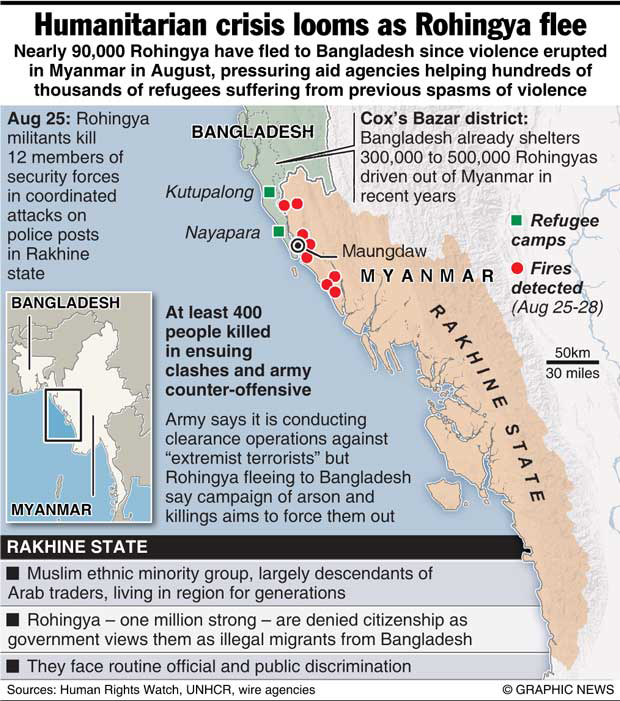
The Rohingyas have faced severe persecution and violence at the hands of the state for decades. They have been stripped of their nationality in terms of a 1982 law, though they have been living in Myanmar for generations. They have no access to state education and employment.  Successive Myanmar governments have denied the existence of the Rohingya as an ethnic group, calling the most oppressed people on Earth “illegal Bengalis” instead. However, Bangladesh strongly disputes Myanmar’s claim.  

Myanmar’s strategic importance gives it licence to violate international humanitarian laws and still call itself a fledgling democracy. In other words, geopolitics undermines R2P.

The United States, China and India are in a competition to bring Myanmar under their sphere of influence. They were like three men on their knees proposing to one damsel. They would not mind that she has reddened her lips by sucking the blood of Rohingyas and darkened her eyebrows with charred remnants of Rohingya’s wooden huts.  

Geopolitics is why the US condemnation is not commensurate with the crime being committed against 1.3 million Rohingyas.  Myanmar during the latter part of military strongman Than Shwe’s administration (1992-2011) adopted an equidistance policy vis-à-vis China, the US and India, after being under China’s economic protection for decades.  The visit of the then US President Barack Obama to Myanmar took bilateral relations to a new level where human rights abuses are largely ignored, and if they warrant a mention, the criticism appeared mere routine.  With the aim of reducing Myanmar’s economic dependency on China, the US has increased economic aid to Myanmar following the country’s transition to democracy.  

Entangling the Rohingya case in big power politics is China’s bid to build a deep sea port at Kyauk Pyu in the troubled Rakhine state – close to Maungdaw -- and an oil pipeline extending from there across Myanmar upto China’s hinterland – a shorter energy supply route that circumvents the arduous Malaca Strait.  China has won the contract for the port, but is negotiating for an 85 percent stake in the project instead of the 50 percent that formed the basis of the negotiations.  The Chinese port project together with an industrial park has ruffled feathers in India’s security circles as the port is overlooking India’s northeast. Also, Rakhine is believed to be rich in resources, including natural gas.

It was to counter China’s strategic foothold in Myanmar that India’s Prime Minister Narendra Modi was in Myanmar this week. This is why India has not condemned Myanmar’s atrocities against the Rohingyas.  Throwing human rights principles into the dustbin of self-centred politics,  Modi during his visit sought to enhance cooperation on intelligence sharing amid politically motivated s claims that linked Rohingya rebels with ISIS terrorists following the August 25 rebel attack on police posts.  India and Myanmar are also to ink a deal on a 1640 km highway project that would connect India with Myanmar and Thailand – a highway which India describes as its gateway to Southeast Asia and its response to China’s One-Belt-One-Road initiative. 

With big powers in a scramble to improve relations with Myanmar, the new government which came to power promising to strengthen democracy and uphold human rights, finds itself in a comfort zone from where it could spurn international criticism on the armed forces’ oppression against the Rohingyas, whom Pope Francis in a speech in February described as “our brothers and sisters”, while calling on Myanmar to stop the persecution.

It is while sitting in this comfort zone of crime that Myanmar is counting on China to block moves to bring the Rohingyas issue before the UN Security Council, and Myanmar’s de facto leader Aung San Suu Kyi could dismiss international criticism and irrefutable video evidence as “fake news”.   The story being churned out by the Suu Kyi’s government is that the Rohingyas killed Rohingyas.  Journalists who were taken on a guided tour on Wednesday under police escort were told the Rohingyas fled because the Rohingya rebels were burning their villages. The hard-to-believe story does not provide answers to questions over refugees who bore gunshot wounds, women who were raped and mutilated bodies found in Rakhine jungles.

Suu Kyi’s government has blocked UN aid agencies from delivering vital supplies of food, water and medicine to the besieged Rohingyas.  A few months ago, a dozen Nobel peace prize winners signed a petition calling on fellow Nobel laureate Suu Kyi to protect the Rohingyas. This week, the youngest Nobel Peace Prize winner, Malala Yousafzai, in a statemnent called Suu Kyi to condemn the “tragic and shameful treatment” of the Rohingyas.

But Suu Kyi’s conduct is unbecoming of a Nobel laureate. On the one hand she refuses to defy the military, which is the ultimate power in Myanmar -- a situation that makes the so-called transition to democracy a charade. On the other, if she acts against the perpetrators, she runs the risk of being labelled unpatriotic by the military and extremists led by monk Ashin Wirathu.  She failed to act against the extremists, though she had an opportunity in May this year when the Sangha Maha Nayaka Committee, Myanmar’s highest Buddhist authority, issued a declaration ordering Wirathu and his Ma Ba Tha organisation to end their activities. Unperturbed, Wirathu continues his hate campaign, while Suu Kyi plays politics with the lives of the Rohingyas.

The Rohingyas crisis is a humanitarian issue. It is not a Muslim issue, though Myanmar’s persecution of the Rohingyas has triggered a series of protests in the Islamic world, with Turkey, Pakistan and other Muslim countries issuing strong statements. 

Humanitarianism is beyond race, religion and other considerations. If Myanmar cannot solve the Rohingya crisis in a civilized manner, then the international community should intervene.  Let the R2P initiative begin with an international conference on the Rohingya crisis.

(The writer is social justice activist, lecturer in journalism and international affairs and deputy editor of Sri Lanka based Sunday Times)
Courtesy: Daily Mirror

Comments

Add new comment

  • Coastaldigest.com reserves the right to delete or block any comments.
  • Coastaldigset.com is not responsible for its readers’ comments.
  • Comments that are abusive, incendiary or irrelevant are strictly prohibited.
  • Please use a genuine email ID and provide your name to avoid reject.
News Network
November 21,2025

Bengaluru, Nov 21: The Karnataka government is facing pressure to overhaul its employment system after a high-level Cabinet sub-committee recommended the complete phase-out of job outsourcing in government offices, boards, and corporations by March 2028. The move is aimed at tackling a systemic issue that has led to the potential violation of constitutional reservation policies and the exploitation of workers.

The Call for Systemic Change

With over three lakh vacant posts currently being filled through private agencies on an outsource, insource, or daily wage basis, the sub-committee highlighted a significant lapse. "As a result, reservations are not being followed as per the Constitution and state laws. It’s an urgent need to take serious steps to change the system. It has been recommended to completely stop the system of outsourcing by March 2028," the panel stated in a document.

The practice of outsourcing involves private companies hiring workers to perform duties for a government agency. Critics argue this model results in lesser salaries, a lack of social security benefits (otherwise available to permanent government employees), and a failure to adhere to the provisions of Articles 14 and 15 of the Constitution, which guarantee equality before the law and prohibit discrimination.

The 'Bidar Model' as a Stop-Gap Solution

To regulate the current mode of employment and reduce worker exploitation until the 2028 deadline, the government plans to establish workers’ services multi-purpose cooperative societies across all districts, following the successful "Bidar Model."

The Bidar District Services of Labour Multi-purpose Cooperative Society Ltd., which operates under the District Commissioner, is cited as a successful example of providing a measure of social security to outsourced staff. Labour Department officials argue this society ensures workers receive their due wages and statutory facilities like ESI (Employees' State Insurance) and PF (Provident Fund), in exchange for a 1% service fee collected from the employees.

legislative push and Priority Insourcing

The recommendations, led by the sub-committee headed by Law and Parliamentary Affairs Minister H K Patil, are set to be discussed at the next Cabinet meeting. The committee has proposed the introduction of the Karnataka Outsourced Employees (Regulation, Placement and Welfare) Bill 2025.

In a move addressing immediate concerns, Labour Minister Santosh Lad, a member of the sub-committee, has reportedly assured that steps will be taken over the next 2-3 years to insource workers in "life-threatening services" on a priority basis. This includes essential personnel like pourakarmikas (sanitation workers), drivers, electrical staff in the Energy Department, and Health Department staff handling contagious diseases. The transition aims to grant these workers the long-term security and benefits they currently lack under the outsourcing system. 

Comments

Add new comment

  • Coastaldigest.com reserves the right to delete or block any comments.
  • Coastaldigset.com is not responsible for its readers’ comments.
  • Comments that are abusive, incendiary or irrelevant are strictly prohibited.
  • Please use a genuine email ID and provide your name to avoid reject.
News Network
November 21,2025

malpe.jpg

Udupi: The Malpe Police have arrested two men from Uttar Pradesh for allegedly sharing classified information related to Indian Navy vessels with individuals in Pakistan, posing a serious threat to national security.

According to a complaint filed by the CEO of Udupi Cochin Shipyard, Malpe—an institution under the Union Ministry of Ports, Shipping and Waterways—the prime accused, Rohit (29), was working as an insulator through subcontractor M/S Shushma Marine Pvt Ltd. He had earlier served at Cochin Shipyard Limited in Kochi, Kerala, where naval ships are under construction.

Udupi SP Hariram Shankar said the accused had unlawfully shared, via WhatsApp, confidential identification numbers of Navy-related ships and other classified details while working in Kerala, allegedly for illegal gains.

After joining the Malpe shipyard unit, Rohit reportedly continued collecting sensitive information through a friend in Kochi and circulated it to unauthorised individuals, violating national security protocols and potentially endangering India’s sovereignty, unity, and integrity.

Based on the complaint, Malpe Police registered a case under Section 152 of the Bharatiya Nyaya Sanhita (BNS) and Sections 3 and 5 of the Official Secrets Act, 1923.

A police team led by Karkala Subdivision Assistant Superintendent of Police Harsha Priyamvada—along with PSI Anil Kumar D, ASI Harish, and PC Ravi Jadhav—conducted the investigation and arrested the two accused, identified as Rohit (29) and Santri (37), both residents of Sultanpur district, Uttar Pradesh.

The duo was produced before the court, which remanded them in judicial custody till December 3. Further investigation is in progress.

Comments

Add new comment

  • Coastaldigest.com reserves the right to delete or block any comments.
  • Coastaldigset.com is not responsible for its readers’ comments.
  • Comments that are abusive, incendiary or irrelevant are strictly prohibited.
  • Please use a genuine email ID and provide your name to avoid reject.
News Network
November 29,2025

DKSsiddu.jpg

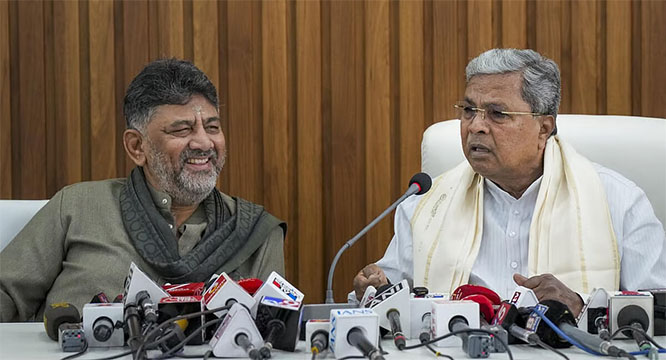
New Delhi: Karnataka chief minister Siddaramaiah and deputy CM DK Shivakumar on Saturday put up a dramatic display of unity at a closely watched joint press briefing, firmly dismissing weeks of speculation about a power-sharing tussle within the Congress. With the high command nudging both leaders to sit together and settle the dust, the meeting became a political spectacle, ending with the duo declaring that there was “no confusion, no differences.”

Calling the reports of a rift “manufactured confusion,” Siddaramaiah said the talks had gone smoothly, even joking about their breakfast. “Breakfast was very good. All three of us enjoyed it,” he said. “We want to end this confusion once and for all. For local elections and for 2028, our mission is clear — Congress must return to power. There is no difference between me and DKS, not now, not before.”

He blamed the media for fuelling rumours and reiterated absolute adherence to the party leadership. “From tomorrow, let there be no confusion. What the high command says, we will follow.”

Siddaramaiah also assured that the Assembly session starting December 8 would run smoothly and vowed that Congress would take on the BJP and JD(S) “together.”

Shivakumar echoed the chief minister word for word, stressing loyalty and discipline. “People have given us a massive mandate. It is our duty to deliver,” he said. “This government was formed under Siddaramaiah’s leadership. We both have complete trust in the high command. If they tell me to wait, I will wait.”

He added that the two leaders had discussed strategy for the 2028 Assembly elections. “Whatever the CM says, I agree. We are loyal soldiers of the party. The party may be facing challenges nationally, but we will keep it strong in Karnataka.”

Shivakumar also said Siddaramaiah would soon visit his home for lunch or dinner — another symbolic gesture meant to underline their unity.

Both leaders later posted on social media describing the breakfast meeting as “productive” and focused on “Karnataka’s priorities.”

The BJP, however, rejected the show of camaraderie as “pure bunkum,” accusing Congress of trying to paper over an internal power struggle. But Siddaramaiah and Shivakumar insisted their united front would continue — and that there was “no confusion” within the state leadership.

Comments

Add new comment

  • Coastaldigest.com reserves the right to delete or block any comments.
  • Coastaldigset.com is not responsible for its readers’ comments.
  • Comments that are abusive, incendiary or irrelevant are strictly prohibited.
  • Please use a genuine email ID and provide your name to avoid reject.