



Gita Gopinath joins International Monetary Fund as first female chief economist

Agencies
January 8, 2019

Washington, Jan 8: Prominent Indian-American economist Gita Gopinath has joined as the chief economist of the International Monetary Fund, becoming the first woman to occupy the top post at the global lender.

Gopinath, 47, joined last week at a time, when she believes the world is experiencing a retreat from globalisation, posing challenges to multilateral institutions.

The John Zwaanstra professor of International Studies and Economics at Harvard University, Gopinath, a US citizen, succeeds Maurice (Maury) Obstfeld as Economic Counsellor and Director of the IMF's Research Department. Obstfeld retired December 31.

Announcing her appointment on October 1, IMF Managing Director Christine Lagarde described her as "one of the world's outstanding economists with impeccable academic credentials, a proven track record of intellectual leadership and extensive international experience."

The 11th chief economist of the IMF, Mysore-born Gopinath in a recent interview to The Harvard Gazette described her appointment at the IMF as a "tremendous honour" and said the appointment of the first ever woman for this position speaks highly of IMF's Managing Director Lagarde.

"She is phenomenal, not just in her leadership of the IMF but as a role model for women around the world," she said.

Identifying some of her top priorities at the IMF, Gopinath told The Harvard Gazette that she would like the IMF to continue to be a place that provides intellectual leadership on important policy questions.

“Among the research issues that I would like to push, one would be understanding the role of dominant currencies like the dollar in international trade and finance. We could do more on the empirical side to try to understand countries' dollar exposures and on the theoretical side in terms of the implications for international spillovers, consequences of dollar shortages, etc,” she said.

Most countries invoice their trade in dollars and borrow internationally in dollars. This is a central part of the international price system and the international financial system and it will be exciting to explore its consequences in greater depth with the IMF, she said.

Gopinath considers the perceived retreat from globalisation as one of the top challenges being faced by the IMF.

"The one (biggest issues being faced by the IMF) that is absolutely clear and present is that we are seeing the first serious retreat from globalisation. This has not happened in the past 50 or 60 years when the world moved toward lower tariffs and increasing trade across countries,” she told the prestigious Harvard publication.

"Over the past several months, we have the US-imposed tariffs and retaliation to them from China and other nations. There is in general growing uncertainty about trade policy, including the one arising out of Brexit (the British move to leave the European Union).

"While the trade has reduced global poverty and raised livelihoods, its consequences for inequality, and on whether the rules of engagement are fair, are real concerns that need to be addressed,” she said.

Gopinath said there is also a concern about whether there is the right multilateral institutions and frameworks in place to make sure everybody feels that there is fairness in trade. “And the same goes for capital flows," she added.

"Foreign direct investment (FDI) was always viewed very favourably by countries. But because most of the FDI is now in tech-heavy firms, there are growing concerns about national security and international property theft. So I believe this retreat from globalisation and this retreat from multilateralism is quite unique to the times we are living in," Gopinath said.

Another important concern, she said, is the health of emerging markets as the US continues to normalize its interest rates.

The capital flows to several markets have reversed, putting pressure on their exchange rates and consequently on inflation, and on balance sheets, given that several emerging markets borrow heavily in dollars, said the IMF chief economist.

Comments

Add new comment

  • Coastaldigest.com reserves the right to delete or block any comments.
  • Coastaldigset.com is not responsible for its readers’ comments.
  • Comments that are abusive, incendiary or irrelevant are strictly prohibited.
  • Please use a genuine email ID and provide your name to avoid reject.
News Network
November 27,2025

DKSvokkaliga.jpg

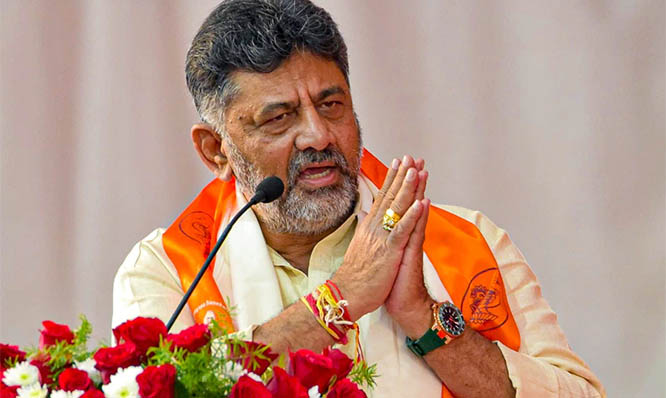
Bengaluru: The Vokkaligara Sangha on Thursday issued a stern warning to the Congress, saying the party could face serious electoral repercussions if Deputy Chief Minister D.K. Shivakumar is not appointed as Chief Minister.

The warning follows the public backing of Shivakumar’s chief ministerial ambition by top Vokkaliga pontiff Nirmalanandanatha Swami, who urged the Congress high command to honor his claim.

“The community supported Congress in the 2023 Assembly elections only because Shivakumar had a real chance to become CM. If he is cheated, we’ll teach the party a big lesson,” said newly elected Sangha president L. Srinivas. He added that Vokkaligas would organize protests under the guidance of community leaders.

General Secretary C.G. Gangadhar pointed out that Congress won more seats in the Vokkaliga-dominated Old Mysuru region due to Shivakumar’s influence, adding, “If Congress wants to retain power, Shivakumar should be made the CM.”

Outgoing president Kenchappa Gowda emphasized Shivakumar’s contribution to Congress’ victory. “Our community voted for Congress thinking he would become CM. Siddaramaiah has also served the party well, but Shivakumar should now be given a chance,” he said.

Former general-secretary Konappa Reddy appealed to Sonia and Rahul Gandhi to recognize Shivakumar’s loyalty and service, saying, “Congress is known to keep its promises. We hope it won’t break the promise made to him.”

Comments

Add new comment

  • Coastaldigest.com reserves the right to delete or block any comments.
  • Coastaldigset.com is not responsible for its readers’ comments.
  • Comments that are abusive, incendiary or irrelevant are strictly prohibited.
  • Please use a genuine email ID and provide your name to avoid reject.
News Network
November 30,2025

The United Nations Committee against Torture (CAT) has condemned the Israeli regime for enforcing a policy of “organized torture” against Palestinians.

In a report published on Friday, CAT stated that the occupying regime enforces a deliberate policy of “organized and widespread torture and ill-treatment” against Palestinian abductees, particularly since October 7, 2023, when Israel launched its genocidal war on Gaza.

The committee expressed “deep concern over repeated severe beatings, dog attacks, electrocution, water-boarding, use of prolonged stress positions [and] sexual violence” inflicted on Palestinians.

Palestinian prisoners were degraded by “being made to act like animals or being urinated on,” systematically denied medical care, and subjected to excessive restraints, “in some cases resulting in amputation,” the report added.

CAT also condemned the routine application of “unlawful combatants law” to justify the prolonged detention without trial of thousands of Palestinian men, women, and children.

More than 10,000 Palestinians, including women and children, are currently held in Israeli prisons, according to Palestinian and international human rights groups, with 3,474 Palestinians in “administrative detention,” meaning they are imprisoned without trial for indefinite periods.

The report highlighted the “high proportion of children who are currently detained without charge or on remand,” noting that while Israel sets the age of criminal responsibility at 12, even younger children have been abducted.

Children designated as security prisoners face severe restrictions on family contact, may be subjected to solitary confinement, and are denied access to education, in clear violation of international law.

The committee further suggested that Israel’s policies across the Occupied Territories constitute collective torture against the Palestinian population.

“A range of policies adopted by Israel in the course of its continued unlawful presence in the Occupied Palestinian Territory amounts to cruel, inhuman or degrading living conditions for the Palestinian population,” the report said.

On Thursday, the Palestinian resistance movement Hamas condemned the systematic killing and torture of Palestinian abductees in Israeli prisons, urging international action to halt these abuses.

Citing human rights data, Hamas stated that 94 Palestinians have been killed in Israeli prisons since the start of Tel Aviv’s genocidal war on Gaza.

“This reflects an organized criminal approach that has turned these prisons into direct killing grounds to eliminate our people,” the resistance movement said.

Hamas called on the international community, the UN, and human rights organizations to immediately pressure Israel to end crimes against prisoners and uphold their rights as guaranteed by all international conventions and norms.

Comments

Add new comment

  • Coastaldigest.com reserves the right to delete or block any comments.
  • Coastaldigset.com is not responsible for its readers’ comments.
  • Comments that are abusive, incendiary or irrelevant are strictly prohibited.
  • Please use a genuine email ID and provide your name to avoid reject.