Government Ups ATM Withdrawal, Old-Notes Exchange Limit

November 14, 2016

New Delhi, Nov 14: With public anger rising across the country over limited cash availability, the government tonight eased key restrictions including raising daily withdrawal limit from bank counters and ATM as well as hiking the amount of old and now defunct currency notes that can be exchanged.
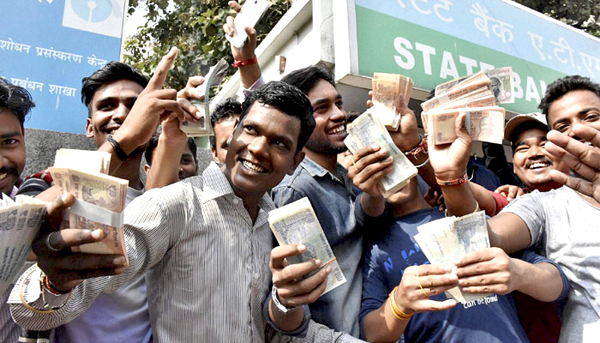
newnotes

To augment cash supplies, newly printed hard-to-fake Rs 500 notes were also released in market.

After a review by Finance ministry, the limit of old and now defunct Rs 500 and Rs 1000 rupee notes that can be exchanged for freshly minted Rs 2000 and new Rs 500 notes was increased from Rs 4000 to Rs 4500 per day.

Cash withdrawal limit at ATMs was hiked to Rs 2,500 from Rs 2,000 a day.

The weekly limit of Rs 20,000 for withdrawal from bank counters has been increased to Rs 24,000. The maximum limit of Rs 10,000 per day on such withdrawals has been removed, the ministry said in a statement.

"Banks have been advised to increase the issuance and use of mobile wallets and debit/credit cards as also to provide them to those customers and establishments not having access to these non-cash means of payment," it said.

Also, the last date for submission of the annual life certificate for the government pensioners which is to be submitted in November every year has been extended up to January 15, 2017.

Finance Ministry this evening reviewed the position regarding availability and distribution of notes of all denominations in different parts of the country.

Instructions have been issued to the banks and post offices to ensure proper distribution of all notes, including those of smaller denominations, up to the last mile through mobile banking vans and Banking Correspondents (BCs) to ease pressure.

While the old Rs 500 and Rs 1000 currency notes were demonetised from the midnight of November 8, a brand new Rs 2000 note was introduced on November 10.

"In the first four days (from November 10th to 13th, upto 5 pm ), about Rs 3 lakh crore of old Rs 500 and 1000 bank notes have been deposited in the banking system and about Rs 50,000 crores has been dispensed to customers by either withdrawal from their accounts or withdrawal from ATM's or by exchange at the counter," the statement said.

Within three four days, the banking system has handled about 21 crore transactions.

Further based on the review of the reports received from the States, banks and other sources, the ministry decided that continuous coordination is to be done with RBI, banks and post offices to make all denomination notes available at all locations.

"Instructions have been given to the banks and post offices to ensure proper distribution of all denomination notes. Banks have also been especially advised to ensure the availability and distribution of small denomination notes," it said.

Also, Chief Secretaries of the states have been asked to identify the rural pockets where availability of cash has been a problem and provide all support to ensure the last mile distribution of small denomination of notes is done through mobile banking vans and Banking Correspondents (BCs), the statement said.

"It has been reported that certain business houses viz. hospitals, caterers , tent houses etc. are not accepting Cheques/Demand Drafts and online payment transfer from customers. It is advised that in such cases customer can make a complaint to the concerned District Magistrates/District Administration for action against such establishments," the statement said.

All banks have been advised to arrange mobile banking vans to the extent possible at major hospitals to carry out emergency banking transaction for patients.

Banks have also been asked to make arrangements for separate queues for senior citizens and physically handicapped. Separate queues will also be arranged for exchange of cash to cash and transactions against bank accounts.

"State governments have been requested to facilitate opening of new bank accounts as a part of financial inclusion programme," the statement added.


Comments

Add new comment

  • Coastaldigest.com reserves the right to delete or block any comments.
  • Coastaldigset.com is not responsible for its readers’ comments.
  • Comments that are abusive, incendiary or irrelevant are strictly prohibited.
  • Please use a genuine email ID and provide your name to avoid reject.
News Network
December 16,2025

bengal.jpg

The deletion of over 58 lakh names from West Bengal’s draft electoral rolls following a Special Intensive Revision (SIR) has sparked widespread concern and is likely to deepen political tensions in the poll-bound state.

According to the Election Commission, the revision exercise has identified 24 lakh voters as deceased, 19 lakh as relocated, 12 lakh as missing, and 1.3 lakh as duplicate entries. The draft list, published after the completion of the first phase of SIR, aims to remove errors and duplication from the electoral rolls.

However, the scale of deletions has raised fears that a large number of eligible voters may have been wrongly excluded. The Election Commission has said that individuals whose names are missing can file objections and seek corrections. The final voter list is scheduled to be published in February next year, after which the Assembly election announcement is expected. Notably, the last Special Intensive Revision in Bengal was conducted in 2002.

The development has intensified the political row over the SIR process. Chief Minister Mamata Banerjee and her Trinamool Congress have strongly opposed the exercise, accusing the Centre and the Election Commission of attempting to disenfranchise lakhs of voters ahead of the elections.

Addressing a rally in Krishnanagar earlier this month, Banerjee urged people to protest if their names were removed from the voter list, alleging intimidation during elections and warning of serious consequences if voting rights were taken away.

The BJP, meanwhile, has defended the revision and accused the Trinamool Congress of politicising the issue to protect what it claims is an illegal voter base. Leader of the Opposition Suvendu Adhikari alleged that the ruling party fears losing power due to the removal of deceased, fake, and illegal voters.

The controversy comes amid earlier allegations by the Trinamool Congress that excessive work pressure during the SIR led to the deaths by suicide of some Booth Level Officers (BLOs), for which the party blamed the Election Commission. With the draft list now out, another round of political confrontation appears imminent.

As objections begin to be filed, the focus will be on whether the correction mechanism is accessible, transparent, and timely—critical factors in ensuring that no eligible voter is denied their democratic right ahead of a crucial election.

Comments

Add new comment

  • Coastaldigest.com reserves the right to delete or block any comments.
  • Coastaldigset.com is not responsible for its readers’ comments.
  • Comments that are abusive, incendiary or irrelevant are strictly prohibited.
  • Please use a genuine email ID and provide your name to avoid reject.
News Network
December 6,2025

pilot.jpg

New Delhi: IndiGo, India’s largest airline, faced major operational turbulence this week after failing to prepare for new pilot-fatigue regulations issued by the Directorate General of Civil Aviation (DGCA). The stricter rules—designed to improve flight safety—took effect in phases through 2024, with the latest implementation on November 1. IndiGo has acknowledged that inadequate roster planning led to widespread cancellations and delays.

Below are the key DGCA rules that affected IndiGo’s operations:

1. Longer Mandatory Weekly Rest

Weekly rest for pilots has been increased from 36 hours to 48 hours.

The government says the extended break is essential to curb cumulative fatigue. This rule remains in force despite the current crisis.

2. Cap on Night Landings

Pilots can now perform only two night landings per week—a steep reduction from the earlier limit of six.

Night hours, defined as midnight to early morning, are considered the least alert period for pilots.

Given the disruptions, this rule has been temporarily relaxed for IndiGo until February 10.

3. Reduced Maximum Night Flight Duty

Flight duty that stretches into the night is now capped at 10 hours.

This measure has also been kept on hold for IndiGo until February 10 to stabilize operations.

4. Weekly Rest Cannot Be Replaced With Personal Leave

Airlines can no longer count a pilot’s personal leave as part of the mandatory 48-hour rest.

Pilots say this closes a loophole that previously reduced actual rest time.

Currently, all airlines are exempt from this rule to normalise travel.

5. Mandatory Fatigue Monitoring

Airlines must submit quarterly fatigue reports along with corrective actions to DGCA.

This system aims to create a transparent fatigue-tracking framework across the industry.

The DGCA has stressed that these rules were crafted to strengthen flight safety and align India with global fatigue-management standards. The temporary relaxations are expected to remain until February 2025, giving IndiGo time to stabilise its schedules and restore normal air travel.

Comments

Add new comment

  • Coastaldigest.com reserves the right to delete or block any comments.
  • Coastaldigset.com is not responsible for its readers’ comments.
  • Comments that are abusive, incendiary or irrelevant are strictly prohibited.
  • Please use a genuine email ID and provide your name to avoid reject.
News Network
December 5,2025

indigoCEO.jpg

New Delhi, Dec 5: IndiGo CEO Pieter Elbers issued a public apology this evening after more than a thousand flights were cancelled today, making it the "most severely impacted day" in terms of cancellations. The biggest airline of the country cancelled "more than half" of its daily number of flights on Friday, said Elbers. He also said that even though the crisis will persist on Saturday, the airline anticipates fewer than 1,000 flight cancellations.

"Full normalisation is expected between December 10 and 15, though IndiGo cautions that recovery will take time due to the scale of operations," the IndiGo CEO said. 

IndiGo operates around 2,300 domestic and international flights daily.

Pieter Elbers, while apologising for the major inconvenience due to delays and cancellations, said the situation is a result of various causes.

The crisis at IndiGo stems from new regulations that boost pilots' weekly rest requirements by 12 hours to 48 and allow only two night-time landings per week, down from six. IndiGo has attributed the mass cancellations to "misjudgment and planning gaps".

Elbers also listed three lines of action that the airline will adopt to address the issue.

"Firstly, customer communication and addressing your needs, for this, messages have been sent on social media. And just now, a more detailed communication with information, refunds, cancellations and other customer support measures was sent," he said.

The airline has also stepped up its call centre capacity.

"Secondly, due to yesterday's situation, we had customers stranded mostly at the nation's largest airports. Our focus was for all of them to be able to travel today itself, which will be achieved. For this, we also ask customers whose flights are cancelled not to come to the airports as notifications are sent," the CEO said.

"Thirdly, cancellations were made for today to align our crew and planes to be where they need to start tomorrow morning afresh. Earlier measures of the last few days, regrettable, have proven not to be enough, but we have decided today to reboot all our systems and schedules, resulting in the highest numbers of cancellations so far, but imperative for progressive improvements starting from tomorrow," he added.

As airports witnessed chaotic scenes, the Directorate General of Civil Aviation (DGCA) stepped in to grant IndiGo a temporary exemption from stricter night duty rules for pilots. It also allowed substitution of leaves with a weekly rest period. 

Civil Aviation Minister Ram Mohan Naidu has said a high-level inquiry will be ordered and accountability will be fixed.

Comments

Add new comment

  • Coastaldigest.com reserves the right to delete or block any comments.
  • Coastaldigset.com is not responsible for its readers’ comments.
  • Comments that are abusive, incendiary or irrelevant are strictly prohibited.
  • Please use a genuine email ID and provide your name to avoid reject.