



Gulf storm played bigger role in Delhi air pollution

Agencies
November 17, 2017

New Delhi, Nov 17:  A West Asian dust storm has been identified as the chief trigger behind the recent air pollution crisis in Delhi.

While stubble burning was said to be a key cause for the toxic smog in the national capital, prompting a spat between Delhi government and governments of neighbouring states, a Centre-run monitoring agency said the particulates from the dust storm that entered the upper atmospheric layer of Delhi and the larger region also contributed to a spike in air pollution levels.

On November 8, the contribution of the dust storm was 40 per cent, eclipsing the role of emissions from stubble burning, which stood at 25 per cent, the Pune-based System of Air Quality And Weather Forecasting And Research (SAFAR) said.

That was the day pollution levels peaked with PM2.5 concentration reaching 640 micrograms per cubic metre, according to the SAFAR scientific assessment report of the week-long pollution crisis accessed by news agency.

"Rest was made up of emissions from local sources such vehicular combustion. If external sources did not have any role, levels of PM2.5 during this period could have been around 200 micrograms per cubic metre," the report has stated.

Uptick in air pollution levels prompted Aam Admi Party led Delhi government to impose a swries of emergency measures in the national capital such as a ban on the entry of trucks and construction activities yielded positive results, the agency said, putting the gains at around 15 per cent in terms of percentage.

PM2.5 are ultrafine particulates, up to 30 times finer than a width of a human hair, which can lodge deep in the lungs and enter the bloodstream, causing irreparable harm to living beings.

The 24-hour prescribed standard of this variety of suspended particulate matter is 60 micrograms per cubic metre.

SAFAR, an arm of the Indian Institute of Tropical Meteorology, said particulates from the dust storm, which swept across Iraq, Kuwait, and Saudi Arabia between the last week of October and November 4, entered the upper atmospheric layer of Delhi and the larger region.

Moreover, according to the report, stubble burning in Punjab, Uttar Pradesh and Haryana were very high on November 6 and as upper air winds became North Westerly (towards Delhi), pollutants were strongly pumped in, exacerbating the situation.

"As per SAFAR forecasting model, the pollution contribution of Gulf Dust Storm on peak day (8th Nov 2017) was around 40 per cent and 25 per cent from stubble burning," the report said.

Till about November 6, the mean PM2.5 level remained between 140-190 ug/m3, usual for this time of the year, SAFAR, the only agency which puts out pollution forecast bulletins in India, said.

Subsequently, from around November 10, there was no pumping of dust from West Asia. Influence of stubble burning also came down as upper air winds slowed down and changed direction, resulting in a brief respite from pollution.

"However, localized weather took over by the evening of November 11. Before pollutants could be flushed, inversion layer (beyond which pollutants cannot escape) fell down from 1600 metres to just 45 metres in eight hours and Delhi entered the severe zone again which delayed full recovery by two days," SAFAR said.

Comments

Add new comment

  • Coastaldigest.com reserves the right to delete or block any comments.
  • Coastaldigset.com is not responsible for its readers’ comments.
  • Comments that are abusive, incendiary or irrelevant are strictly prohibited.
  • Please use a genuine email ID and provide your name to avoid reject.
News Network
December 2,2025

Puttur: The long-cherished dream of a government medical college in Puttur has moved a decisive step closer to reality, with the Karnataka State Finance Department granting its official approval for the construction of a new 300-bed hospital.

Puttur MLA Ashok Kumar Rai announced the crucial development to reporters on Monday, confirming that the official communication from the finance department was issued on November 27. This 300-bed facility is intended to be the cornerstone for the establishment of the government medical college, a project announced in the state budget.

Fast-Track Implementation

The MLA outlined an aggressive timeline for the project:

•    A Detailed Project Report (DPR) for the hospital is expected to be ready within 45 days.

•    The tender process for the construction will be completed within two months.

Following the completion of the tender process, Chief Minister Siddaramaiah is scheduled to lay the foundation stone for the project.

"Setting up a medical college in Puttur is a historical decision by the Congress government in Karnataka," Rai stated. The project has an estimated budget allocation of Rs 1,000 crore for the medical college.

Focus on Medical Education Department

The MLA highlighted a key strategic move: requesting the government to implement the hospital construction through the Medical Education Department instead of the Health and Family Welfare Department. This is intended to streamline the entire process of establishing the full medical college, ensuring the facilities—including labs, operation theatres, and other necessary infrastructure—adhere to the strict guidelines set by the Medical Council of India (MCI). The proposed site for the project is in Bannur.

Rai also took the opportunity to address political criticism, stating that the government has fulfilled its promise despite "apprehensions" and "mocking and criticising" from opposition parties who had failed to take similar initiatives when they were in power. "Chief Minister Siddaramaiah has kept his word," he added.

Comments

Add new comment

  • Coastaldigest.com reserves the right to delete or block any comments.
  • Coastaldigset.com is not responsible for its readers’ comments.
  • Comments that are abusive, incendiary or irrelevant are strictly prohibited.
  • Please use a genuine email ID and provide your name to avoid reject.
News Network
November 24,2025

Mangaluru, Nov 24: The original departure time of 11.10 pm was a distant memory for scores of Dammam-bound passengers at Mangaluru International Airport last Friday night, as their Air India Express flight was abruptly cancelled at the eleventh hour, sparking hours of frustration and chaos.

The flight, IX 885, initially scheduled to depart at 11.10 pm on November 22, was subject to two back-to-back reschedules—first pushed to 11.45 pm and then significantly postponed to 1.40 am—before the final, crushing announcement of cancellation was made. For the travellers, many of whom are likely expatriate workers with tight schedules, the last-minute change marked the beginning of a distressing ordeal.

"There was no drinking water, no food, and absolutely no proper guidance. We were left stranded like refugees," complained a stranded passenger.

According to multiple passenger accounts, the airline's ground staff failed to provide adequate support or essential amenities following the cancellation. Complaints poured in about the total absence of drinking water, food provisions, and any reliable guidance from the carrier's representatives. Travellers alleged they were left stranded for a considerable period, with no immediate arrangements or clear communication offered regarding accommodation or alternative travel to send them back home.

The incident has highlighted serious concerns over the carrier's contingency planning and customer service protocols during flight disruptions at one of India's key international gateways. The airline is yet to issue a comprehensive statement addressing the alleged lapse in passenger care.
 

Comments

Add new comment

  • Coastaldigest.com reserves the right to delete or block any comments.
  • Coastaldigset.com is not responsible for its readers’ comments.
  • Comments that are abusive, incendiary or irrelevant are strictly prohibited.
  • Please use a genuine email ID and provide your name to avoid reject.
News Network
December 2,2025

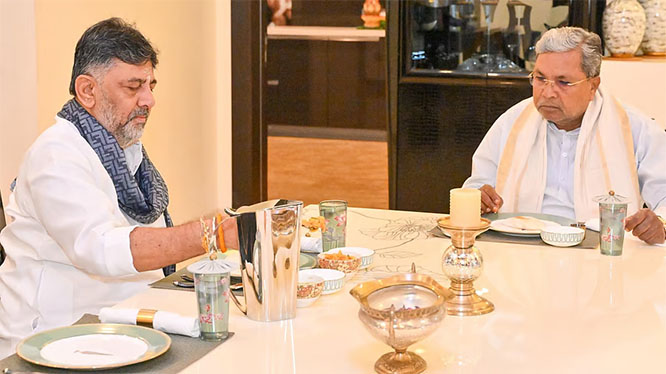
DKSsiddu.jpg

Bengaluru: 'Nati koli saaru' (country chicken curry) considered one of Chief Minister Siddaramaiah’s favourites along with steaming hot idlis was on the breakfast menu at Deputy CM D K Shivakumar’s residence on Tuesday, according to official sources.

The spread also included 'nati koli' fry, vada and pongal, among other items, they said.

In an apparent show of unity, Siddaramaiah visited Shivakumar’s residence for breakfast, just days after the two leaders shared a meal amid a simmering power tussle in the state Congress.

Siddaramaiah drove to the Deputy CM’s residence in Sadashivanagar, where he was received by Shivakumar and his brother D K Suresh, who is a former Congress MP.

Suresh and Kunigal MLA H D Ranganath, a relative of Shivakumar, joined them for breakfast, which featured a mix of vegetarian and non-vegetarian dishes.

Speaking to reporters later, Siddaramaiah said Shivakumar had invited him during his visit to the CM’s residence for breakfast on Saturday.

Asked about the difference between the two meals, the chief minister said, "At his (Shivakumar’s) house it was non-veg, while at my house it was veg. He is a vegetarian, I am a non-vegetarian. I had not prepared non-veg. I told DK to get chicken from the village as you won’t get the original in Bengaluru."

Shivakumar said he had initially invited Siddaramaiah to his residence, but the CM had suggested visiting his place first and reciprocating later. "It was a vegetarian breakfast at the CM’s house on Saturday," he noted.

"Today, I invited him (the CM) to my house. He enjoyed the breakfast, which had his Mysuru taste," Shivakumar added. At this point, Siddaramaiah remarked that Shivakumar’s wife is also from Mysuru.

Saturday’s breakfast at Siddaramaiah’s official residence, held as part of efforts by the Congress high command to ease tensions in the leadership dispute between the two, reportedly included idlis and sambar, according to official sources.

Comments

Add new comment

  • Coastaldigest.com reserves the right to delete or block any comments.
  • Coastaldigset.com is not responsible for its readers’ comments.
  • Comments that are abusive, incendiary or irrelevant are strictly prohibited.
  • Please use a genuine email ID and provide your name to avoid reject.