



Over 80 per cent of childhood cancers are curable

Dr Parinitha Gutha
February 15, 2021

cancer.jpg

Children’s Cancers are rare compared to those in adults.

Worldwide, around 3 lakh children and adolescents are diagnosed with cancer every year and 80% of them live in developing countries.

As infectious diseases are becoming more controlled in children, cancer is emerging to be the leading cause of death after accidental deaths. 

The good news is that most of the children’s cancers are now curable, but many factors are acting against achieving this result. Because they have their uniqueness, both biologically and psychologically, they must be treated in dedicated Pediatric Cancer Units to achieve results.

Types of Childhood Cancers

More than a dozen kinds of childhood cancers and a hundred different subtypes exist. 

Blood cancers, brain cancers, and neuroblastomas account for more than half of the cancers in children.

The most common childhood cancer is Acute Lymphoblastic Leukemia (ALL). In the 1950s, almost every child with ALL died. But today, about 90% of children with ALL survive.

Causes

The cause is usually unknown and not linked to any environmental or genetic factors apart from a small proportion (5%) which is caused by an inherited genetic condition.

In adults, the mutations reflect the cumulative effects of aging, long-term exposure to cancer-causing agents. However, it has been difficult to identify potential environmental causes of childhood cancer.

The analogy is that most cancers develop as a result of mutations in genes that lead to uncontrolled cell growth.

Treatment

It is important to know that Children's cancers are not always treated like adult cancers.

Children should not only survive, but thrive. To achieve this, Cancer needs to be diagnosed early and treated in dedicated Paediatric Oncology Units where the team is focused and qualified to respond to children's needs. Many individuals are not aware that this expertise exists and that many childhood cancers are handled successfully.

The types of treatment that a child with cancer receives will depend on the type of cancer and how advanced it is. Common treatments include chemotherapy, surgery, radiation, immunotherapy, and bone marrow transplantation.

What is the outlook?

Most childhood cancers are highly curable, provided prompt and effective treatment is accessible. 

In resource-rich countries, three out of four children survive (about 80%).

The Survival gap…

Unfortunately, this is not the case in India. Around 80% of children with cancer live in developing countries and more than half die. There are no cancer registries to give us accurate statistics, children are often not diagnosed, or diagnosed too late, and limited access to information and life-saving treatment. 

However, the situation is becoming more hopeful with the availability of dedicated Paediatric cancer Units providing excellent standards of care.

Children’s Cancers are curable and they are no less important than children fighting malaria, dengue, malnutrition, and other causes of death.

Let us stand up to cancer and strive to save our children!


Dr Parinitha Gutha is a Senior Consultant, Paediatric Oncology/Hematology at American Oncology Institute, Hyderabad

Comments

Add new comment

  • Coastaldigest.com reserves the right to delete or block any comments.
  • Coastaldigset.com is not responsible for its readers’ comments.
  • Comments that are abusive, incendiary or irrelevant are strictly prohibited.
  • Please use a genuine email ID and provide your name to avoid reject.
News Network
December 7,2025

envoy.jpg

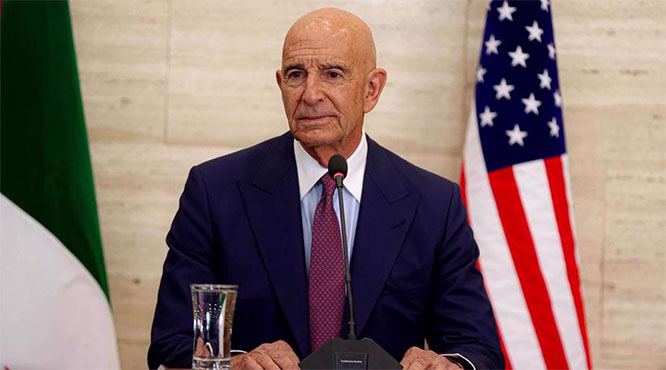
Since 1946, the United States has attempted 93 coups or “regime change” operations across the world — including two in Iran, US Special Envoy for Syria Tom Barrack has admitted.

Speaking to the UAE-based IMI Media Group, in remarks published by The National, Barrack said Washington tried twice to overthrow the Iranian government but failed both times. 

“For (Trump) then to be imputed with regime change — we had two regime changes in Iran already. Neither one worked. So I think wisely leave it to the region to solve,” said Barrack, who also serves as the US ambassador to Turkey.

His comments come six months after the US joined Israel in airstrikes against Iran during ongoing indirect nuclear negotiations between Tehran and Washington.

On June 13, Israel launched an attack on Iran that killed at least 1,064 people and hit civilian infrastructure. Days later, the United States targeted three nuclear facilities — Fordow, Natanz and Isfahan — in what Iran called a clear violation of international law. Iranian retaliation eventually forced a halt to the assault on June 24.

Barrack further claimed that US President Donald Trump and Foreign Secretary Marco Rubio are “not into regime change” and prefer a regional approach driven by Middle Eastern countries themselves. According to him, regional dialogue and non-interference by outside powers offer a more durable path forward.

He added that Washington is still open to an agreement with Tehran if Iranian authorities show “seriousness” and willingness to engage constructively.

However, Iran maintains the US has not shown readiness for meaningful talks. In an interview with Japan’s Kyodo News, Iranian Foreign Minister Abbas Araghchi said negotiations could advance only if Washington acknowledges Iran’s right to peaceful nuclear energy and lifts unilateral sanctions.

Comments

Add new comment

  • Coastaldigest.com reserves the right to delete or block any comments.
  • Coastaldigset.com is not responsible for its readers’ comments.
  • Comments that are abusive, incendiary or irrelevant are strictly prohibited.
  • Please use a genuine email ID and provide your name to avoid reject.
News Network
December 6,2025

pilot.jpg

New Delhi: IndiGo, India’s largest airline, faced major operational turbulence this week after failing to prepare for new pilot-fatigue regulations issued by the Directorate General of Civil Aviation (DGCA). The stricter rules—designed to improve flight safety—took effect in phases through 2024, with the latest implementation on November 1. IndiGo has acknowledged that inadequate roster planning led to widespread cancellations and delays.

Below are the key DGCA rules that affected IndiGo’s operations:

1. Longer Mandatory Weekly Rest

Weekly rest for pilots has been increased from 36 hours to 48 hours.

The government says the extended break is essential to curb cumulative fatigue. This rule remains in force despite the current crisis.

2. Cap on Night Landings

Pilots can now perform only two night landings per week—a steep reduction from the earlier limit of six.

Night hours, defined as midnight to early morning, are considered the least alert period for pilots.

Given the disruptions, this rule has been temporarily relaxed for IndiGo until February 10.

3. Reduced Maximum Night Flight Duty

Flight duty that stretches into the night is now capped at 10 hours.

This measure has also been kept on hold for IndiGo until February 10 to stabilize operations.

4. Weekly Rest Cannot Be Replaced With Personal Leave

Airlines can no longer count a pilot’s personal leave as part of the mandatory 48-hour rest.

Pilots say this closes a loophole that previously reduced actual rest time.

Currently, all airlines are exempt from this rule to normalise travel.

5. Mandatory Fatigue Monitoring

Airlines must submit quarterly fatigue reports along with corrective actions to DGCA.

This system aims to create a transparent fatigue-tracking framework across the industry.

The DGCA has stressed that these rules were crafted to strengthen flight safety and align India with global fatigue-management standards. The temporary relaxations are expected to remain until February 2025, giving IndiGo time to stabilise its schedules and restore normal air travel.

Comments

Add new comment

  • Coastaldigest.com reserves the right to delete or block any comments.
  • Coastaldigset.com is not responsible for its readers’ comments.
  • Comments that are abusive, incendiary or irrelevant are strictly prohibited.
  • Please use a genuine email ID and provide your name to avoid reject.
News Network
December 7,2025

Mangaluru, Dec 7: A 34-year-old fruit and vegetable trader in Mangaluru has reportedly lost ₹33.1 lakh after falling victim to an online investment scam run through a fake mobile app.

Police said the scam began in September, when the victim received a link on Facebook. Clicking it connected him to a WhatsApp number, where an unidentified person introduced a high-return investment scheme and instructed him to download an app.

To build trust, the fraudster asked him to invest ₹30,000 on September 24. The trader soon received ₹34,000 as “profit,” convincing him the scheme was genuine. Over the next two months, he transferred money in multiple instalments via Google Pay and IMPS to different scanner codes and bank accounts shared by the scammers. Between September 24 and December 3, he ended up sending a total of ₹33.1 lakh.

When he later requested a refund of his investment and promised returns, the scammers demanded additional payments, claiming he needed to pay a “service tax” first. Even after he paid a small amount, no money was returned, and the scammers continued pressuring him for more.

A case has been registered at the CEN Crime Police Station.

Comments

Add new comment

  • Coastaldigest.com reserves the right to delete or block any comments.
  • Coastaldigset.com is not responsible for its readers’ comments.
  • Comments that are abusive, incendiary or irrelevant are strictly prohibited.
  • Please use a genuine email ID and provide your name to avoid reject.
