



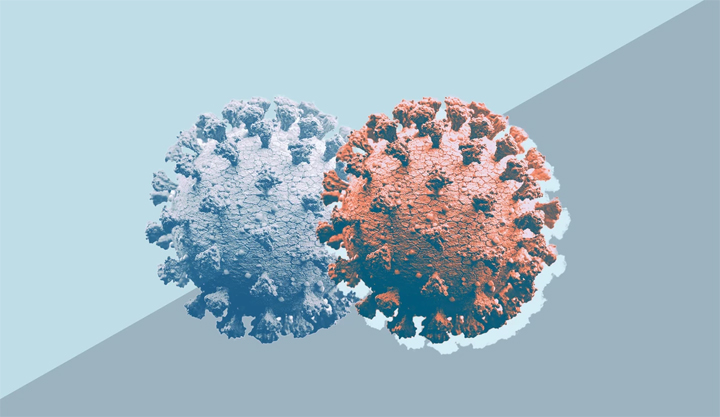
All you need to know about new coronavirus variant

News Network
December 31, 2020

coronaverient.jpg

Washington, Dec 31: Does it spread more easily? Make people sicker? Mean that treatments and vaccines won't work? Questions are multiplying as fast as new variants of the coronavirus, especially the one moving through England and now popping up in the US and other countries.

Scientists say there is reason for concern and more to learn but that the new variants should not cause alarm.

Worry has been growing since before Christmas, when Britain's prime minister said the coronavirus variant seemed to spread more easily than earlier ones and was moving rapidly through England. On Tuesday, Colorado health officials said they had found it there.

Here are some questions and answers on what's known about the virus so far.

Q: Where did this new variant come from?

A: New variants have been seen almost since the virus was first detected in China nearly a year ago. Viruses often mutate, or develop small changes, as they reproduce and move through a population.

Most changes are trivial. "It's the change of one or two letters in the genetic alphabet that doesn't make much difference in the ability to cause disease,” said Dr Philip Landrigan, a former Centres for Disease Control and Prevention scientist who directs a global health programme at Boston College.

A more concerning situation is when a virus mutates by changing the proteins on its surface to help it escape from drugs or the immune system, or if it acquires a lot of changes that make it very different from previous versions.

Q: How does one variant become dominant?

A: That can happen if one variant takes hold and starts spreading in an area, or because “super spreader” events helped it become established.

It also can happen if a mutation gives a new variant an advantage, such as helping it spread more easily than other ones that are circulating.

Scientists are still working to confirm whether the variant in England spreads more easily, but they are finding some evidence that it does. The variant “out-competes the other strains and moves faster and infects more people, so it wins the race,” Landrigan said.

The British variant was first detected in September, WHO officials said. A new South African variant also has emerged.

Q: What's worrisome about the British variant?

A: It has many mutations — nearly two dozen — and eight are on the spike protein that the virus uses to attach to and infect cells. The spike is what vaccines and antibody drugs target.

Dr Ravi Gupta, a virus expert at the University of Cambridge in England, said modeling studies suggest it may be up to two times more infectious than the version that's been most common in England so far. He and other researchers posted a report of it on a website scientists use to quickly share developments, but it has not been formally reviewed or published in a journal.

Q: Does it make people sicker or more likely to die?

A: “There's no indication that either of those is true, but clearly those are two issues we've got to watch,” Landrigan said. As more patients get infected with the new variant, “they'll know fairly soon if the new strain makes people sicker.”

A WHO outbreak expert, Maria Van Kerkhove, said that “the information that we have so far is that there isn't a change” in the kind of illness or its severity.

Q: What do the mutations mean for treatments?

A: A couple of cases in England raise concern that the mutations in some of the emerging new variants could hurt the potency of drugs that supply antibodies to block the virus from infecting cells.

Studies on antibody response are under way, Van Kerkhove said.

One drugmaker, Eli Lilly, said tests in its lab suggest that its drug remains fully active.

Q: What about vaccines?

A: Scientists believe current vaccines will still be effective against the variant, but they are working to confirm that. On Wednesday, British officials reiterated that there is no data suggesting the new variant hurts the effectiveness of the available vaccines.

Vaccines induce broad immune system responses besides just prompting the immune system to make antibodies to the virus, so they are expected to still work, several scientists said.

Q: What can I do to reduce my risk?

A: Follow the advice to wear a mask, wash your hands often, maintain social distance and avoid crowds, public health experts say.

“The bottom line is we need to suppress transmission” of the coronavirus, said the WHO's director-general, Dr Tedros Adhanom Ghebreyesus.

“The more we allow it to spread, the more mutations will happen.”

Comments

Add new comment

  • Coastaldigest.com reserves the right to delete or block any comments.
  • Coastaldigset.com is not responsible for its readers’ comments.
  • Comments that are abusive, incendiary or irrelevant are strictly prohibited.
  • Please use a genuine email ID and provide your name to avoid reject.
News Network
November 21,2025

malpe.jpg

Udupi: The Malpe Police have arrested two men from Uttar Pradesh for allegedly sharing classified information related to Indian Navy vessels with individuals in Pakistan, posing a serious threat to national security.

According to a complaint filed by the CEO of Udupi Cochin Shipyard, Malpe—an institution under the Union Ministry of Ports, Shipping and Waterways—the prime accused, Rohit (29), was working as an insulator through subcontractor M/S Shushma Marine Pvt Ltd. He had earlier served at Cochin Shipyard Limited in Kochi, Kerala, where naval ships are under construction.

Udupi SP Hariram Shankar said the accused had unlawfully shared, via WhatsApp, confidential identification numbers of Navy-related ships and other classified details while working in Kerala, allegedly for illegal gains.

After joining the Malpe shipyard unit, Rohit reportedly continued collecting sensitive information through a friend in Kochi and circulated it to unauthorised individuals, violating national security protocols and potentially endangering India’s sovereignty, unity, and integrity.

Based on the complaint, Malpe Police registered a case under Section 152 of the Bharatiya Nyaya Sanhita (BNS) and Sections 3 and 5 of the Official Secrets Act, 1923.

A police team led by Karkala Subdivision Assistant Superintendent of Police Harsha Priyamvada—along with PSI Anil Kumar D, ASI Harish, and PC Ravi Jadhav—conducted the investigation and arrested the two accused, identified as Rohit (29) and Santri (37), both residents of Sultanpur district, Uttar Pradesh.

The duo was produced before the court, which remanded them in judicial custody till December 3. Further investigation is in progress.

Comments

Add new comment

  • Coastaldigest.com reserves the right to delete or block any comments.
  • Coastaldigset.com is not responsible for its readers’ comments.
  • Comments that are abusive, incendiary or irrelevant are strictly prohibited.
  • Please use a genuine email ID and provide your name to avoid reject.
News Network
November 26,2025

students.jpg

Bengaluru, Nov 26: Karnataka is taking its first concrete steps towards lifting a three-decade-old ban on student elections in colleges and universities. Deputy Chief Minister D.K. Shivakumar announced Wednesday that the state government will form a small committee to study the reintroduction of campus polls, a practice halted in 1989 following incidents of violence.

Speaking at a 'Constitution Day' event organised by the Karnataka Congress, Mr. Shivakumar underscored the move's aim: nurturing new political leadership from the grassroots.

"Recently, (Leader of the Opposition in Lok Sabha) Rahul Gandhi wrote a letter to me and Chief Minister (Siddaramaiah) asking us to think about restarting student elections," Shivakumar stated. "I'm announcing today that we'll form a small committee and seek a report on this."

Student elections were banned in Karnataka in 1989, largely due to concerns over violence and the infiltration of political party affiliates into campus life. The ban effectively extinguished vibrant student bodies and the pipeline of young leaders they often produced.

Mr. Shivakumar, who also serves as the Karnataka Congress president, said that former student leaders will be consulted to "study the pros and cons" of the re-introduction.

Acknowledging the history of the ban, he added, "There were many criminal activities taking place back then. We’ll see how we can conduct (student) elections by regulating such criminal activities."

The Deputy CM reminisced about his own journey, which began on campus. He recalled his political activism at Sri Jagadguru Renukacharya College leading to his first Assembly ticket in 1985 at the age of 23. "That's how student leadership was at the time. Such leadership has gone today. College elections have stopped," he lamented, adding that for many, college elections were "like a big movement" where leaders were forged.

The move, driven by the Congress high command's push to cultivate young talent, will face scrutiny from academics and university authorities who have, in the past, expressed concern that the return of polls could disrupt the peaceful academic environment and turn campuses into political battlegrounds.

Comments

Add new comment

  • Coastaldigest.com reserves the right to delete or block any comments.
  • Coastaldigset.com is not responsible for its readers’ comments.
  • Comments that are abusive, incendiary or irrelevant are strictly prohibited.
  • Please use a genuine email ID and provide your name to avoid reject.
News Network
November 27,2025

DKSvokkaliga.jpg

Bengaluru: The Vokkaligara Sangha on Thursday issued a stern warning to the Congress, saying the party could face serious electoral repercussions if Deputy Chief Minister D.K. Shivakumar is not appointed as Chief Minister.

The warning follows the public backing of Shivakumar’s chief ministerial ambition by top Vokkaliga pontiff Nirmalanandanatha Swami, who urged the Congress high command to honor his claim.

“The community supported Congress in the 2023 Assembly elections only because Shivakumar had a real chance to become CM. If he is cheated, we’ll teach the party a big lesson,” said newly elected Sangha president L. Srinivas. He added that Vokkaligas would organize protests under the guidance of community leaders.

General Secretary C.G. Gangadhar pointed out that Congress won more seats in the Vokkaliga-dominated Old Mysuru region due to Shivakumar’s influence, adding, “If Congress wants to retain power, Shivakumar should be made the CM.”

Outgoing president Kenchappa Gowda emphasized Shivakumar’s contribution to Congress’ victory. “Our community voted for Congress thinking he would become CM. Siddaramaiah has also served the party well, but Shivakumar should now be given a chance,” he said.

Former general-secretary Konappa Reddy appealed to Sonia and Rahul Gandhi to recognize Shivakumar’s loyalty and service, saying, “Congress is known to keep its promises. We hope it won’t break the promise made to him.”

Comments

Add new comment

  • Coastaldigest.com reserves the right to delete or block any comments.
  • Coastaldigset.com is not responsible for its readers’ comments.
  • Comments that are abusive, incendiary or irrelevant are strictly prohibited.
  • Please use a genuine email ID and provide your name to avoid reject.
