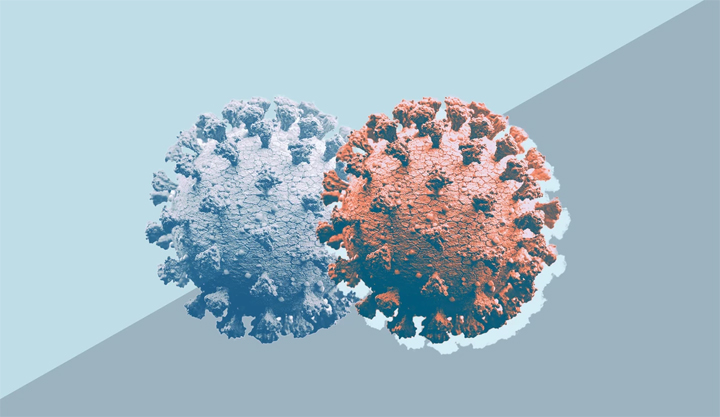
All you need to know about new coronavirus variant

News Network
December 31, 2020

coronaverient.jpg

Washington, Dec 31: Does it spread more easily? Make people sicker? Mean that treatments and vaccines won't work? Questions are multiplying as fast as new variants of the coronavirus, especially the one moving through England and now popping up in the US and other countries.

Scientists say there is reason for concern and more to learn but that the new variants should not cause alarm.

Worry has been growing since before Christmas, when Britain's prime minister said the coronavirus variant seemed to spread more easily than earlier ones and was moving rapidly through England. On Tuesday, Colorado health officials said they had found it there.

Here are some questions and answers on what's known about the virus so far.

Q: Where did this new variant come from?

A: New variants have been seen almost since the virus was first detected in China nearly a year ago. Viruses often mutate, or develop small changes, as they reproduce and move through a population.

Most changes are trivial. "It's the change of one or two letters in the genetic alphabet that doesn't make much difference in the ability to cause disease,” said Dr Philip Landrigan, a former Centres for Disease Control and Prevention scientist who directs a global health programme at Boston College.

A more concerning situation is when a virus mutates by changing the proteins on its surface to help it escape from drugs or the immune system, or if it acquires a lot of changes that make it very different from previous versions.

Q: How does one variant become dominant?

A: That can happen if one variant takes hold and starts spreading in an area, or because “super spreader” events helped it become established.

It also can happen if a mutation gives a new variant an advantage, such as helping it spread more easily than other ones that are circulating.

Scientists are still working to confirm whether the variant in England spreads more easily, but they are finding some evidence that it does. The variant “out-competes the other strains and moves faster and infects more people, so it wins the race,” Landrigan said.

The British variant was first detected in September, WHO officials said. A new South African variant also has emerged.

Q: What's worrisome about the British variant?

A: It has many mutations — nearly two dozen — and eight are on the spike protein that the virus uses to attach to and infect cells. The spike is what vaccines and antibody drugs target.

Dr Ravi Gupta, a virus expert at the University of Cambridge in England, said modeling studies suggest it may be up to two times more infectious than the version that's been most common in England so far. He and other researchers posted a report of it on a website scientists use to quickly share developments, but it has not been formally reviewed or published in a journal.

Q: Does it make people sicker or more likely to die?

A: “There's no indication that either of those is true, but clearly those are two issues we've got to watch,” Landrigan said. As more patients get infected with the new variant, “they'll know fairly soon if the new strain makes people sicker.”

A WHO outbreak expert, Maria Van Kerkhove, said that “the information that we have so far is that there isn't a change” in the kind of illness or its severity.

Q: What do the mutations mean for treatments?

A: A couple of cases in England raise concern that the mutations in some of the emerging new variants could hurt the potency of drugs that supply antibodies to block the virus from infecting cells.

Studies on antibody response are under way, Van Kerkhove said.

One drugmaker, Eli Lilly, said tests in its lab suggest that its drug remains fully active.

Q: What about vaccines?

A: Scientists believe current vaccines will still be effective against the variant, but they are working to confirm that. On Wednesday, British officials reiterated that there is no data suggesting the new variant hurts the effectiveness of the available vaccines.

Vaccines induce broad immune system responses besides just prompting the immune system to make antibodies to the virus, so they are expected to still work, several scientists said.

Q: What can I do to reduce my risk?

A: Follow the advice to wear a mask, wash your hands often, maintain social distance and avoid crowds, public health experts say.

“The bottom line is we need to suppress transmission” of the coronavirus, said the WHO's director-general, Dr Tedros Adhanom Ghebreyesus.

“The more we allow it to spread, the more mutations will happen.”

Comments

Add new comment

  • Coastaldigest.com reserves the right to delete or block any comments.
  • Coastaldigset.com is not responsible for its readers’ comments.
  • Comments that are abusive, incendiary or irrelevant are strictly prohibited.
  • Please use a genuine email ID and provide your name to avoid reject.
coastaldigest.com news network
November 28,2025

roadshow.jpg

Udupi district transformed into a sea of saffron and celebration on Friday, November 28, as Prime Minister Narendra Modi’s roadshow swept through the coastal temple town. Thousands of residents lined the streets, turning the event into a vibrant public spectacle filled with cheers, flags, and festive energy.

The procession route—from the helipad to the historic Sri Krishna Math—was decked with buntings, saffron flags, and multilayered security barricades. One of the district’s largest-ever security deployments was put in place for the high-profile visit, with over 3,000 police personnel on duty. The arrangement included ten SPs, 27 DSPs, 49 inspectors, 127 sub-inspectors, 232 assistant sub-inspectors, 1,608 constables, and 39 women staff.

Six platoons of the Karnataka State Reserve Police, six Quick Response Teams, bomb detection units, and dog squads were stationed across Udupi. Enhanced surveillance covered Adi Udupi, Bannanje bus stand, and the Sri Krishna Math parking zone, with combing operations carried out along the roadshow corridor.

At the 800-year-old Sri Krishna Math, preparations reached a ceremonial peak. Paryaya Puttige Math seer Sugunendra Teertha Swamiji said the Prime Minister would take part in the Laksha Kantha Geetha Parayana, a mass chanting of the Bhagavad Gita by one lakh devotees, and inaugurate the new Suvarna Teertha Mantapa.

“He will first offer floral tributes to saint-poet Kanakadasa and then unveil the golden covering over the Kanakana Kindi,” the seer said.

The Prime Minister will also receive a Poorna Kumbha welcome and have darshan of Lord Sri Krishna, Mukhyaprana Devaru, and the Suvarna Paduke. Union Minister Pralhad Joshi, Karnataka Governor Thaawarchand Gehlot, Minister Bairathi Suresh, Dharmadhikari D. Veerendra Heggade, and seers from the Ashta Maths are expected to join the ceremony.

Ahead of his arrival, the Prime Minister posted on X that he felt “honoured” to attend the spiritually significant gathering. “This is a special occasion that brings together people from different sections of society for a recital of the Gita. This Matha has a very special significance in our cultural life,” he wrote, noting the institution’s long-standing legacy rooted in the teachings of Sri Madhvacharya.

roadshow2.jpg

Comments

Add new comment

  • Coastaldigest.com reserves the right to delete or block any comments.
  • Coastaldigset.com is not responsible for its readers’ comments.
  • Comments that are abusive, incendiary or irrelevant are strictly prohibited.
  • Please use a genuine email ID and provide your name to avoid reject.
News Network
November 26,2025

Mangaluru, Nov 26: Mangaluru East police have registered a case following a sophisticated online fraud where a 57-year-old local resident was allegedly cheated out of ₹13.4 lakh after being targeted on Facebook.

The scam began in February when the complainant, while browsing Facebook reels, was contacted by a woman identifying herself as "Lillian Mary George" from London. After establishing a chat relationship, the woman claimed she would visit India in November and bring a significant sum of money.

The trap was sprung on November 15, when the victim received a call from a woman named "Sonali Gupta," who claimed Lillian had arrived at Mumbai International Airport but was detained by customs. The fraudsters convinced the man that Lillian was carrying £25,000 (about ₹26 lakh) in traveller’s cheques and 1 kg of gold (valued at around ₹30 lakh).

Under the pretense of clearing these items, the victim was asked to make numerous online transfers between November 15 and 18 for various bogus charges, including:

•    "Pounds exchange registration"
•    "Customs declaration issues"
•    "Discount charges"
•    "Money-laundering charges"

Believing the fictitious story, the complainant transferred the cumulative sum of ₹13.4 lakh to various bank accounts provided by the fraudsters. He realised he was cheated when the culprits later promised a refund within two days but stopped answering his calls. The Mangaluru East police are now investigating the case, which highlights the continuing threat of transnational cyber fraud using social engineering and promises of fictitious wealth.

Comments

Add new comment

  • Coastaldigest.com reserves the right to delete or block any comments.
  • Coastaldigset.com is not responsible for its readers’ comments.
  • Comments that are abusive, incendiary or irrelevant are strictly prohibited.
  • Please use a genuine email ID and provide your name to avoid reject.
News Network
November 21,2025

malpe.jpg

Udupi: The Malpe Police have arrested two men from Uttar Pradesh for allegedly sharing classified information related to Indian Navy vessels with individuals in Pakistan, posing a serious threat to national security.

According to a complaint filed by the CEO of Udupi Cochin Shipyard, Malpe—an institution under the Union Ministry of Ports, Shipping and Waterways—the prime accused, Rohit (29), was working as an insulator through subcontractor M/S Shushma Marine Pvt Ltd. He had earlier served at Cochin Shipyard Limited in Kochi, Kerala, where naval ships are under construction.

Udupi SP Hariram Shankar said the accused had unlawfully shared, via WhatsApp, confidential identification numbers of Navy-related ships and other classified details while working in Kerala, allegedly for illegal gains.

After joining the Malpe shipyard unit, Rohit reportedly continued collecting sensitive information through a friend in Kochi and circulated it to unauthorised individuals, violating national security protocols and potentially endangering India’s sovereignty, unity, and integrity.

Based on the complaint, Malpe Police registered a case under Section 152 of the Bharatiya Nyaya Sanhita (BNS) and Sections 3 and 5 of the Official Secrets Act, 1923.

A police team led by Karkala Subdivision Assistant Superintendent of Police Harsha Priyamvada—along with PSI Anil Kumar D, ASI Harish, and PC Ravi Jadhav—conducted the investigation and arrested the two accused, identified as Rohit (29) and Santri (37), both residents of Sultanpur district, Uttar Pradesh.

The duo was produced before the court, which remanded them in judicial custody till December 3. Further investigation is in progress.

Comments

Add new comment

  • Coastaldigest.com reserves the right to delete or block any comments.
  • Coastaldigset.com is not responsible for its readers’ comments.
  • Comments that are abusive, incendiary or irrelevant are strictly prohibited.
  • Please use a genuine email ID and provide your name to avoid reject.