



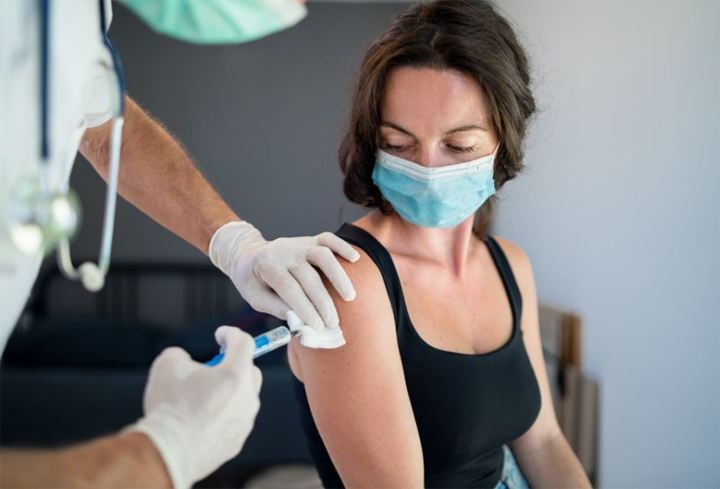
Here is why vaccinated people still need to wear mask

News Network
December 9, 2020

vaccine.JPG

Dec 9: The new Covid-19 vaccines from Pfizer and Moderna seem to be remarkably good at preventing serious illness. But it’s unclear how well they will curb the spread of the coronavirus.

That’s because the Pfizer and Moderna trials tracked only how many vaccinated people became sick with Covid-19. That leaves open the possibility that some vaccinated people get infected without developing symptoms and could then silently transmit the virus — especially if they come in close contact with others or stop wearing masks.

If vaccinated people are silent spreaders of the virus, they may keep it circulating in their communities, putting unvaccinated people at risk.

“A lot of people are thinking that once they get vaccinated, they’re not going to have to wear masks anymore,” said Michal Tal, an immunologist at Stanford University. “It’s really going to be critical for them to know if they have to keep wearing masks because they could still be contagious.”

In most respiratory infections, including the new coronavirus, the nose is the main port of entry. The virus rapidly multiplies there, jolting the immune system to produce a type of antibodies that are specific to the mucosa, the moist tissue lining the nose, mouth, lungs and stomach. If the same person is exposed to the virus a second time, those antibodies, as well as immune cells that remember the virus, rapidly shut down the virus in the nose before it gets a chance to take hold elsewhere in the body.

The coronavirus vaccines, in contrast, are injected deep into the muscles and quickly absorbed into the blood, where they stimulate the immune system to produce antibodies. This appears to be enough protection to keep the vaccinated person from getting ill.

Some of those antibodies will circulate to the nasal mucosa and stand guard there, but it’s not clear how much of the antibody pool can be mobilized or how quickly. If the answer is not much, then viruses could bloom in the nose — and be sneezed or breathed out to infect others.

“It’s a race: It depends whether the virus can replicate faster, or the immune system can control it faster,” said Marion Pepper, an immunologist at the University of Washington in Seattle. “It’s a really important question.”

This is why mucosal vaccines, like nasal spray FluMist or the oral polio vaccine, are better than intramuscular injections at fending off respiratory viruses, experts said.

The next generation of coronavirus vaccines may elicit immunity in the nose and the rest of the respiratory tract, where it’s most needed. Or people could get an intramuscular injection followed by a mucosal boost that produces protective antibodies in the nose and throat.

The coronavirus vaccines have proved to be powerful shields against severe illness, but that is no guarantee of their efficacy in the nose. The lungs — the site of severe symptoms — are much more accessible to the circulating antibodies than the nose or throat, making them easier to safeguard.

“Preventing severe disease is easiest, preventing mild disease is harder, and preventing all infections is the hardest,” said Deepta Bhattacharya, an immunologist at the University of Arizona. “If it’s 95% effective at preventing symptomatic disease, it’s going to be something less than that in preventing all infections, for sure.”

Still, he and other experts said they were optimistic that the vaccines would suppress the virus enough even in the nose and throat to prevent immunized people from spreading it to others.

“My feeling is that once you develop some form of immunity with the vaccine, your ability to get infected will also go down,” said Akiko Iwasaki, an immunologist at Yale University. “Even if you’re infected, the level of virus that you replicate in your nose should be reduced.”

The vaccine trials have not produced data on how many vaccinated people were infected with the virus but did not have symptoms. Some hints are emerging, however.

AstraZeneca, which announced some of its trial results in November, said that volunteers had been testing themselves regularly for the virus and that those results suggested that the vaccine might prevent some infections.

Pfizer will test a subset of its trial participants for antibodies against a viral protein called N. Because the vaccines have nothing to do with this protein, N antibodies would reveal whether the volunteers had become infected with the virus after immunization, said Jerica Pitts, a spokeswoman for the company.

Moderna also plans to analyze blood from all its participants and test for N antibodies.

“It will take several weeks before we can expect to see those results,” said Colleen Hussey, a spokeswoman for Moderna.

The trials have so far analyzed only blood, but testing for antibodies in mucosa would confirm that the antibodies can travel to the nose and mouth. Tal’s team is planning to analyze matched blood and saliva samples from volunteers in the Johnson & Johnson trial to see how the two antibody levels compare.

In the meantime, Bhattacharya said, he was encouraged by recent work showing that people who received an intramuscular flu vaccine had abundant antibodies in the nose. And a study of Covid-19 patients found that antibody levels in saliva and blood were closely matched — suggesting that a strong immune response in the blood would also protect mucosal tissues.

Only people who have virus teeming in their nose and throat would be expected to transmit the virus, and the lack of symptoms in the immunized people who became infected suggests that the vaccine may have kept the virus levels in check.

But some studies have suggested that even people with no symptoms can have high amounts of coronavirus in their nose, noted Dr. Yvonne Maldonado, who represents the American Academy of Pediatrics at meetings of the Federal Advisory Committee on Immunization Practices. The first person confirmed to be reinfected with the coronavirus, a 33-year-old man in Hong Kong, also did not have symptoms but harboured enough virus to infect others.

Vaccinated people who have a high viral load but don’t have symptoms “would actually be, in some ways, even worse spreaders because they may be under a false sense of security,” Maldonado said.

Tal said she was concerned by monkey studies showing that some vaccinated animals did not get ill but still had virus in their nose.

But those monkeys were intentionally exposed to massive amounts of virus and still had less virus than unvaccinated animals, said John Moore, a virus expert at Weill Cornell Medicine in New York.

“The more you reduce viral load, the less likely you are to be transmissible,” Moore said. But “all of these are things where data trumps theory, and we need the data.”


Comments

Add new comment

  • Coastaldigest.com reserves the right to delete or block any comments.
  • Coastaldigset.com is not responsible for its readers’ comments.
  • Comments that are abusive, incendiary or irrelevant are strictly prohibited.
  • Please use a genuine email ID and provide your name to avoid reject.
News Network
November 22,2025

The Karnataka government has announced a 50% rebate on pending traffic and transport fines. The discount is available from November 21 to December 12.

The rebate applies to all traffic e-challans and violation cases booked by the RTO between 1991–92 and 2019–20. Officials clarified that the offer is not applicable to pending tax dues and is restricted only to traffic-violation fines.

Across Karnataka, more than 4 lakh RTO cases remain pending, including those involving transport vehicles. While thousands of vehicle owners have already cleared their dues, the department expects to generate substantial revenue through this limited-period rebate.

How to Pay and Avail the Discount

There are three ways to check and pay your pending fines:

1. Through Mobile Apps
Available on both Play Store and App Store:
•    Karnataka State Police (KSP) app
•    KarnatakaOne app
•    ASTraM app

Steps:
•    Enter your vehicle number in any of the above apps
•    Verify the photo/details of your vehicle
•    Pay the fine with the 50% discount applied

2. Visit a Traffic Police Station

You can pay your pending fine at any nearby traffic police station.

3. Visit the Traffic Management Centre (TMC)

•    Location: First Floor, Infantry Road, near Indian Express, Bengaluru

Transport Commissioner Yogeesh A M said, “We don't issue e-challans, so there's no online payment system.”

The department estimates ₹52 crore in pending RTO fines up to March 2020. “With the 50% rebate, we expect to collect around ₹25 crore if all dues are cleared,” he added.

Comments

Add new comment

  • Coastaldigest.com reserves the right to delete or block any comments.
  • Coastaldigset.com is not responsible for its readers’ comments.
  • Comments that are abusive, incendiary or irrelevant are strictly prohibited.
  • Please use a genuine email ID and provide your name to avoid reject.
News Network
December 3,2025

indigo.jpg

IndiGo, India’s largest airline, is battling one of its worst operational disruptions in recent years, with hundreds of delays and cancellations throwing domestic travel into chaos.

Government data on Tuesday showed its on-time performance plunging to 35%, an unusual dip for a carrier long associated with punctuality.

By Wednesday afternoon, airports in Delhi, Mumbai, Bengaluru and Hyderabad had collectively reported close to 200 cancellations, stranding travellers across the country.

Crew Shortage After New Duty Norms

A major trigger behind the meltdown is a severe crew shortage, especially among pilots, following the rollout of revised Flight Duty Time Limitation (FDTL) norms last month.

The rules mandate longer rest hours and more humane rosters — a shift IndiGo has struggled to incorporate across its vast network.

Sources said several flights were grounded due to lack of cabin crew, while some delays stretched upwards of eight hours.

With IndiGo controlling over 60% of India’s domestic aviation market, the ripple effect has impacted airports nationwide.

IndiGo Issues Apology, Lists “Compounding Factors”

In a statement, IndiGo acknowledged the large-scale disruption:

“We sincerely apologise to customers. A series of unforeseen operational challenges — technology glitches, winter schedule changes, adverse weather, system congestion and updated FDTL norms — created a compounding impact that could not have been anticipated.”

To stabilise operations, the airline has begun calibrated schedule adjustments for the next 48 hours, aiming to restore punctuality. Affected passengers are being offered refunds or alternate travel arrangements, IndiGo said.

What the FDTL Rules Require

The FDTL norms, designed to reduce pilot fatigue, cap duty and flying hours as follows:
•    Maximum 8 hours of flying per day
•    35 hours per week
•    125 hours per month
•    1,000 hours per year

Crew must also receive rest equalling twice the flight duration, with a minimum 10-hour rest period in any 24-hour window.

The DGCA introduced these limits to enhance flight safety.

Hyderabad: 33 Flights Cancelled, Long Queues Reported

Hyderabad’s Rajiv Gandhi International Airport saw heavy early-morning crowds as 33 IndiGo flights (arrivals and departures) were cancelled.

The airport clarified on X that operations were normal, advising passengers to contact IndiGo directly for latest flight status.

Cancellations included flights to and from Visakhapatnam, Goa, Ahmedabad, Delhi, Bengaluru, Chennai, Madurai, Hubli, Bhopal and Bhubaneswar.

Bengaluru: 42 Flights Disrupted

Bengaluru’s Kempegowda International Airport recorded 42 cancellations — 22 arrivals and 20 departures — affecting routes to Delhi, Mumbai, Chennai, Hyderabad, Goa, Kolkata and Lucknow.

Passengers Vent on Social Media

Irate travellers took to X to share their experiences. One passenger stranded in Hyderabad wrote: “I have been here since 3 a.m. and missed an important meeting.”

Another said: “My flight was pushed from 1:55 PM to 2:55 PM and now 4:35 PM. I was informed only three minutes before entering the airport.”

Delhi Airport Hit by Tech Glitch

At Delhi Airport, the disruption deepened due to a slowdown in the Amadeus system — used for reservations, check-ins and departure control.

The technical issue led to longer queues and sluggish processing, adding to delays already worsened by staff shortages.

Comments

Add new comment

  • Coastaldigest.com reserves the right to delete or block any comments.
  • Coastaldigset.com is not responsible for its readers’ comments.
  • Comments that are abusive, incendiary or irrelevant are strictly prohibited.
  • Please use a genuine email ID and provide your name to avoid reject.
News Network
November 30,2025

The United Nations Committee against Torture (CAT) has condemned the Israeli regime for enforcing a policy of “organized torture” against Palestinians.

In a report published on Friday, CAT stated that the occupying regime enforces a deliberate policy of “organized and widespread torture and ill-treatment” against Palestinian abductees, particularly since October 7, 2023, when Israel launched its genocidal war on Gaza.

The committee expressed “deep concern over repeated severe beatings, dog attacks, electrocution, water-boarding, use of prolonged stress positions [and] sexual violence” inflicted on Palestinians.

Palestinian prisoners were degraded by “being made to act like animals or being urinated on,” systematically denied medical care, and subjected to excessive restraints, “in some cases resulting in amputation,” the report added.

CAT also condemned the routine application of “unlawful combatants law” to justify the prolonged detention without trial of thousands of Palestinian men, women, and children.

More than 10,000 Palestinians, including women and children, are currently held in Israeli prisons, according to Palestinian and international human rights groups, with 3,474 Palestinians in “administrative detention,” meaning they are imprisoned without trial for indefinite periods.

The report highlighted the “high proportion of children who are currently detained without charge or on remand,” noting that while Israel sets the age of criminal responsibility at 12, even younger children have been abducted.

Children designated as security prisoners face severe restrictions on family contact, may be subjected to solitary confinement, and are denied access to education, in clear violation of international law.

The committee further suggested that Israel’s policies across the Occupied Territories constitute collective torture against the Palestinian population.

“A range of policies adopted by Israel in the course of its continued unlawful presence in the Occupied Palestinian Territory amounts to cruel, inhuman or degrading living conditions for the Palestinian population,” the report said.

On Thursday, the Palestinian resistance movement Hamas condemned the systematic killing and torture of Palestinian abductees in Israeli prisons, urging international action to halt these abuses.

Citing human rights data, Hamas stated that 94 Palestinians have been killed in Israeli prisons since the start of Tel Aviv’s genocidal war on Gaza.

“This reflects an organized criminal approach that has turned these prisons into direct killing grounds to eliminate our people,” the resistance movement said.

Hamas called on the international community, the UN, and human rights organizations to immediately pressure Israel to end crimes against prisoners and uphold their rights as guaranteed by all international conventions and norms.

Comments

Add new comment

  • Coastaldigest.com reserves the right to delete or block any comments.
  • Coastaldigset.com is not responsible for its readers’ comments.
  • Comments that are abusive, incendiary or irrelevant are strictly prohibited.
  • Please use a genuine email ID and provide your name to avoid reject.