India beat Australia by 137 runs to take 2-1 lead in four-match series

Agencies
December 30, 2018

Melbourne, Dec 30: India took giant strides towards winning their first ever series on Australian soil in seven decades by retaining the Border-Gavaskar Trophy with a comprehensive 137-run win in the third Test on Sunday.

Taking an unassailable 2-1 lead in the four-match series, India will retain the coveted trophy even if the series is drawn level at Sydney as they have won the previous series at home in 2017.

It took only 27 balls on the fifth day afternoon as Jasprit Bumrah (3/53) and Ishant Sharma (2/40) completed the formalities in what turned out to be India's 150th Test victory.

After losing out the first session due to steady showers, Australia could only manage to add three runs to their overnight score of 258 for 8 as they were all out for 261 in 89.3 overs.

India thus won a Test match at the iconic MCG after 37 long years when Sunil Gavaskar's men beat Greg Chappell's side in the 1980-81 series.

Fittingly it was the legendary Kapil Dev, who had then played a major role taking five wickets in defending a low total while it was young Bumrah with match figures of 9 for 86, who was the hero on what looked like a docile track.

Bumrah got rid of Pat Cummins (63), who edged to first slip and brought an end to his heroic effort in this Test.

Five balls later, Ishant Sharma got rid of Nathan Lyon (7), caught behind as Rishabh Pant took his 20th dismissal in this series, which is highest by any Indian wicket-keeper.

For Bumrah, 48 wickets in his debut Test season is highest by any pace bowler and also is a testimony to a lethal pace trio involving the veteran Ishant Sharma and the wily Mohammed Shami (2/71), who also played his part well.

The trio have collectively taken 134 away wickets (Bumrah 48, Ishant 40 and Shami 46) in a single calendar year eclipsing the 34-year-old record that stood in the name of the fearsome West Indies trio of Malcolm Marshall, Michael Holding and Joel Garner (130 wickets in away tours in 1984).

No wonder skipper Virat Kohli was delighted and attributed their success to their ability to complement each other.

"We knew that it would be tough for Australia, but credit to our bowlers, especially Jasprit. The three fast bowlers have broken the record for most wickets by pacers in a calendar year for a team, which is brilliant," Kohli was all praise for his speed merchants.

"I certainly feel proud as a captain when they bowl in partnerships. No one is looking to out-bowl each other. Our first-class cricket is amazing, which is why we won. Credit must go to first-class set-up in India, which challenges our fast bowlers in India, and that helps them abroad," the skipper said.

Even Bumrah spoke about how India's first-class set-up has him a better bowler.

"My aim is to always focus on consistency. We train very hard and we are used to bowling a lot of overs in Ranji Cricket, so the body is doing well. My focus is on the next Test now," said Bumrah.

Having got only better since his debut in South Africa, Bumrah is hopeful that better things await for him in near future.

"It was always a dream to play Test cricket and I was really happy when I debuted in South Africa. I started learning slowly, in England it was a different experience. Coming to Australia has been a different experience as well. The start has been good, and hopefully, I will keep getting better," the bowler said.

Bumrah's skipper is confident that his men won't take their feet off the pedal and win the series 3-1.

"We are not going to stop here. This (win) will give us more confidence and we will play more positively in Sydney. I think we have been really smart in all the departments in the two matches that we have won," Kohli said

"That is the reason we have at least retained the trophy but job is not done yet. It's not finished at all. We want to win the last Test match as well, if an opportunity comes our way. We don't want to be complacent. We are all but ready for the final Test match," he added.

There was a bit of scare when the morning session was lost due to rain but Kohli said that he was not bothered about talks of not enforcing the follow-on.

"It's a good thing that I don't read any comments or what the opinions are. What matters is what we decide inside the dressing room as a team unit. We were pretty clear that we wanted to bat third on this pitch and wanted to get more runs as the pitch was only getting worse.

"I always felt the pitch had enough for the bowlers and a score around 400 will be extremely tough for Australia to chase down," the skipper said.

In Video: 3rd test: India beat Australia by 137 runs.

Comments

Add new comment

  • Coastaldigest.com reserves the right to delete or block any comments.
  • Coastaldigset.com is not responsible for its readers’ comments.
  • Comments that are abusive, incendiary or irrelevant are strictly prohibited.
  • Please use a genuine email ID and provide your name to avoid reject.
News Network
December 7,2025

envoy.jpg

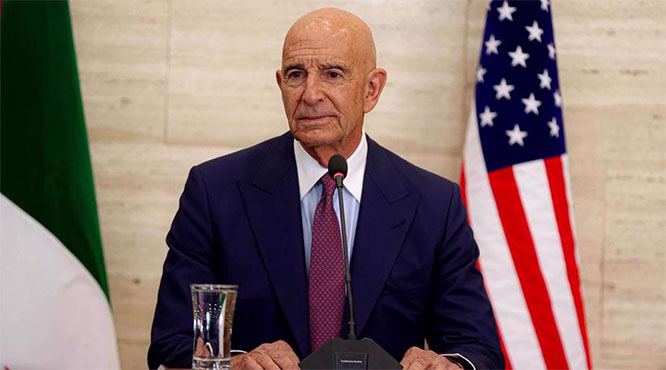
Since 1946, the United States has attempted 93 coups or “regime change” operations across the world — including two in Iran, US Special Envoy for Syria Tom Barrack has admitted.

Speaking to the UAE-based IMI Media Group, in remarks published by The National, Barrack said Washington tried twice to overthrow the Iranian government but failed both times. 

“For (Trump) then to be imputed with regime change — we had two regime changes in Iran already. Neither one worked. So I think wisely leave it to the region to solve,” said Barrack, who also serves as the US ambassador to Turkey.

His comments come six months after the US joined Israel in airstrikes against Iran during ongoing indirect nuclear negotiations between Tehran and Washington.

On June 13, Israel launched an attack on Iran that killed at least 1,064 people and hit civilian infrastructure. Days later, the United States targeted three nuclear facilities — Fordow, Natanz and Isfahan — in what Iran called a clear violation of international law. Iranian retaliation eventually forced a halt to the assault on June 24.

Barrack further claimed that US President Donald Trump and Foreign Secretary Marco Rubio are “not into regime change” and prefer a regional approach driven by Middle Eastern countries themselves. According to him, regional dialogue and non-interference by outside powers offer a more durable path forward.

He added that Washington is still open to an agreement with Tehran if Iranian authorities show “seriousness” and willingness to engage constructively.

However, Iran maintains the US has not shown readiness for meaningful talks. In an interview with Japan’s Kyodo News, Iranian Foreign Minister Abbas Araghchi said negotiations could advance only if Washington acknowledges Iran’s right to peaceful nuclear energy and lifts unilateral sanctions.

Comments

Add new comment

  • Coastaldigest.com reserves the right to delete or block any comments.
  • Coastaldigset.com is not responsible for its readers’ comments.
  • Comments that are abusive, incendiary or irrelevant are strictly prohibited.
  • Please use a genuine email ID and provide your name to avoid reject.
News Network
December 6,2025

pilot.jpg

New Delhi: IndiGo, India’s largest airline, faced major operational turbulence this week after failing to prepare for new pilot-fatigue regulations issued by the Directorate General of Civil Aviation (DGCA). The stricter rules—designed to improve flight safety—took effect in phases through 2024, with the latest implementation on November 1. IndiGo has acknowledged that inadequate roster planning led to widespread cancellations and delays.

Below are the key DGCA rules that affected IndiGo’s operations:

1. Longer Mandatory Weekly Rest

Weekly rest for pilots has been increased from 36 hours to 48 hours.

The government says the extended break is essential to curb cumulative fatigue. This rule remains in force despite the current crisis.

2. Cap on Night Landings

Pilots can now perform only two night landings per week—a steep reduction from the earlier limit of six.

Night hours, defined as midnight to early morning, are considered the least alert period for pilots.

Given the disruptions, this rule has been temporarily relaxed for IndiGo until February 10.

3. Reduced Maximum Night Flight Duty

Flight duty that stretches into the night is now capped at 10 hours.

This measure has also been kept on hold for IndiGo until February 10 to stabilize operations.

4. Weekly Rest Cannot Be Replaced With Personal Leave

Airlines can no longer count a pilot’s personal leave as part of the mandatory 48-hour rest.

Pilots say this closes a loophole that previously reduced actual rest time.

Currently, all airlines are exempt from this rule to normalise travel.

5. Mandatory Fatigue Monitoring

Airlines must submit quarterly fatigue reports along with corrective actions to DGCA.

This system aims to create a transparent fatigue-tracking framework across the industry.

The DGCA has stressed that these rules were crafted to strengthen flight safety and align India with global fatigue-management standards. The temporary relaxations are expected to remain until February 2025, giving IndiGo time to stabilise its schedules and restore normal air travel.

Comments

Add new comment

  • Coastaldigest.com reserves the right to delete or block any comments.
  • Coastaldigset.com is not responsible for its readers’ comments.
  • Comments that are abusive, incendiary or irrelevant are strictly prohibited.
  • Please use a genuine email ID and provide your name to avoid reject.
News Network
December 7,2025

SHRIMP.jpg

Mangaluru, Dec 7: A rare bamboo shrimp has been rediscovered on mainland India more than 70 years after it was last reported, confirming for the first time the presence of Atyopsis spinipes in the country. The find was made by researchers from the Centre for Climate Change Studies at Sathyabama Institute of Science and Technology, Chennai, during surveys in Karnataka and Odisha.

The team — shrimp expert Dr S Prakash, PhD scholar K Kunjulakshmi, and Mangaluru-based researcher Maclean Antony Santos — combined field surveys, ecological assessments and DNA analysis to identify the elusive species. Their findings, published in Zootaxa, resolve decades of taxonomic confusion stemming from a 1951 report that misidentified the species as Atyopsis moluccensis without strong evidence.

The shrimp has now been confirmed at two locations: the Mulki–Pavanje estuary near Mangaluru and the Kuakhai River in Bhubaneswar. Historical specimens from the Andaman Islands, previously labelled as A. moluccensis, were also found to be misidentified and actually belong to A. spinipes.

The rediscovery began after an aquarium hobbyist in Odisha spotted a shrimp in 2022, prompting systematic surveys across Udupi, Karwar and Mangaluru. Four female specimens were collected in Mulki and one in Odisha, all genetically matching.

Researchers warn the species may exist in very small, vulnerable populations as freshwater habitats face increasing pressure from pollution, sand mining and infrastructure development. All verified specimens have been deposited with the Zoological Survey of India for future reference.

Comments

Add new comment

  • Coastaldigest.com reserves the right to delete or block any comments.
  • Coastaldigset.com is not responsible for its readers’ comments.
  • Comments that are abusive, incendiary or irrelevant are strictly prohibited.
  • Please use a genuine email ID and provide your name to avoid reject.