



Amid Opec snub, Saudi Arabia asks India to use cheap oil it bought last year

Agencies
March 5, 2021

New Delhi, Mar 5: International oil prices rose after Opec and its allies ignored India's plea to ease production control, with Saudi Arabia asking New Delhi to instead use oil it bought at rock bottom rates last year.

Brent crude, the most widely used benchmark, on Friday rose nearly 1 per cent to $67.44 a barrel after the Organization of the Petroleum Exporting Countries (Opec) and its allies, a group known as Opec, agreed not to increase supplies in April awaiting more substantial recovery in demand.

India's oil minister Dharmendra Pradhan had in the run-up to Thursday's Opec meeting urged the producers' group to ease production curbs to fulfil their promise of stable oil prices.

He felt rising international oil prices were hurting economic recovery and demand.

Responding to a question on India's pleas, Saudi energy minister Prince Abdulaziz bin Salman at a press conference after the OPEC+ decision on Thursday said New Delhi should take some of the crude out of storage that they had purchased at very cheap rates last year.

"With regard to India, very simple. I would ask my friend that he withdraw some of the cheap oil that they bought in April, May and June (last year)," the Saudi minister said. "There is an opportunity cost for not withdrawing it now."

India had purchased 16.71 million barrels of crude in April-May, 2020 and filled all the three Strategic Petroleum Reserves created at Visakhapatnam in Andhra Pradesh and Mangalore and Padur in Karnataka. The average cost of that crude purchase was $19 per barrel, according to Pradhan's written reply to a question in the Rajya Sabha on September 21, 2020.

Retail petrol and diesel prices, which already are at historic highs, should rise if the oil companies decide to pass on the surge in international oil prices to consumers.

Petrol and diesel prices have remained unchanged for the last five years and oil companies have in past not revised prices in the run to crucial assembly elections in 2017 and 2018 ahead of elections in states like Uttar Pradesh and Gujarat.

West Bengal, Tamil Nadu, Kerala, Pondicherry and Assam will go to the polls in the next few weeks.

Earlier this week, Pradhan had said India, where fuel demand is recovering to pre-pandemic levels, wants reasonable and responsible oil prices.

India, the world's third-biggest oil importer and consumer, had supported the decision of the oil producers' cartel Opec and its allies to cut production last year in view of the oil demand collapsing due to the spread of Covid-19.

"At that point in time, the producers especially Opec assured the global market, that by the beginning of the 2021 demand will be coming back and production will be as usual. But I am sorry to say the production is yet to be normal," he said. "If you do not supply properly if there is a gap in demand and supply artificially (created), there is a price rise."

The average price of crude oil India imports was less than $50 per barrel between April and December 2020 and comparable to 2019-20 average rate of $60.47 in months thereafter but petrol and diesel prices are at historic highs now as the government has so far not rolled back the taxes it levied when prices plummeted almost a year back.

The record taxes coupled with international rates returning to pre-Covid levels on resurrecting demand have meant that petrol has crossed Rs 100 mark in some places in Rajasthan, Madhya Pradesh and Maharashtra.

Excise duty was raised by Rs 13 and Rs 16 per litre on petrol and diesel between March 2020 and May 2020 and now accounts for more than one-third of the Rs 91.17 a litre price of petrol in Delhi and 40 per cent of Rs 81.47 per litre rate of diesel.

'Excise duty on petrol, diesel can be reduced by Rs 8.5 a litre without hurting revenues'

The basket of crude oil India imported in February averaged $61.22 per barrel and $54.79 in January this year. It had fallen to $19.90 in April last year and was between $40 and $49 during June and December.

India imports about 85 per cent of its oil needs and local retail rates are benchmarked to international prices.

Opec+, which is currently reining in about 7 million barrels per day of production -- about 7 per cent of pre-pandemic supply -- has helped engineer a nearly 80 per cent rise in the Dated Brent benchmark since November. Saudi Arabia has taken a voluntary extra 1 million bpd production cut in February and March.

Comments

Add new comment

  • Coastaldigest.com reserves the right to delete or block any comments.
  • Coastaldigset.com is not responsible for its readers’ comments.
  • Comments that are abusive, incendiary or irrelevant are strictly prohibited.
  • Please use a genuine email ID and provide your name to avoid reject.
News Network
January 23,2026

modIKERALA.jpg

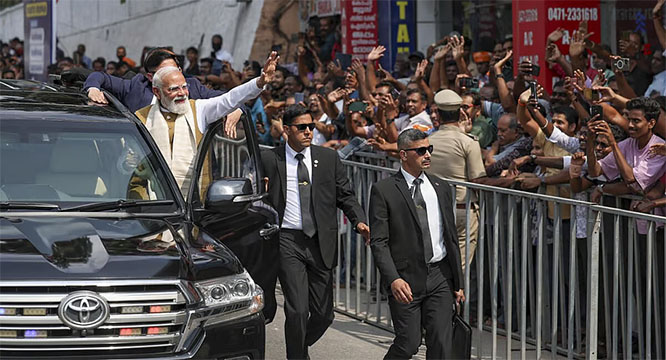
Prime Minister Narendra Modi, during his visit to Thiruvananthapuram on Friday, January 23, indicated that the Bharatiya Janata Party (BJP) is aiming to expand its political footprint in Kerala ahead of the Assembly elections scheduled in the coming months.

Speaking at a BJP-organised public meeting, Modi drew parallels between the party’s early electoral gains in Gujarat and its recent victory in the Thiruvananthapuram Municipal Corporation. The civic body win, which ended decades of Left control, was cited by the Prime Minister as a possible starting point for the party’s broader ambitions in the state.

Recalling BJP’s political trajectory in Gujarat, Modi said the party was largely insignificant before 1987 and received little media attention. He pointed out that the BJP’s first major breakthrough came with its victory in the Ahmedabad Municipal Corporation that year.

“Just as our journey in Gujarat began with one city, Kerala’s journey has also started with a single city,” Modi said, suggesting that the party’s municipal-level success could translate into wider electoral acceptance.

The Prime Minister alleged that successive governments led by the Left Democratic Front (LDF) and the United Democratic Front (UDF) had failed to adequately develop Thiruvananthapuram. He accused both fronts of corruption and neglect, claiming that basic infrastructure and facilities were denied to the capital city for decades.

According to Modi, the BJP’s control of the civic body represents a shift driven by public dissatisfaction with the existing political alternatives. He asserted that the BJP administration in Thiruvananthapuram had begun working towards development, though no specific details or timelines were outlined.

Addressing the gathering at Putharikandam Maidan, Modi said the BJP intended to project Thiruvananthapuram as a “model city,” reiterating his party’s commitment to governance-led change.

The Prime Minister’s visit to Kerala also included the inauguration of several development projects and the flagging off of new train services, as the BJP intensifies its political outreach in the poll-bound state.

Comments

Add new comment

  • Coastaldigest.com reserves the right to delete or block any comments.
  • Coastaldigset.com is not responsible for its readers’ comments.
  • Comments that are abusive, incendiary or irrelevant are strictly prohibited.
  • Please use a genuine email ID and provide your name to avoid reject.
News Network
February 1,2026

Bengaluru, Feb 1: For travelers landing at Kempegowda International Airport (KIA), the sleek, wood-paneled curves of Terminal 2 promise a world-class welcome. But the famed “Garden City” charm quickly withers at the curb. As India’s aviation sector swells to record numbers—handling over 43 million passengers in Bengaluru alone this past year—the “last mile” has turned into a marathon of frustration.

The Bengaluru Logjam: Rules vs Reality

While the city awaits the 2027 completion of the Namma Metro Blue Line, the interim has been chaotic. Recent “decongestion” rules at Terminal 1 have pushed app-based cab pickups to distant parking zones, forcing weary passengers into a 20-minute walk with luggage.

“I landed after ten months away and felt like a stranger in my own city,” says Ruchitha Jain, a Koramangala resident. “My driver couldn’t find me, staff couldn’t guide me, and the so-called ‘Premium’ lane is just a fancy tax on convenience.”

•    The Cost of Distance: A 40-km cab ride can now easily cross ₹1,500, driven by demand pricing and airport surcharges.

•    The Bus Gap: While Vayu Vajra remains a lifeline, its ₹300–₹400 fare is often cited as the most expensive airport bus service in the country.

A National Pattern of Disconnect

The struggle is not unique to Karnataka. From Chennai’s coast to Hyderabad’s plateau, India’s airports tell a familiar story: brilliant runways, broken exits.

City:    Primary Issue   |    Recent Development

Bengaluru:    Cab pickup restrictions & distance  |    App-based taxis shifted to far parking zones; long walks and fare spikes reported

Chennai:    Multi-Level Parking (MLCP) hike  |    Passengers report 40-minute walks to reach cab pickup points

Hyderabad:    “Taxi mafia” & touting  |    Over 440 touting cases reported; security presence intensified

Mumbai:    Fare scams  |     Tourists charged ₹18,000 for just 400 metres, triggering police action

In Hyderabad, travelers continue to battle entrenched local groups that intimidate Uber and Ola drivers, pushing passengers toward overpriced private taxis. Chennai flyers, meanwhile, complain that reaching the designated pickup zones now takes longer than short-haul flights from cities like Coimbatore.

The ‘Budget Day’ Hope

As Finance Minister Nirmala Sitharaman presents the Union Budget 2026 today, the aviation sector is watching closely. With the government’s renewed emphasis on multimodal integration, there is cautious hope for funding toward seamless airport-metro-bus hubs.

The vision is clear: a future where planes, trains, and metros speak the same language. Until then, passengers at KIA—and airports across India—will continue to discover that the hardest part of flying isn’t the thousands of kilometres in the air, but the last few on the ground.

Comments

Add new comment

  • Coastaldigest.com reserves the right to delete or block any comments.
  • Coastaldigset.com is not responsible for its readers’ comments.
  • Comments that are abusive, incendiary or irrelevant are strictly prohibited.
  • Please use a genuine email ID and provide your name to avoid reject.
News Network
February 1,2026

Bengaluru, Feb 1: For travelers landing at Kempegowda International Airport (KIA), the sleek, wood-paneled curves of Terminal 2 promise a world-class welcome. But the famed “Garden City” charm quickly withers at the curb. As India’s aviation sector swells to record numbers—handling over 43 million passengers in Bengaluru alone this past year—the “last mile” has turned into a marathon of frustration.

The Bengaluru Logjam: Rules vs Reality

While the city awaits the 2027 completion of the Namma Metro Blue Line, the interim has been chaotic. Recent “decongestion” rules at Terminal 1 have pushed app-based cab pickups to distant parking zones, forcing weary passengers into a 20-minute walk with luggage.

“I landed after ten months away and felt like a stranger in my own city,” says Ruchitha Jain, a Koramangala resident. “My driver couldn’t find me, staff couldn’t guide me, and the so-called ‘Premium’ lane is just a fancy tax on convenience.”

•    The Cost of Distance: A 40-km cab ride can now easily cross ₹1,500, driven by demand pricing and airport surcharges.

•    The Bus Gap: While Vayu Vajra remains a lifeline, its ₹300–₹400 fare is often cited as the most expensive airport bus service in the country.

A National Pattern of Disconnect

The struggle is not unique to Karnataka. From Chennai’s coast to Hyderabad’s plateau, India’s airports tell a familiar story: brilliant runways, broken exits.

City:    Primary Issue   |    Recent Development

Bengaluru:    Cab pickup restrictions & distance  |    App-based taxis shifted to far parking zones; long walks and fare spikes reported

Chennai:    Multi-Level Parking (MLCP) hike  |    Passengers report 40-minute walks to reach cab pickup points

Hyderabad:    “Taxi mafia” & touting  |    Over 440 touting cases reported; security presence intensified

Mumbai:    Fare scams  |     Tourists charged ₹18,000 for just 400 metres, triggering police action

In Hyderabad, travelers continue to battle entrenched local groups that intimidate Uber and Ola drivers, pushing passengers toward overpriced private taxis. Chennai flyers, meanwhile, complain that reaching the designated pickup zones now takes longer than short-haul flights from cities like Coimbatore.

The ‘Budget Day’ Hope

As Finance Minister Nirmala Sitharaman presents the Union Budget 2026 today, the aviation sector is watching closely. With the government’s renewed emphasis on multimodal integration, there is cautious hope for funding toward seamless airport-metro-bus hubs.

The vision is clear: a future where planes, trains, and metros speak the same language. Until then, passengers at KIA—and airports across India—will continue to discover that the hardest part of flying isn’t the thousands of kilometres in the air, but the last few on the ground.

Comments

Add new comment

  • Coastaldigest.com reserves the right to delete or block any comments.
  • Coastaldigset.com is not responsible for its readers’ comments.
  • Comments that are abusive, incendiary or irrelevant are strictly prohibited.
  • Please use a genuine email ID and provide your name to avoid reject.