



100 days of instability, immaturity and crimes against women: Congress on Modi govt's performance

News Network
September 17, 2024

congmodi.jpg

As the Modi-led NDA government completes the first 100 days of its third term, the Congress party has launched a scathing attack, dubbing it as the "U-Turn Sarkar" for its failures and policy reversals.

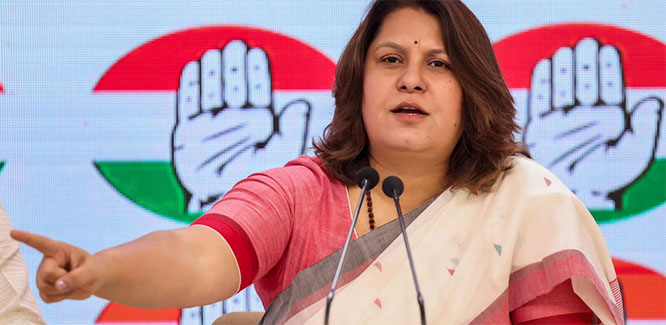
At a press conference in Delhi, Congress spokesperson Supriya Shrinate highlighted what she called "100 days of instability, indecisiveness, and immaturity," accusing the Modi government of damaging critical sectors of the economy and public infrastructure.

Shrinate criticised the government's handling of the economy, which she described as being in "dire straits".

She argued that under Modi's leadership, sectors such as agriculture, youth employment, and infrastructure have been neglected. "These 100 days have been very heavy on the country's economy, farmers, youth, women, infrastructure, railways, and institutions," she said, adding "It has become clear that Narendra Modi has no vision to deal with the country's problems."

She went on to debunk the government's claims of progress in infrastructure development, citing multiple instances of structural failures in key projects.

“The airports inaugurated by Narendra Modi--from Jabalpur to Delhi and Rajkot--could not even withstand a single monsoon,” Shrinate pointed out. She also referenced failures such as:

•    Atal setu: Constructed at a cost of Rs18,000 crore, the bridge developed cracks soon after its inauguration.

•    Sudarshan setu in Gujarat: Opened in February 2024, it also developed cracks within months.

•    Shivaji statue collapse: The iconic statue of Chhatrapati Shivaji Maharaj was destroyed within eight months of being unveiled, an event Shrinate described as an "insult to Shivaji Maharaj."

•    Ram mandir water leakage: The sanctum sanctorum of the Ram Mandir, a symbol of faith for millions, was found to be leaking during the monsoon.

•    "Who will take accountability for these incidents?" Shrinate asked, questioning the government's competency in executing large-scale projects.

•    On railway safety, Shrinate accused the government of overseeing a period marked by frequent accidents and derailments.

•    "There have been 38 railway accidents in 100 days, resulting in 21 deaths," she stated. Despite the public outrage following the tragic Balasore accident, which killed nearly 300 people earlier this year, the Congress spokesperson said that the government has failed to take effective measures to improve rail safety.

•    She criticised the slow implementation of Kavach, an anti-collision device, stating, “The reality is that even after 21 deaths, Kavach is being installed at a pace of 2 km per year, while the Railway Minister shamelessly calls these 'minor' incidents.” Shrinate’s remarks come amidst mounting public concern over the Modi government’s inability to secure rail travel in one of the world’s largest railway networks.

In addition to infrastructure and safety concerns, Shrinate accused the Modi government of making hasty policy decisions, only to later backtrack under public pressure. "If any of your decisions affect the country negatively, it won’t become law because the government will take a U-turn on it," she said. Among the key policy reversals Shrinate cited were:

•    Lateral entry: A controversial policy of hiring private-sector professionals for bureaucratic roles, which was quietly shelved.

•    Broadcast Bill: Withdrawn after fierce opposition, highlighting the government's poor handling of policy legislation.

•    Waqf Board Bill: Another example of the government's failure to gauge the impact of its decisions.

•    NPS to UPS: Indexation policy changes that were hastily reversed after protests from key stakeholders.

"Narendra Modi's first 100 days symbolise not just U-turns, but a government that is fundamentally unsure of its direction," Shrinate remarked.

"In 100 days, 104 heinous crimes have been committed against women, in which there are 157 victims. Women are raped publicly in BJP ruled states but Narendra Modi doesn't say a word on this. But how will you speak, because you are the one who stood with those who sexually exploited the daughters of the country," she added.

The Congress's sharp critique of the Modi government's first 100 days has set the tone for the coming months, as the opposition gears up for a series of state elections and prepares for the 2024 general election.

"The country cannot afford this level of instability, immaturity, and incompetence," Shrinate concluded, calling on citizens to hold the Modi government accountable for what she described as its "endless U-turns and policy failures."

In these 100 days, Congress has made clear that it will focus on highlighting the government’s missteps in the economy, public safety, and governance, presenting itself as a viable alternative in the face of what it calls "a government in retreat."


Comments

Add new comment

  • Coastaldigest.com reserves the right to delete or block any comments.
  • Coastaldigset.com is not responsible for its readers’ comments.
  • Comments that are abusive, incendiary or irrelevant are strictly prohibited.
  • Please use a genuine email ID and provide your name to avoid reject.
News Network
January 31,2026

Roy.jpg

Bengaluru: The shooting incident involving CJ Roy, founder of the Confident Group, has once again put the spotlight on a businessman whose life has swung between flamboyant global success and persistent controversy at home.

Though Roy’s business interests extended across continents, his roots lay firmly in Karnataka. An alumnus of Christ School in Bengaluru, he later moved to Tumakuru to pursue an engineering degree. Those familiar with his early years describe him as intensely ambitious, beginning his career as a salesman at a small electronics firm dealing in computers.

Roy’s entry into large-scale real estate came through the Crystal Group, where he worked closely with Latha Namboothiri and rose from manager to director. However, the launch of the Confident Group in 2005 was clouded by industry speculation. Insiders speak of a fallout involving alleged “benami” properties and claims of deception that ultimately led to his independent venture—an episode Roy spent years trying to distance himself from, according to associates.

A tale of two cities

Roy’s professional trajectory diverged sharply across geographies.

In Dubai, he built a reputation as a bold and efficient developer, completing massive luxury residential projects in record time—some reportedly within 11 months. His rapid project delivery and lavish lifestyle in the Emirates earned him admiration and visibility in the real estate sector.

In Bengaluru, however, his image remained far more fractured. Sources say Roy stayed away from the city for several years amid disputes over unpaid dues to vendors and suppliers. Several projects were allegedly stalled, with accusations of unfulfilled commitments to cement and steel suppliers continuing to follow him.

Roy’s return to Bengaluru’s business and social circles began around 2018, marked by a conscious attempt at rebranding. His appointment as Honorary Consul of the Slovak Republic added diplomatic legitimacy, which he complemented with visible CSR initiatives, including ambulance donations and high-profile charity events.

Heavy police presence in Langford Town

Following the incident, police personnel from the Central division were deployed outside the Confident Group building in Langford Town, which also houses the Slovak Honorary Consulate in Bengaluru.

The otherwise busy premises near Hosur Road wore a deserted look on Friday, reflecting the shock and uncertainty that followed the tragedy.

Comments

Add new comment

  • Coastaldigest.com reserves the right to delete or block any comments.
  • Coastaldigset.com is not responsible for its readers’ comments.
  • Comments that are abusive, incendiary or irrelevant are strictly prohibited.
  • Please use a genuine email ID and provide your name to avoid reject.
News Network
February 1,2026

Bengaluru: Karnataka Deputy Chief Minister D K Shivakumar on Sunday criticised the Union Budget presented by Finance Minister Nirmala Sitharaman, claiming it offered no tangible benefit to the state.

Though he said he was yet to study the budget in detail, Shivakumar asserted that Karnataka had gained little from it. “There is no benefit for our state from the central budget. I was observing it. They have now named a programme after Mahatma Gandhi, after repealing the MGNREGA Act that was named after him,” he said.

Speaking to reporters here, the Deputy Chief Minister demanded the restoration of MGNREGA, and made it clear that the newly enacted rural employment scheme — VB-G RAM G — which proposes a 60:40 fund-sharing formula between the Centre and the states, would not be implemented in Karnataka.

“I don’t see any major share for our state in this budget,” he added.

Shivakumar, who also holds charge of Bengaluru development, said there were high expectations for the city from the Union Budget. “The Prime Minister calls Bengaluru a ‘global city’, but what has the Centre done for it?” he asked.

He also drew attention to the problems faced by sugar factories, particularly those in the cooperative sector, alleging a lack of timely decisions and support from the central government.

Noting that the Centre has the authority to fix the minimum support price (MSP) for agricultural produce, Shivakumar said the Union government must take concrete steps to protect farmers’ interests.

Comments

Add new comment

  • Coastaldigest.com reserves the right to delete or block any comments.
  • Coastaldigset.com is not responsible for its readers’ comments.
  • Comments that are abusive, incendiary or irrelevant are strictly prohibited.
  • Please use a genuine email ID and provide your name to avoid reject.
News Network
February 1,2026

Bengaluru, Feb 1: For travelers landing at Kempegowda International Airport (KIA), the sleek, wood-paneled curves of Terminal 2 promise a world-class welcome. But the famed “Garden City” charm quickly withers at the curb. As India’s aviation sector swells to record numbers—handling over 43 million passengers in Bengaluru alone this past year—the “last mile” has turned into a marathon of frustration.

The Bengaluru Logjam: Rules vs Reality

While the city awaits the 2027 completion of the Namma Metro Blue Line, the interim has been chaotic. Recent “decongestion” rules at Terminal 1 have pushed app-based cab pickups to distant parking zones, forcing weary passengers into a 20-minute walk with luggage.

“I landed after ten months away and felt like a stranger in my own city,” says Ruchitha Jain, a Koramangala resident. “My driver couldn’t find me, staff couldn’t guide me, and the so-called ‘Premium’ lane is just a fancy tax on convenience.”

•    The Cost of Distance: A 40-km cab ride can now easily cross ₹1,500, driven by demand pricing and airport surcharges.

•    The Bus Gap: While Vayu Vajra remains a lifeline, its ₹300–₹400 fare is often cited as the most expensive airport bus service in the country.

A National Pattern of Disconnect

The struggle is not unique to Karnataka. From Chennai’s coast to Hyderabad’s plateau, India’s airports tell a familiar story: brilliant runways, broken exits.

City:    Primary Issue   |    Recent Development

Bengaluru:    Cab pickup restrictions & distance  |    App-based taxis shifted to far parking zones; long walks and fare spikes reported

Chennai:    Multi-Level Parking (MLCP) hike  |    Passengers report 40-minute walks to reach cab pickup points

Hyderabad:    “Taxi mafia” & touting  |    Over 440 touting cases reported; security presence intensified

Mumbai:    Fare scams  |     Tourists charged ₹18,000 for just 400 metres, triggering police action

In Hyderabad, travelers continue to battle entrenched local groups that intimidate Uber and Ola drivers, pushing passengers toward overpriced private taxis. Chennai flyers, meanwhile, complain that reaching the designated pickup zones now takes longer than short-haul flights from cities like Coimbatore.

The ‘Budget Day’ Hope

As Finance Minister Nirmala Sitharaman presents the Union Budget 2026 today, the aviation sector is watching closely. With the government’s renewed emphasis on multimodal integration, there is cautious hope for funding toward seamless airport-metro-bus hubs.

The vision is clear: a future where planes, trains, and metros speak the same language. Until then, passengers at KIA—and airports across India—will continue to discover that the hardest part of flying isn’t the thousands of kilometres in the air, but the last few on the ground.

Comments

Add new comment

  • Coastaldigest.com reserves the right to delete or block any comments.
  • Coastaldigset.com is not responsible for its readers’ comments.
  • Comments that are abusive, incendiary or irrelevant are strictly prohibited.
  • Please use a genuine email ID and provide your name to avoid reject.