



AI-171’s Final Descent: A Minute-by-Minute Breakdown of Ahmedabad Dreamliner Crash

News Network
July 12, 2025

dreamliner.jpg

What began as a routine international flight turned tragic in less than a minute. The preliminary report from the Aircraft Accident Investigation Bureau (AAIB) offers a chilling, minute-by-minute reconstruction of events leading up to the deadly June 12 crash of Air India flight AI-171 in Ahmedabad.

The London-bound Boeing 787-8 Dreamliner plunged to the ground just 32 seconds after takeoff, killing nearly everyone on board and several people on the ground. While the report confirms that fuel supply to both engines was cut off seconds into the flight, investigators continue to piece together the causes behind this catastrophic failure.

Here’s a detailed timeline based on the AAIB’s 15-page preliminary findings:

Minute-by-Minute Timeline of AI-171

11:17 AM – Aircraft VT-ANB lands in Ahmedabad from Delhi and logs a defect report related to the stabilizer position transducer (STAB POS XDCR), a sensor that helps control the horizontal stabilizer.

11:55 AM – Replacement crew arrives at the airport to operate the Gatwick-bound flight.

12:10 PM – Troubleshooting is carried out on the earlier reported fault; the aircraft is cleared for flight.

12:35 PM – Flight crew arrives at the boarding gate.

1:13 PM – Pilots request pushback and engine start; ATC grants approval.

1:18 PM – Aircraft leaves the bay.

1:19 PM – Pilots confirm they require the full length of Runway 23 for takeoff.

1:25 PM – Taxi clearance is granted.

1:32 PM – Aircraft transferred from Ground to Tower Control.

1:33 PM – Instructed to line up on Runway 23.

1:37 PM – Cleared for takeoff; wind reported at 240°/06 knots.

1:38 PM – Aircraft reaches maximum recorded speed of 180 knots during takeoff roll. Seconds later, fuel switches transition from RUN to CUTOFF, one after another. Engines lose thrust.

One pilot is heard asking, “Why did you cut off?”

The other replies, “I didn’t.”

1:39 PM – A MAYDAY distress call is transmitted. ATC asks for the call sign but receives no response. Moments later, controllers witness the aircraft crash beyond the airport boundary. Emergency response is activated.

1:44 PM – Crash fire tenders are dispatched from the airport.

Aircraft and Flight Details

•    Aircraft: Boeing 787-8 Dreamliner
•    Year of Manufacture: 2013
•    Total Flying Hours: 41,868
•    Fuel on Board: 54,200 kg
•    Take-Off Weight: 213,401 kg (Maximum allowed: 218,183 kg)
•    Dangerous Goods: None reported

Cockpit Voice and Flight Recorders

•    Voice recording captured the final exchange between the pilots and the MAYDAY call.
•    Ram Air Turbine (RAT), which deploys during dual engine or power failure, is seen activating on CCTV just after liftoff.
•    The aircraft was airborne for only 32 seconds.
•    Black boxes were recovered on June 13 and 16 and transported to Delhi.
•    Due to damage, the units required support from the U.S. National Transportation Safety Board to extract data.
•    Audio covers two hours and includes the entire accident sequence.
•    One flight data recorder was badly damaged and had to be opened to access the memory card.

Maintenance and Technical Notes

•    In 2018, the FAA issued a Special Airworthiness Information Bulletin (SAIB) warning about the possibility of disengaged locking on fuel control switches.
•    Air India did not conduct the suggested checks, citing that the advisory was not mandatory.
•    Throttle modules were replaced in 2019 and 2023, though not for switch-related issues.
•    No recent faults were recorded with the fuel control switches.

Investigation Status

•    Wreckage was documented using drones and secured at a protected site.
•    Both engines retrieved and quarantined.
•    Fuel samples from bowsers tested satisfactory; only limited fuel recovered from the aircraft’s systems.
•    Analysis of medical findings and flight data is ongoing.
•    Statements from the surviving passenger and eyewitnesses have been recorded.
•    No immediate directives issued for Boeing or General Electric, pending further evidence.
•    Additional leads and data are being reviewed.

As investigators dig deeper into system design, crew actions, and maintenance history, the reconstructed timeline offers the clearest picture yet of how a modern aircraft, cleared and certified for flight, came down in under a minute.

Comments

Add new comment

  • Coastaldigest.com reserves the right to delete or block any comments.
  • Coastaldigset.com is not responsible for its readers’ comments.
  • Comments that are abusive, incendiary or irrelevant are strictly prohibited.
  • Please use a genuine email ID and provide your name to avoid reject.
News Network
January 23,2026

modIKERALA.jpg

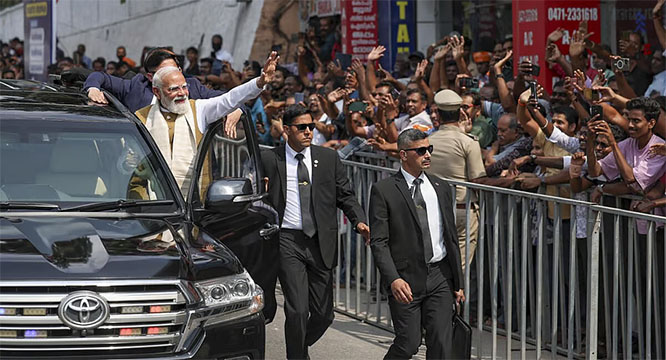
Prime Minister Narendra Modi, during his visit to Thiruvananthapuram on Friday, January 23, indicated that the Bharatiya Janata Party (BJP) is aiming to expand its political footprint in Kerala ahead of the Assembly elections scheduled in the coming months.

Speaking at a BJP-organised public meeting, Modi drew parallels between the party’s early electoral gains in Gujarat and its recent victory in the Thiruvananthapuram Municipal Corporation. The civic body win, which ended decades of Left control, was cited by the Prime Minister as a possible starting point for the party’s broader ambitions in the state.

Recalling BJP’s political trajectory in Gujarat, Modi said the party was largely insignificant before 1987 and received little media attention. He pointed out that the BJP’s first major breakthrough came with its victory in the Ahmedabad Municipal Corporation that year.

“Just as our journey in Gujarat began with one city, Kerala’s journey has also started with a single city,” Modi said, suggesting that the party’s municipal-level success could translate into wider electoral acceptance.

The Prime Minister alleged that successive governments led by the Left Democratic Front (LDF) and the United Democratic Front (UDF) had failed to adequately develop Thiruvananthapuram. He accused both fronts of corruption and neglect, claiming that basic infrastructure and facilities were denied to the capital city for decades.

According to Modi, the BJP’s control of the civic body represents a shift driven by public dissatisfaction with the existing political alternatives. He asserted that the BJP administration in Thiruvananthapuram had begun working towards development, though no specific details or timelines were outlined.

Addressing the gathering at Putharikandam Maidan, Modi said the BJP intended to project Thiruvananthapuram as a “model city,” reiterating his party’s commitment to governance-led change.

The Prime Minister’s visit to Kerala also included the inauguration of several development projects and the flagging off of new train services, as the BJP intensifies its political outreach in the poll-bound state.

Comments

Add new comment

  • Coastaldigest.com reserves the right to delete or block any comments.
  • Coastaldigset.com is not responsible for its readers’ comments.
  • Comments that are abusive, incendiary or irrelevant are strictly prohibited.
  • Please use a genuine email ID and provide your name to avoid reject.
News Network
January 23,2026

Mangaluru: The Karnataka Government Polytechnic (KPT), Mangaluru, has achieved autonomous status from the All India Council for Technical Education (AICTE), becoming the first government polytechnic in the country to receive such recognition in its 78-year history. The status was granted by AICTE, New Delhi, and subsequently approved by the Karnataka Board of Technical Education in October last year.

Officials said the autonomy was conferred a few months ago. Until recently, AICTE extended autonomous status only to engineering colleges, excluding diploma institutions. However, with a renewed national focus on skill development, several government polytechnics across India have now been granted autonomy.

KPT, the second-largest polytechnic in Karnataka, was established in 1946 with four branches and has since expanded to offer eight diploma programmes, including computer science and polymer technology. The institution is spread across a 19-acre campus.

Ravindra M Keni, the first dean of the institution, told The Times of India that AICTE had proposed autonomous status for polytechnic institutions that are over 25 years old. “Many colleges applied. In the first round, 100 institutions were shortlisted, which was further narrowed down to 15 in the second round. We have already completed one semester after becoming an autonomous institution,” he said. He added that nearly 500 students are admitted annually across eight three-year diploma courses.

Explaining the factors that helped KPT secure autonomy, Keni said the institution has consistently recorded 100 per cent admissions and placements for its graduates. He also noted its strong performance in sports, with the college emerging champions for 12 consecutive years, along with active student participation in NCC and NSS activities.

Autonomous status allows KPT to design industry-oriented curricula, conduct examinations, prepare question papers, and manage academic documentation independently. The institution can also directly collaborate with industries and receive priority funding from AICTE or the Ministry of Education. While academic autonomy has been granted, financial control will continue to rest with the state government.

“There will be separate committees for examinations, question paper setting, boards of studies, and boards of examiners. The institution will now have the freedom to conduct admissions without government notifications and issue its own marks cards,” Keni said, adding that new academic initiatives would be planned after a year of functioning under the autonomous framework.

Comments

Add new comment

  • Coastaldigest.com reserves the right to delete or block any comments.
  • Coastaldigset.com is not responsible for its readers’ comments.
  • Comments that are abusive, incendiary or irrelevant are strictly prohibited.
  • Please use a genuine email ID and provide your name to avoid reject.
News Network
February 1,2026

Bengaluru: Karnataka Deputy Chief Minister D K Shivakumar on Sunday criticised the Union Budget presented by Finance Minister Nirmala Sitharaman, claiming it offered no tangible benefit to the state.

Though he said he was yet to study the budget in detail, Shivakumar asserted that Karnataka had gained little from it. “There is no benefit for our state from the central budget. I was observing it. They have now named a programme after Mahatma Gandhi, after repealing the MGNREGA Act that was named after him,” he said.

Speaking to reporters here, the Deputy Chief Minister demanded the restoration of MGNREGA, and made it clear that the newly enacted rural employment scheme — VB-G RAM G — which proposes a 60:40 fund-sharing formula between the Centre and the states, would not be implemented in Karnataka.

“I don’t see any major share for our state in this budget,” he added.

Shivakumar, who also holds charge of Bengaluru development, said there were high expectations for the city from the Union Budget. “The Prime Minister calls Bengaluru a ‘global city’, but what has the Centre done for it?” he asked.

He also drew attention to the problems faced by sugar factories, particularly those in the cooperative sector, alleging a lack of timely decisions and support from the central government.

Noting that the Centre has the authority to fix the minimum support price (MSP) for agricultural produce, Shivakumar said the Union government must take concrete steps to protect farmers’ interests.

Comments

Add new comment

  • Coastaldigest.com reserves the right to delete or block any comments.
  • Coastaldigset.com is not responsible for its readers’ comments.
  • Comments that are abusive, incendiary or irrelevant are strictly prohibited.
  • Please use a genuine email ID and provide your name to avoid reject.