



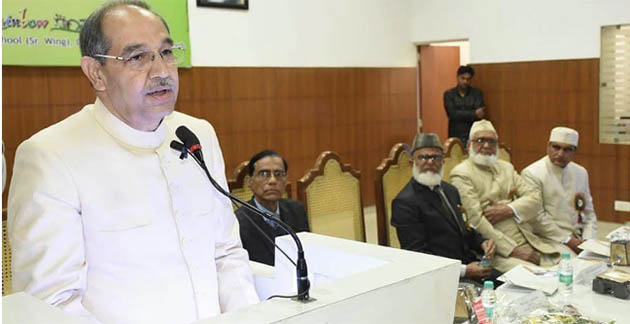
Aligarh Muslim University’s ex Vice-chancellor Tariq Mansoor is BJP’s new Vice President

News Network
July 29, 2023

mansoor.jpg

New Delhi, July 29: In an attempt to strengthen its ongoing outreach among Muslim Pasmanda communities, the BJP on Sunday appointed former Aligarh Muslim University vice-chancellor Tariq Mansoor as one of its vice presidents.

Mr Mansoor was instrumental in steering the AMU, one of the hotbeds of anti-NRC and CAA protests, on a "middle path", and later closely working with the RSS on its project to promote the teachings of Mughal prince Dara Shikoh on peaceful Hindu-Muslim coexistence that was in contradiction to his brother Mughal emperor Aurangzeb's way of working.

The appointment came on a day when Home Minister Amit Shah was in Rameshwaram in Tamil Nadu to launch a book on former president APJ Abdul Kalam, also one of the icons of the party's Pasmanda outreach.

BJP has been continuously reaching out to a section of the Muslim population through Minority Morcha meetings, mostly focused on Pasmanda Muslims, who are from Dalit and other backward class communities. Mr Mansoor was elected to the Uttar Pradesh Legislative Council, the fourth Muslim picked by the BJP for the post in the last few years.

Tariq Mansoor is from Aligarh in Uttar Pradesh, where Muslims constitute roughly 19% of the state's electorate, and have a sizeable presence in at least 30 Lok Sabha seats, out of which they play a major role in deciding the outcome in 15 to 20 constituencies. 

According to an RSS functionary, Mr Mansoor had impressed the sangh's leadership by his work on the Dara Shikoh project, by effectively using the AMU's Persian department to translate much of Shikoh's work on inter-faith dialogue and project him as an ideal for the Muslim community. He organised seminars and conferences on the same.

Mr Mansoor, a surgeon, has been associated with AMU since the 1970s when he completed his MBBS degree in surgery from the university's JN Medical College. He then went on to do his Master of Surgery (MS) degree in 1982 from the same college. Apart from the BJP's focus on the Pasmanda Muslims, which is important in terms of influence, the RSS has been specifically reaching out to Muslim academics, and people of the community from professions such as medicine, law, and bureaucracy, to make a difference in the minority discourse.

Jamal Siddiqui, head of the BJP's Minority Morcha said Mr Mansoor was a "nationalist Muslim" who has always promoted the ideal of "nation first." "His understanding of the fault lines in the Muslim community is as deep as his knowledge about the country and its history. He has led the students of AMU on the right path and prevented them from being misled. His appointment will help the party to expand better."

He was the fourth person from the Muslim community to be promoted to the Legislative Council by the party in UP since 2017, after Bukkal Nawab, Mohsin Raza, and Danish Azad Ansari.

Mr Mansoor was the AMU Vice Chancellor when it witnessed protests against the Citizenship Amendment Act (CAA) and the proposed National Register of Citizens (NRC) in 2020. He was then criticised for "not standing up for students" when policemen allegedly barged into the university, as opposed to the VC of Jamia Millia Islamia in Delhi, who stood by the students. Mr Mansoor has, however, always said he did his best, and talked about the importance of welfare and socio-economic justice over identity issues.

"Mansoor belongs to Aligarh, the hub of Muslim politics, and comes from an educated, middle class family. His family has doctors and lawyers. This is the kind of Muslims we want to work with to take the nation forward," a BJP functionary from UP said.

Khalid Anis Ansari, associate professor from Azim Premji University, who has been actively raising issues pertaining to the community for many years, has often pointed out that Indian Muslims too are victims of caste-based stratification, and are divided into three main classes, and hundreds of biradaris.

The 'Ashraf' Muslims, or native upper caste converts, for instance Syed, Sheikh, Mughal, Pathan, etc are at the top, and the Syed biradari is highly revered. The movements against the Ashraf dominance have been led by the 'lower' ones - Ajlaf (backward Muslims) and Arzal (Dalit Muslims), and these are known as Pasmandas, the community the BJP has been trying to woo. Only 15 percent of the community come from these upper caste communities, while the rest are largely Pasmanda Muslims. The BJP has planned a massive Sneh Yatra to reach out to these Pasmanda Muslims in the coming days.

Muslim intellectuals and opposition parties have, however, said this was an attempt by the BJP to create a divide among the Muslim community, and that often the Muslim victims of hate crimes or economic boycott were Pasmanda themselves.


Comments

Add new comment

  • Coastaldigest.com reserves the right to delete or block any comments.
  • Coastaldigset.com is not responsible for its readers’ comments.
  • Comments that are abusive, incendiary or irrelevant are strictly prohibited.
  • Please use a genuine email ID and provide your name to avoid reject.
News Network
December 7,2025

envoy.jpg

Since 1946, the United States has attempted 93 coups or “regime change” operations across the world — including two in Iran, US Special Envoy for Syria Tom Barrack has admitted.

Speaking to the UAE-based IMI Media Group, in remarks published by The National, Barrack said Washington tried twice to overthrow the Iranian government but failed both times. 

“For (Trump) then to be imputed with regime change — we had two regime changes in Iran already. Neither one worked. So I think wisely leave it to the region to solve,” said Barrack, who also serves as the US ambassador to Turkey.

His comments come six months after the US joined Israel in airstrikes against Iran during ongoing indirect nuclear negotiations between Tehran and Washington.

On June 13, Israel launched an attack on Iran that killed at least 1,064 people and hit civilian infrastructure. Days later, the United States targeted three nuclear facilities — Fordow, Natanz and Isfahan — in what Iran called a clear violation of international law. Iranian retaliation eventually forced a halt to the assault on June 24.

Barrack further claimed that US President Donald Trump and Foreign Secretary Marco Rubio are “not into regime change” and prefer a regional approach driven by Middle Eastern countries themselves. According to him, regional dialogue and non-interference by outside powers offer a more durable path forward.

He added that Washington is still open to an agreement with Tehran if Iranian authorities show “seriousness” and willingness to engage constructively.

However, Iran maintains the US has not shown readiness for meaningful talks. In an interview with Japan’s Kyodo News, Iranian Foreign Minister Abbas Araghchi said negotiations could advance only if Washington acknowledges Iran’s right to peaceful nuclear energy and lifts unilateral sanctions.

Comments

Add new comment

  • Coastaldigest.com reserves the right to delete or block any comments.
  • Coastaldigset.com is not responsible for its readers’ comments.
  • Comments that are abusive, incendiary or irrelevant are strictly prohibited.
  • Please use a genuine email ID and provide your name to avoid reject.
News Network
December 15,2025

Mangaluru, Dec 15: Air India Express has announced that it will resume direct flight services between Mangaluru and Muscat from March 2026, restoring an important international air link for passengers from the coastal region.

Airport authorities said the service will operate twice a week—on Sundays and Tuesdays—from March 1. The initial flights are scheduled on March 3, 8 and 10, followed by March 15 and 17, with the same operating pattern to continue thereafter. The flight duration is approximately three hours and 25 minutes.

The Mangaluru–Muscat route was earlier operated under the 2025 summer schedule, with services beginning on July 14. At that time, Air India Express had operated four flights a week before suspending the service.

Officials said the summer schedule will come into effect from March 29, after which changes in flight timings and departure schedules from Mangaluru are expected. Passengers have been advised to check the latest schedules while planning their travel.

The resumption of direct flights to Muscat is expected to significantly benefit expatriates, business travellers and others, further strengthening Mangaluru’s air connectivity with the Gulf region.

Comments

Add new comment

  • Coastaldigest.com reserves the right to delete or block any comments.
  • Coastaldigset.com is not responsible for its readers’ comments.
  • Comments that are abusive, incendiary or irrelevant are strictly prohibited.
  • Please use a genuine email ID and provide your name to avoid reject.
News Network
December 13,2025

New Delhi: School-going children are picking up drug and smoking habits and engaging in consumption of alcohol, with the average age of introduction to such harmful substances found to be around 13 years, suggesting a need for earlier interventions as early as primary school, a multi-city survey by AIIMS-Delhi said.

The findings also showed substance use increased in higher grades, with grade XI/XII students two times more likely to report use of substances when compared with grade VIII students. This emphasised the importance of continued prevention and intervention through middle and high school.

The study led by Dr Anju Dhawan of AIIMS's National Drug Dependence Treatment Centre, published in the National Medical Journal of India this month, looks at adolescent substance use across diverse regions.

The survey included 5,920 students from classes 8, 9, 11 and 12 in urban government, private and rural schools across 10 cities -- Bengaluru, Chandigarh, Delhi, Dibrugarh, Hyderabad, Imphal, Jammu, Lucknow, Mumbai, and Ranchi. The data were collected between May 2018 and June 2019.

The average age of initiation for any substance was 12.9 (2.8) years. It was lowest for inhalants (11.3 years) followed by heroin (12.3 years) and opioid pharmaceuticals (without prescription; 12.5 years).

Overall, 15.1 per cent of participants reported lifetime use, 10.3 per cent reported past year use, and 7.2 per cent reported use in the past month of any substance, the study found.

The most common substances used in the past year, after tobacco (4 per cent) and alcohol (3.8 per cent), were opioids (2.8 per cent), followed by cannabis (2 per cent) and inhalants (1.9 per cent). Use of non-prescribed pharmaceutical opioids was most common among opioid users (90.2 per cent).

On being asked, 'Do you think this substance is easily available for a person of your age' separately for each substance category, nearly half the students (46.3 per cent) endorsed that tobacco products and more than one-third of the students (36.5 per cent) agreed that a person of their age can easily procure alcohol products.

Similarly, for Bhang (21.9 per cent), ganja/charas (16.1 per cent), inhalants (15.2 per cent), sedatives (13.7 per cent), opium and heroin (10 per cent each), the students endorsed that these can be easily procured.

About 95 per cent of the children, irrespective of their grade, agreed with the statement that 'drug use is harmful'.

The rates of substance use (any) among boys were significantly higher than those of girls for substance use (ever), use in the past year and use in the past 30 days. Compared to grade VIII students, grade IX students were more likely, and grade XI/XII students were twice as likely to have used any substance (ever).

The likelihood of past-year use of any substance was also higher for grade IX students and for grade XI/XII students as compared to grade VIII students.

About 40 per cent of students mentioned that they had a family member who used tobacco or alcohol each. The use of cannabis (any product) and opioid (any product) by a family member was reported by 8.2 per cent and 3.9 per cent of students, respectively, while the use of other substances, such as inhalants/sedatives by family was 2-3 per cent, the study found.

A relatively smaller percentage of students reported use of tobacco or alcohol among peers as compared to among family members, while a higher percentage reported inhalants, sedatives, cannabis or opioid use among peers.

Children using substances (past year) compared to non-users reported significantly higher any substance use by their family members and peers.

There were 25.7 per cent students who replied 'yes' to the question 'conflicts/fights often occur in your family'. Most students also replied affirmatively to 'family members are aware of how their time is being spent' and 'damily members are aware of with whom they spend their time'.

Comments

Add new comment

  • Coastaldigest.com reserves the right to delete or block any comments.
  • Coastaldigset.com is not responsible for its readers’ comments.
  • Comments that are abusive, incendiary or irrelevant are strictly prohibited.
  • Please use a genuine email ID and provide your name to avoid reject.