



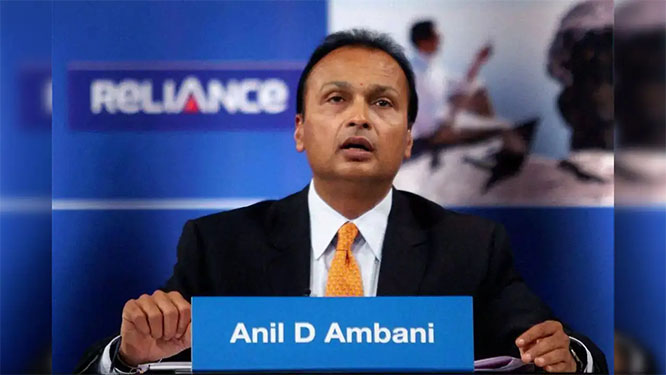
Anil Ambani empire under siege: ED raids 35 premises linked to Reliance Group in ₹3,000-cr scam

Agencies
July 24, 2025

anilambani.jpg

In one of the biggest financial crackdowns in recent years, the Enforcement Directorate (ED) on Thursday swooped down on 35 locations in Delhi and Mumbai connected to Anil Ambani’s Reliance Group — also known as the Reliance Anil Dhirubhai Ambani Group (RAAGA). The raids, part of a ₹3,000-crore money-laundering investigation, target more than 50 companies and 25 individuals allegedly involved in a complex financial fraud.

The ED’s probe stems from two CBI FIRs alleging large-scale irregularities in loans disbursed by Yes Bank between 2017 and 2019. Investigators claim RAAGA companies secured unsecured loans worth nearly ₹3,000 crore, allegedly facilitated through bribery of senior bank officials, including Yes Bank’s former promoters.

Preliminary findings suggest a meticulously planned scheme to siphon public funds by cheating banks, shareholders, and investors. Key red flags identified include shell companies with common directors, loans issued without proper verification, funds routed through multiple entities, and “loan evergreening” — fresh loans allegedly issued to repay old ones.

Regulatory bodies including SEBI, NHB, NFRA, and Bank of Baroda have flagged anomalies in group companies, particularly Reliance Home Finance Limited, whose loan book nearly doubled in a single year. The State Bank of India has already classified Reliance Communications and Anil Ambani himself as “fraud” accounts, a move first initiated in 2020.

Thursday’s raids involve combing through records across 50 entities tied to Ambani’s empire. Sources indicate that senior Yes Bank executives and other key individuals are under scrutiny for allegedly receiving personal benefits in exchange for loan approvals.

The ED’s massive operation marks a dramatic escalation in the ongoing probe into corporate governance and financial fraud at some of India’s largest business houses.

Comments

Add new comment

  • Coastaldigest.com reserves the right to delete or block any comments.
  • Coastaldigset.com is not responsible for its readers’ comments.
  • Comments that are abusive, incendiary or irrelevant are strictly prohibited.
  • Please use a genuine email ID and provide your name to avoid reject.
News Network
January 23,2026

Mangaluru: The Karnataka Government Polytechnic (KPT), Mangaluru, has achieved autonomous status from the All India Council for Technical Education (AICTE), becoming the first government polytechnic in the country to receive such recognition in its 78-year history. The status was granted by AICTE, New Delhi, and subsequently approved by the Karnataka Board of Technical Education in October last year.

Officials said the autonomy was conferred a few months ago. Until recently, AICTE extended autonomous status only to engineering colleges, excluding diploma institutions. However, with a renewed national focus on skill development, several government polytechnics across India have now been granted autonomy.

KPT, the second-largest polytechnic in Karnataka, was established in 1946 with four branches and has since expanded to offer eight diploma programmes, including computer science and polymer technology. The institution is spread across a 19-acre campus.

Ravindra M Keni, the first dean of the institution, told The Times of India that AICTE had proposed autonomous status for polytechnic institutions that are over 25 years old. “Many colleges applied. In the first round, 100 institutions were shortlisted, which was further narrowed down to 15 in the second round. We have already completed one semester after becoming an autonomous institution,” he said. He added that nearly 500 students are admitted annually across eight three-year diploma courses.

Explaining the factors that helped KPT secure autonomy, Keni said the institution has consistently recorded 100 per cent admissions and placements for its graduates. He also noted its strong performance in sports, with the college emerging champions for 12 consecutive years, along with active student participation in NCC and NSS activities.

Autonomous status allows KPT to design industry-oriented curricula, conduct examinations, prepare question papers, and manage academic documentation independently. The institution can also directly collaborate with industries and receive priority funding from AICTE or the Ministry of Education. While academic autonomy has been granted, financial control will continue to rest with the state government.

“There will be separate committees for examinations, question paper setting, boards of studies, and boards of examiners. The institution will now have the freedom to conduct admissions without government notifications and issue its own marks cards,” Keni said, adding that new academic initiatives would be planned after a year of functioning under the autonomous framework.

Comments

Add new comment

  • Coastaldigest.com reserves the right to delete or block any comments.
  • Coastaldigset.com is not responsible for its readers’ comments.
  • Comments that are abusive, incendiary or irrelevant are strictly prohibited.
  • Please use a genuine email ID and provide your name to avoid reject.