



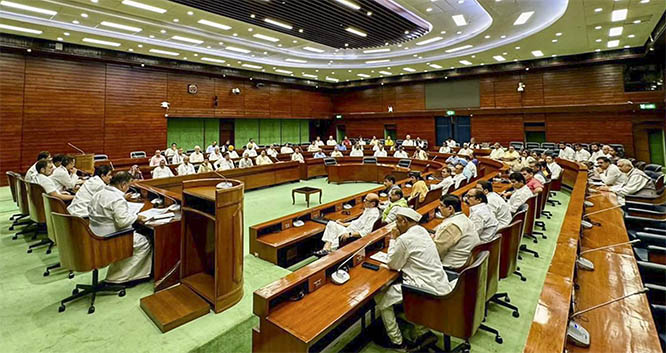
Congress set to oppose introduction of Waqf amendment bill in Lok Sabha

News Network
August 8, 2024

wakf.jpg

New Delhi: The Congress is set to oppose the introduction of the bill to amend the law governing Waqf boards in the Lok Sabha, sources said on Thursday.

Congress MPs K C Venugopal and Hibi Eden have also given notices to oppose the introduction of the Bill in the Lok Sabha.

Eden has said in his notice that he opposes the presentation of the bill as it is "unconstitutional" and cited that it is in conflict with the Right to Property (Article 300A), the sources said.

The Bill can potentially infringe on the property rights of individuals and religious institutions without adequate legal safeguards, he argued.

Eden also contended that the bill is an infringement on the Fundamental Right of Religious Freedom under Article 25, the sources said.

The Bill's imposition of new conditions for creating waqfs and the requirement for existing waqfs to register detailed information on a government portal might be perceived as undue interference in the administration of religious endowments, he said in his notice.

Eden also argued that it is an encroachment on states' powers.

The Bill, which seeks to amend the law governing waqf boards, has proposed far-reaching changes in the present Act, including ensuring the representation of Muslim women and non-Muslims in such bodies.

The Waqf (Amendment) Bill also seeks to rename the Waqf Act, 1995, as the Unified Waqf Management, Empowerment, Efficiency and Development Act, 1995.

The Bill was circulated among Lok Sabha members on Tuesday night ahead of its introduction.

According to its statement of objects and reasons, the Bill seeks to omit Section 40 of the current law relating to the powers of the Board to decide if a property is waqf property.

It provides for a broad-based composition of the Central Waqf Council and the State Waqf Boards and ensures the representation of Muslim women and non-Muslims in such bodies.

The Bill also proposes the establishment of a separate board of Auqaf for the Bohras and Aghakhanis. The draft law provides for the representation of Shias, Sunnis, Bohras, Agakhanis and other backward classes among Muslim communities. 

Comments

Add new comment

  • Coastaldigest.com reserves the right to delete or block any comments.
  • Coastaldigset.com is not responsible for its readers’ comments.
  • Comments that are abusive, incendiary or irrelevant are strictly prohibited.
  • Please use a genuine email ID and provide your name to avoid reject.
News Network
November 26,2025

students.jpg

Bengaluru, Nov 26: Karnataka is taking its first concrete steps towards lifting a three-decade-old ban on student elections in colleges and universities. Deputy Chief Minister D.K. Shivakumar announced Wednesday that the state government will form a small committee to study the reintroduction of campus polls, a practice halted in 1989 following incidents of violence.

Speaking at a 'Constitution Day' event organised by the Karnataka Congress, Mr. Shivakumar underscored the move's aim: nurturing new political leadership from the grassroots.

"Recently, (Leader of the Opposition in Lok Sabha) Rahul Gandhi wrote a letter to me and Chief Minister (Siddaramaiah) asking us to think about restarting student elections," Shivakumar stated. "I'm announcing today that we'll form a small committee and seek a report on this."

Student elections were banned in Karnataka in 1989, largely due to concerns over violence and the infiltration of political party affiliates into campus life. The ban effectively extinguished vibrant student bodies and the pipeline of young leaders they often produced.

Mr. Shivakumar, who also serves as the Karnataka Congress president, said that former student leaders will be consulted to "study the pros and cons" of the re-introduction.

Acknowledging the history of the ban, he added, "There were many criminal activities taking place back then. We’ll see how we can conduct (student) elections by regulating such criminal activities."

The Deputy CM reminisced about his own journey, which began on campus. He recalled his political activism at Sri Jagadguru Renukacharya College leading to his first Assembly ticket in 1985 at the age of 23. "That's how student leadership was at the time. Such leadership has gone today. College elections have stopped," he lamented, adding that for many, college elections were "like a big movement" where leaders were forged.

The move, driven by the Congress high command's push to cultivate young talent, will face scrutiny from academics and university authorities who have, in the past, expressed concern that the return of polls could disrupt the peaceful academic environment and turn campuses into political battlegrounds.

Comments

Add new comment

  • Coastaldigest.com reserves the right to delete or block any comments.
  • Coastaldigset.com is not responsible for its readers’ comments.
  • Comments that are abusive, incendiary or irrelevant are strictly prohibited.
  • Please use a genuine email ID and provide your name to avoid reject.