



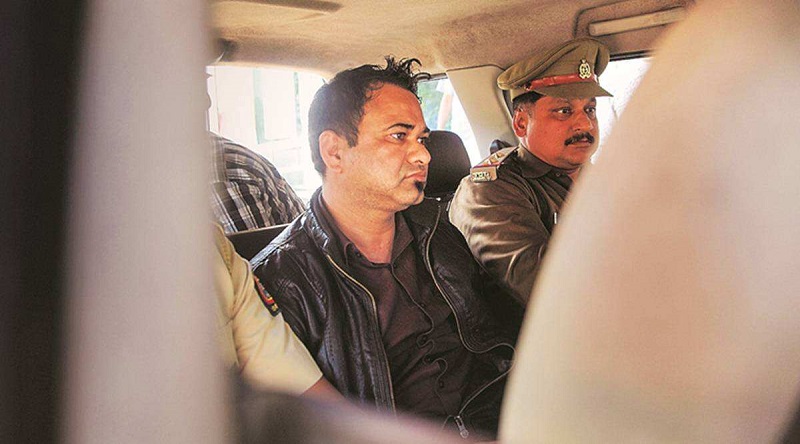
Dr Kafeel Khan’s speech doesn’t promote hatred; it gives a call for national integrity: High Court

coastaldigest.com news network
September 1, 2020

khafeel.jpg

Allahabad, Sept 1: The High Court of Allahabad today observed that Dr Kafeel Khan’s speech at the Aligarh Muslim University on December 13, 2019, amidst the anti-CAA protests, that led to his arrest and subsequent detention under the stringent provisions of the National Security Act, "does not disclose any effort to promote hatred or violence."

The Division Bench comprising Chief Justice Govind Mathur and Justice Saumitra Dayal Singh held that prima facie, the speech is not such that a reasonable man could have arrive at a conclusion as the inference drawn by the District Magistrate, Aligarh, who passed the detention order against Dr. Khan in February this year.

"The speaker was certainly opposing the policies of the government and while doing so certain illustration are given by him, but that no where reflects the eventualities demanding detention. A complete reading of the speech prima facie does not disclose any effort to promote hatred or violence. It also nowhere threatens peace and tranquillity of the city of Aligarh. The address gives a call for national integrity and unity among the citizens. The speech also deprecates any kind of violence. It appears that the District Magistrate had selective reading and selective mention for few phrases from the speech ignoring its true intent," the Bench observed.

Accordingly, it has revoked the NSA charges against Dr. Khan; the order of detention dated 13th February, 2020 passed by District Magistrate, Aligarh under the NSA Act and confirmed by the State of Uttar Pradesh has been set aside. The extension of the period of detention of detenue Dr. Kafeel Khan is also declared illegal.

Dr. Khan was arrested from Mumbai in January this year, after he gave a speech at the Aligarh Muslim University on December 13, 2019, amidst the anti-CAA protests.

Notably, Khan had been granted bail by the court of CJM, Aligarh on February 10. However, he has been languishing in jail under the NSA Act, which was slapped on him by the Aligarh District Magistrate on February 15.

In this backdrop, the Court observed that when the speech was delivered in December 2019, the District Administration, Aligarh did not find the speech of Dr. Kafeel Khan sufficient for preventive detention.

However, only when the CJM allowed his bail application on February 10, the District Magistrate, Aligarh initiated the process for detaining Dr. Kafeel Khan under the National Security Act, 1980.

The Bench clarified that the delay in passing of detention orders or in recording subjective satisfaction to preventively detain a person may not be a subject matter of a hard and fast rule. Nevertheless, it observed, the record must itself indicate that there existed a "continuing casual link" between the satisfaction claimed to have been recorded and the offending act.

In the present case, the Court noted, "Nothing has been said in the order of detention or the grounds for detention that district administration had any information within the period from 12th December, 2019 to 13th February, 2020 about any effort made by the detenue to cause even a simple scar to the peace or tranquility or the public order of the city of Aligarh. It is only after passing of the bail order by the Chief Judicial Magistrate, Aligarh, the police officials and the District Magistrate, Aligarh initiated the process for detaining Dr. Kafeel Khan under the National Security Act, 1980. At the cost of repetition, it would be appropriate to state that from 12th December, 2019 to 29th January, 2020 the detenue was roaming free and he had ample time to make all the efforts to damage public order in the city of Aligarh, if he was intending to do so."

It added that no recommendation, even at the time of Dr. Khan's bail hearing was made for invoking powers under sub-Section (2) of Section 3 of the National Security Act, 1980.

Hence, the Court held that the "causal link" between the Act and the detention order is missing/ completely broken.

Another reason given by the Court while dropping the NSA charges against Dr. Khan was that the State authorities have failed to discharge their "bounden burden" to establish that the lecture delivered by Dr. Khan in December 2019 had such a deleterious effect on the public order in district-Aligarh as had continued to exist up to 13.02.2020, necessitating preventive detention of the detenue, on that later date.

The Court observed, "Preventive detention is an exceptional mode to curtail liberty and freedom of a person in exceptionally rare circumstances. Under Article 21 of the Constitution of India along with the right to life, the right to personal liberty is a precious fundamental right. This precious fundamental right must always be protected."

Lastly the Court observed that Dr. Khan was not supplied the grounds for his detention and thus he was deprived of the material necessary to submit a representation in accordance with clause (5) of Article 22 of the Constitution of India.

Considerably, the grounds for detention along with material were supplied to Dr. Khan in the form of a compact disk. However, neither a transcript nor any device to play the compact device were made available to him. In such circumstances the Court held,

"The non-supply of transcript would have been of no consequence, if a device would have been supplied to the detenue to play the compact disk. It is the position admitted that no such device was made available to the detenue. In absence of such device the supply of compact disk is absolutely non consequential. It virtually amounts non-supply of the material necessary to submit a representation in accordance with clause (5) of Article 22 of the Constitution of India. Such non-supply of material violates a precious fundamental right of a detenue enshrined under Article 22 of the Constitution. On this count also the detention of Dr. Kafeel Khan deserves to be set aside."

It added, "The detention of Dr. Kafeel Khan has also been extended twice. It is stated by learned Additional Advocate General that the detenue even while in prison is in contact with the students of Aligarh Muslim University and is instigating to disturb public order of the city. The facts stated is not acceptable being not supported by any material. At the threshold, it would be appropriate to state that the detenue is in State custody where he can't have any electronic device or other mechanical device to have contact anyone. The other eventuality is sending messages through the visitors, but no record of that too is available."

Comments

Add new comment

  • Coastaldigest.com reserves the right to delete or block any comments.
  • Coastaldigset.com is not responsible for its readers’ comments.
  • Comments that are abusive, incendiary or irrelevant are strictly prohibited.
  • Please use a genuine email ID and provide your name to avoid reject.
News Network
November 30,2025

The United Nations Committee against Torture (CAT) has condemned the Israeli regime for enforcing a policy of “organized torture” against Palestinians.

In a report published on Friday, CAT stated that the occupying regime enforces a deliberate policy of “organized and widespread torture and ill-treatment” against Palestinian abductees, particularly since October 7, 2023, when Israel launched its genocidal war on Gaza.

The committee expressed “deep concern over repeated severe beatings, dog attacks, electrocution, water-boarding, use of prolonged stress positions [and] sexual violence” inflicted on Palestinians.

Palestinian prisoners were degraded by “being made to act like animals or being urinated on,” systematically denied medical care, and subjected to excessive restraints, “in some cases resulting in amputation,” the report added.

CAT also condemned the routine application of “unlawful combatants law” to justify the prolonged detention without trial of thousands of Palestinian men, women, and children.

More than 10,000 Palestinians, including women and children, are currently held in Israeli prisons, according to Palestinian and international human rights groups, with 3,474 Palestinians in “administrative detention,” meaning they are imprisoned without trial for indefinite periods.

The report highlighted the “high proportion of children who are currently detained without charge or on remand,” noting that while Israel sets the age of criminal responsibility at 12, even younger children have been abducted.

Children designated as security prisoners face severe restrictions on family contact, may be subjected to solitary confinement, and are denied access to education, in clear violation of international law.

The committee further suggested that Israel’s policies across the Occupied Territories constitute collective torture against the Palestinian population.

“A range of policies adopted by Israel in the course of its continued unlawful presence in the Occupied Palestinian Territory amounts to cruel, inhuman or degrading living conditions for the Palestinian population,” the report said.

On Thursday, the Palestinian resistance movement Hamas condemned the systematic killing and torture of Palestinian abductees in Israeli prisons, urging international action to halt these abuses.

Citing human rights data, Hamas stated that 94 Palestinians have been killed in Israeli prisons since the start of Tel Aviv’s genocidal war on Gaza.

“This reflects an organized criminal approach that has turned these prisons into direct killing grounds to eliminate our people,” the resistance movement said.

Hamas called on the international community, the UN, and human rights organizations to immediately pressure Israel to end crimes against prisoners and uphold their rights as guaranteed by all international conventions and norms.

Comments

Add new comment

  • Coastaldigest.com reserves the right to delete or block any comments.
  • Coastaldigset.com is not responsible for its readers’ comments.
  • Comments that are abusive, incendiary or irrelevant are strictly prohibited.
  • Please use a genuine email ID and provide your name to avoid reject.
News Network
December 4,2025

indigoflight.jpg

Domestic carrier IndiGo has cancelled over 180 flights from three major airports — Mumbai, Delhi and Bengaluru — on Thursday, December 4, as the airline struggles to secure the required crew to operate its flights in the wake of new flight-duty and rest-period norms for pilots.

While the number of cancellations at Mumbai airport stands at 86 (41 arrivals and 45 departures) for the day, at Bengaluru, 73 flights have been cancelled, including 41 arrivals, according to a PTI report that quoted sources.

"IndiGo cancelled over 180 flights on Thursday at three airports-Mumbai, Delhi and Bengaluru," the source told the news agency.

Besides, it had cancelled as many as 33 flights at Delhi airport for Thursday, the source said, adding, "The number of cancellations is expected to be higher by the end of the day."

The Gurugram-based airline's On-Time Performance (OTP) nosedived to 19.7 per cent at six key airports — Delhi, Mumbai, Chennai, Kolkata, Bengaluru and Hyderabad — on December 3, as it struggled to get the required crew to operate its services, down from almost half of December 2, when it was 35 per cent.

"IndiGo has been facing acute crew shortage since the implementation of the second phase of the FDTL (Flight Duty Time Limitations) norms, leading to cancellations and huge delays in its operations across the airports," a source had told PTI on Wednesday.

Chaos continued at several major airports for the third day on Thursday because of the cancellations.

A spokesperson for the Kempegowda International Airport (KIA) in Bengaluru said that 73 IndiGo flights had been cancelled on Thursday.

At least 150 flights were cancelled and dozens of others delayed on Wednesday, airport sources said, leaving thousands of travellers stranded, according to news agency Reuters.

The Directorate General of Civil Aviation (DGCA) has said it is investigating IndiGo flight disruptions and has asked the airline to submit the reasons for the current situation, as well as its plans to reduce flight cancellations and delays.

It may be mentioned here that the pilots' body, Federation of Indian Pilots (FIP), has alleged that IndiGo, despite getting a two-year preparatory window before the full implementation of new flight duty and rest period norms for cockpit crew, "inexplicably" adopted a "hiring freeze".

The FIP said it has urged the safety regulator, the DGCA, not to approve airlines' seasonal flight schedules unless they have adequate staff to operate their services "safely and reliably" in accordance with the New Flight Duty Time Limitations (FDTL) norms.

In a letter to the DGCA late on Wednesday, the FIP urged the DGCA to consider re-evaluating and reallocating slots to other airlines, which have the capacity to operate them without disruption during the peak holiday and fog season if IndiGo continues to "fail in delivering on its commitments to passengers due to its own avoidable staffing shortages."

Comments

Add new comment

  • Coastaldigest.com reserves the right to delete or block any comments.
  • Coastaldigset.com is not responsible for its readers’ comments.
  • Comments that are abusive, incendiary or irrelevant are strictly prohibited.
  • Please use a genuine email ID and provide your name to avoid reject.
News Network
November 26,2025

students.jpg

Bengaluru, Nov 26: Karnataka is taking its first concrete steps towards lifting a three-decade-old ban on student elections in colleges and universities. Deputy Chief Minister D.K. Shivakumar announced Wednesday that the state government will form a small committee to study the reintroduction of campus polls, a practice halted in 1989 following incidents of violence.

Speaking at a 'Constitution Day' event organised by the Karnataka Congress, Mr. Shivakumar underscored the move's aim: nurturing new political leadership from the grassroots.

"Recently, (Leader of the Opposition in Lok Sabha) Rahul Gandhi wrote a letter to me and Chief Minister (Siddaramaiah) asking us to think about restarting student elections," Shivakumar stated. "I'm announcing today that we'll form a small committee and seek a report on this."

Student elections were banned in Karnataka in 1989, largely due to concerns over violence and the infiltration of political party affiliates into campus life. The ban effectively extinguished vibrant student bodies and the pipeline of young leaders they often produced.

Mr. Shivakumar, who also serves as the Karnataka Congress president, said that former student leaders will be consulted to "study the pros and cons" of the re-introduction.

Acknowledging the history of the ban, he added, "There were many criminal activities taking place back then. We’ll see how we can conduct (student) elections by regulating such criminal activities."

The Deputy CM reminisced about his own journey, which began on campus. He recalled his political activism at Sri Jagadguru Renukacharya College leading to his first Assembly ticket in 1985 at the age of 23. "That's how student leadership was at the time. Such leadership has gone today. College elections have stopped," he lamented, adding that for many, college elections were "like a big movement" where leaders were forged.

The move, driven by the Congress high command's push to cultivate young talent, will face scrutiny from academics and university authorities who have, in the past, expressed concern that the return of polls could disrupt the peaceful academic environment and turn campuses into political battlegrounds.

Comments

Add new comment

  • Coastaldigest.com reserves the right to delete or block any comments.
  • Coastaldigset.com is not responsible for its readers’ comments.
  • Comments that are abusive, incendiary or irrelevant are strictly prohibited.
  • Please use a genuine email ID and provide your name to avoid reject.