Election year budget signals PM Modi’s sky-high confidence as BJP-led alliance aims to win over 400 seats

News Network
February 5, 2024

modi.jpg

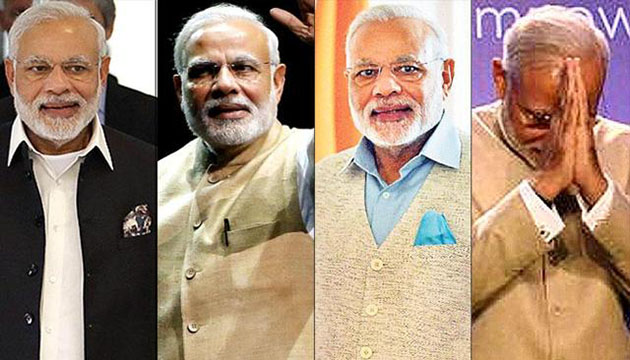
New Delhi: India's finance minister presented an austere budget last week despite upcoming general elections, a strong display of the administration's confidence that Prime Minister Narendra Modi would return to power for a third straight term.

Instead of the usual voter-friendly measures announced in election years, Nirmala Sitharaman's interim budget focused on fiscal discipline and cut subsidies on food, fertiliser and fuel.

In the interim budget before the last general election in 2019, Modi's government announced direct cash support of 750 billion rupees (then about $10.5 billion) for poor farmers, extended income tax exemptions to more people and offered various other sops which led to a wider-than-estimated fiscal deficit.

But Sitharaman left little doubt who she thought would be back after the elections, to be held by May, to present the full budget.

"In the full budget in July, our government will present a detailed roadmap for our pursuit" of a developed India by 2047, she said.

The ruling Bharatiya Janata Party (BJP) is high in confidence ahead of the election, with Modi delivering on key parts of a nationalist agenda aimed at pleasing the country's majority Hindus as well as the country's stellar economic growth.

"The BJP will do very well because people have confidence in the prime minister and there are so many other factors like the economy," said Tariq Mansoor, a party vice president.

India's economy is now the fifth-largest in the world, from the tenth-largest when Modi first took office a decade ago, and the fastest expanding among major nations.

Growth, however, has been centred in urban areas and not in the vast hinterlands where more than 60 per cent of India's 1.42 billion people live. Some critics have noted that similarly lopsided growth led to a shock loss for the party in the 2004 general election.

But most analysts say there is little chance of a surprise in this election and it is all but certain that Modi, 73, would romp to a rare third term in office.

The reasons, they say, include Modi's high approval ratings, effective implementation of welfare measures like free rations for 800 million poor and the inauguration of a grand temple on the site of a razed mosque that has energised the BJP's Hindu base. The opposition, they added, is in disarray.

"There will be no repeat of the 2004 debacle unless there is some Black Swan event in the next three months or so, which is very unlikely," said Yashwant Deshmukh, founder of polling agency CVoter Foundation.

"It's not only because of the economy but more importantly that he has delivered on emotive issues for the cadre, the rank and file of the BJP, and at large the Hindutva (Hindu right) vote base."

CVoter is in the midst of a new survey but Deshmukh said "numbers are suggesting that they are going to get a majority on their own very easily at this point of time".

Over 400 seats

The BJP-led National Democratic Alliance coalition won more than 350 of the 543 directly elected seats in the decision-making lower house of parliament in the 2019 election.

"We are looking at beyond 400 for the alliance this time," the BJP's Mansoor said. That number would give the coalition more than a two-thirds majority in the legislature, which will allow it to bring in changes in the constitution.

Harsh Mander, a human rights worker and political columnist, said the budget was an indication of the government's thinking.

"Normally a pre-election budget would have a certain kind of last-minute set of promises," said Mander, who has been critical of many government policies.

"The fact that they don't feel the need to do that, asserts a high level of confidence that their policies, not economic policies but their social policies of basically Hindu supremacy, will trump whatever discontent is there."

Modi's current government has already delivered on two of the BJP's long-running promises: building a temple on the site of a razed mosque in the northern city of Ayodhya where many Hindus believe the god-king Ram was born, and removing the autonomy of the Muslim-majority region of Jammu and Kashmir.

The consecration of the Ram Temple last month, overseen by Modi, sparked unprecedented nationwide celebrations.

The main opposition Congress party said the government had failed in its promises to double farmers' incomes by 2022 and create millions of jobs every year. But the party's I.N.D.I.A. coalition has been badly hurt by the defection of a major regional leader to the BJP alliance last month and it has yet to formulate an effective counter to Modi's muscular pro-Hindu agenda.

Elara Capital analysts said the budget deliberately steered clear of any major announcements "in a studied step to showcase confidence as regards a re-election encore".

Modi himself has also not disguised his confidence.

"In my third term ...," he said in a speech to business leaders on Friday before being interrupted by claps and chants of "Modi, Modi".

"A word to the wise is enough," he said with a smile when he resumed. "In my third term, our country is bound to become the third-largest economy in the world."

Comments

Add new comment

  • Coastaldigest.com reserves the right to delete or block any comments.
  • Coastaldigset.com is not responsible for its readers’ comments.
  • Comments that are abusive, incendiary or irrelevant are strictly prohibited.
  • Please use a genuine email ID and provide your name to avoid reject.
Agencies
November 22,2025

indiapak.jpg

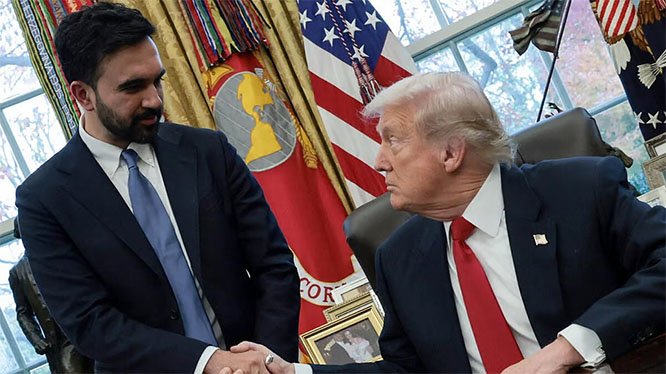
New York/Washington: US President Donald Trump has again claimed to have solved the conflict between India and Pakistan, repeating his assertion during a meeting with New York City Mayor-elect Zohran Mamdani in the Oval Office.

Mamdani flew to Washington DC for his first meeting with Trump in the White House on Friday. Trump said he “enjoyed” the meeting, which he described as “great.”

During remarks in the Oval Office, with Mamdani standing next to him, Trump repeated his claim that he solved the May conflict between India and Pakistan.

"I did eight peace deals of countries, including India and Pakistan,” he said.

On Wednesday, Trump had said he threatened to put 350 per cent tariffs on India and Pakistan if they did not end their conflict, repeating his claim that he solved the fighting between the nuclear-armed neighbours and that Prime Minister Narendra Modi had called him to say “we're not going to go to war.”

Since May 10, when Trump announced on social media that India and Pakistan had agreed to a “full and immediate” ceasefire after a “long night” of talks mediated by Washington, he has repeated his claim over 60 times that he “helped settle” the tensions between India and Pakistan.

India has consistently denied any third-party intervention. India launched Operation Sindoor on May 7, targeting terror infrastructure in Pakistan and Pakistan-occupied Kashmir in retaliation for the April 22 Pahalgam attack that killed 26 civilians. India and Pakistan reached an understanding on May 10 to end the conflict after four days of intense cross-border drone and missile strikes.

Mamdani emerged victorious in the closely-watched battle for New York City Mayor, becoming the first South Asian and Muslim to be elected to sit at the helm of the largest city in the US.

He had been the front-runner in the NYC Mayoral election for months and defeated Republican nominee Curtis Sliwa and political heavyweight former New York State Governor Andrew Cuomo, who ran as an independent candidate and was officially endorsed by Trump just hours before the elections.

Indian-descent Mamdani is the son of renowned filmmaker Mira Nair and Columbia University professor Mahmood Mamdani. He was born and raised in Kampala, Uganda and moved to New York City with his family when he was 7. Mamdani became a naturalised US citizen only recently, in 2018.

Comments

Add new comment

  • Coastaldigest.com reserves the right to delete or block any comments.
  • Coastaldigset.com is not responsible for its readers’ comments.
  • Comments that are abusive, incendiary or irrelevant are strictly prohibited.
  • Please use a genuine email ID and provide your name to avoid reject.
News Network
November 22,2025

gaza.jpg

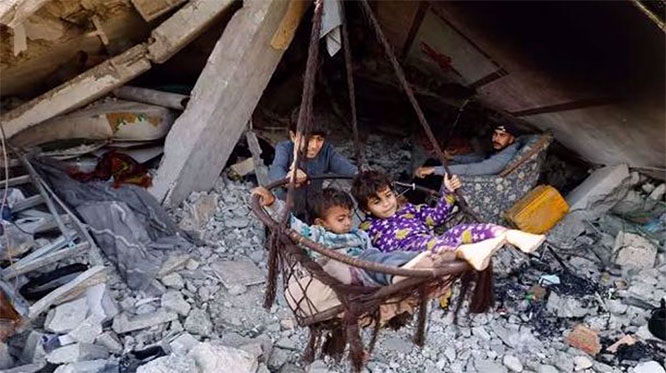
The Israeli regime’s forces have killed two Palestinian children in the Gaza Strip every day since the ceasefire began in early October, UNICEF has warned.

The UN children’s agency said on Friday that Israeli forces continue to attack Palestinians in Gaza even though the agreement was meant to stop the killing.

“Since 11 October, while the ceasefire has been in effect, at least 67 children have been killed in conflict-related incidents in the Gaza Strip. Dozens more have been injured. That is an average of almost two children killed every day since the ceasefire took effect,” UNICEF spokesperson Ricardo Pires said in Geneva, reminding that each number in the statistics represents a child whose life had ended violently.

“These are not statistics,” he said. “Each child had a story, a family, and a future that was stolen from them.”

Data from Palestinian factions, human rights groups, and government bodies recorded since the US-brokered ceasefire deal went into effect on October 10 show that Israeli forces have carried out numerous attacks, each constituting a separate ceasefire violation.

UNICEF teams say they repeatedly continue to witness heart-wrenching scenes of fearful Palestinian children sleeping outdoors with amputated limbs, while others live as orphans in flooded, makeshift shelters.

“I saw this myself in August. There is no safe place for them. The world cannot normalize their suffering,” Pires said, lamenting that the UN could “do a lot more if the aid that is really needed was entering faster.”

The UNICEF spokesperson warned that with the advent of winter, the risks for hundreds of thousands of displaced children will increase.

He warned, “The stakes are incredibly high” for children as winter acts as a threat multiplier, where children have no heating, no insulation, and few blankets. He said respiratory infections rise.

“Too many children have already paid the highest price,” Pires said. “Too many are still paying it, even under a ceasefire. The world promised them it would stop and that we would protect them.”

“Now we must act like it,” the UNICEF spokesperson added.

Since the Israeli regime launched its genocidal war against Palestinians in Gaza in October 2023, it has killed nearly 70,000 people in the territory, most of them women and children, and injured over 170,000 more, while reducing most of the structures in the enclave to rubble.

Comments

Add new comment

  • Coastaldigest.com reserves the right to delete or block any comments.
  • Coastaldigset.com is not responsible for its readers’ comments.
  • Comments that are abusive, incendiary or irrelevant are strictly prohibited.
  • Please use a genuine email ID and provide your name to avoid reject.