External Affairs Minister Jaishankar meets Russian counterpart Lavrov in Saudi Arabia

News Network
September 9, 2024

jayshankar.jpg

Riyadh: External Affairs Minister S Jaishankar Monday met his Russian counterpart Sergey Lavrov here in the Saudi capital, days after President Vladimir Putin named India among the three countries he is constantly in touch over the Ukraine conflict.

Their interaction took place on the sidelines of the India-Gulf Cooperation Council (GCC) foreign ministers' meeting. Both the ministers are in the Saudi capital to attend ministerial meetings of the Gulf Cooperation Council.

"Russia’s Foreign Minister Sergey Lavrov held a meeting with Foreign Minister of India @DrSJaishankar," the Russian Foreign Ministry said in a post on X.

On Thursday, President Putin named India among the three countries he is constantly in touch over the Ukraine conflict and said they are sincerely making efforts to resolve it.

Speaking at the plenary session of the Eastern Economic Forum (EEF) in Vladivostok, Putin said, "If there is a desire of Ukraine to carry on with the negotiations, I can do that." His remarks came within two weeks after Prime Minister Narendra Modi's historic visit to Ukraine, where he held talks with President President Volodymyr Zelenskyy.

"We respect our friends and partners, who, I believe, sincerely seek to resolve all issues surrounding this conflict, primarily China, Brazil and India. I constantly keep in touch with our colleagues on this issue,” Putin was quoted as saying by Russia's TASS news agency.

Russian Presidential Spokesman Dmitry Peskov last week told the Izvestia daily that India could help in establishing a dialogue on Ukraine.

Underlining the existing "highly constructive, even friendly relations" between Modi and Putin, he said the Indian Prime Minister can "lead the line on getting first-hand information from the participants in this conflict," as he “freely communicates with Putin, with Zelenskyy, and with the Americans.” "This gives a great opportunity for India to throw its weight in world affairs, to use its influence that would drive the Americans and Ukrainians towards using a greater political will and entering the peaceful settlement track,” Peskov said.

He, however, said there are "no specific plans" for Modi to mediate on the issue.

"At this time they can hardly exist, as we do not see any preconditions for talks for now,” the Kremlin spokesman said.

Modi on August 23 visited Ukraine where he conveyed to President Zelenskyy that both Ukraine and Russia should sit together without wasting time to end the ongoing war and that India was ready to play an "active role" to restore peace in the region.

His nearly nine-hour visit to Ukraine, the first by an Indian prime minister since its independence in 1991, came six weeks after he held summit talks with President Putin that triggered anguish in some Western countries.

In his talks with Zelenskyy in Kyiv, Modi said India was on the side of peace since the beginning of the conflict and he would even like to contribute personally to a peaceful resolution of the crisis.

Jaishankar arrived in the Saudi capital Sunday on the first leg of his three-nation tour to attend the first India-Gulf Cooperation Council (GCC) foreign ministers' meeting.

The GCC is an influential grouping, comprising the United Arab Emirates, Bahrain, Saudi Arabia, Oman, Qatar and Kuwait. The total volume of India's trade with GCC countries stood at USD 184.46 billion in the financial year 2022-23.

From Riyadh, Jaishankar will travel to Germany where he will meet the German Foreign Minister as well as the leadership and other Ministers from the German government to review the entire gamut of bilateral relations. This will be his third bilateral visit to Berlin.

On the third and final leg of his trip, Jaishankar will visit Geneva.

Comments

Add new comment

  • Coastaldigest.com reserves the right to delete or block any comments.
  • Coastaldigset.com is not responsible for its readers’ comments.
  • Comments that are abusive, incendiary or irrelevant are strictly prohibited.
  • Please use a genuine email ID and provide your name to avoid reject.
News Network
February 1,2026

US President Donald Trump on Saturday claimed that the government of India led by Prime Minister Narendra Modi has made a deal to buy Venezuelan oil, as opposed to purchasing it from Iran.

"We've already made that deal, the concept of the deal," he told reporters on Air Force One.

Trump had imposed 25% tariffs on countries buying Venezuelan oil, including India, in March 2025. He had also hit India with tariffs for buying Russian oil, saying it was "funding" President Vladimir Putin's war against Ukraine.

Trump has said that the US has taken control of the oil-rich Venezuela after capturing former President Nicolas Maduro in January.

A fleet of 18 ships loaded with crude oil bound for refineries in Texas, Louisiana, and Mississippi in January, the most since December 2024, according to a report by the news agency Bloomberg.

Combined crude deliveries to the US will reach about 2,75,000 barrels a day, more than doubling volumes seen in December last year. Shipments to China, which averaged 4,00,000 barrels a day last year, fell to zero in January.

PM Modi, Venezuelan President Agree To Expand Ties

Prime Minister Narendra Modi and Venezuela's acting President Delcy Rodriguez spoke on Friday and agreed to take the bilateral relations to "new heights" in the years ahead.

It was the first phone call between the two leaders since the capture of Maduro and his wife by the US on January 3.

"Spoke with Acting President of Venezuela, Ms. Delcy Rodriguez. We agreed to further deepen and expand our bilateral partnership in all areas, with a shared vision of taking India-Venezuela relations to new heights in the years ahead," PM Modi said in a post on X.

A statement from Prime Minister Modi's office said the two leaders agreed to further expand and deepen the India-Venezuela partnership in all areas, including trade and investment, energy, digital technology, health, agriculture, and people-to-people ties.

They exchanged views on various regional and global issues of mutual interest and underscored the importance of their close cooperation for the Global South, the statement said.

Rodriguez also said that they discussed partnerships in the fields of agriculture, science and technology, mining, and tourism, as well as the pharmaceutical and automotive industries.

Comments

Add new comment

  • Coastaldigest.com reserves the right to delete or block any comments.
  • Coastaldigset.com is not responsible for its readers’ comments.
  • Comments that are abusive, incendiary or irrelevant are strictly prohibited.
  • Please use a genuine email ID and provide your name to avoid reject.
News Network
January 23,2026

Karnataka Governor Thaawarchand Gehlot read only three lines from the 122-paragraph address prepared by the Congress-led state government while addressing the joint session of the Legislature on Thursday, effectively bypassing large sections critical of the BJP-led Union government.

The omitted portions of the customary Governor’s address outlined what the state government described as a “suppressive situation in economic and policy matters” under India’s federal framework. The speech also sharply criticised the Centre’s move to replace the Mahatma Gandhi National Rural Employment Guarantee Act (MGNREGA) with the Viksit Bharat–Guarantee for Rozgar and Ajeevika Mission (Gramin) Act, commonly referred to as the VB-GRAM (G) Act.

Governor Gehlot had earlier conveyed his objection to several paragraphs that were explicitly critical of the Union government. On Thursday, he confined himself to the opening lines — “I extend a warm welcome to all of you to the joint session of the State legislature. I am extremely pleased to address this august House” — before jumping directly to the concluding sentence of the final paragraph.

He ended the address by reading the last line of paragraph 122: “Overall, my government is firmly committed to doubling the pace of the State’s economic, social and physical development. Jai Hind — Jai Karnataka.”

According to the prepared speech, the Karnataka government demanded the scrapping of the VB-GRAM (G) Act, describing it as “contractor-centric” and detrimental to rural livelihoods, and called for the full restoration of MGNREGA. The state government argued that the new law undermines decentralisation, weakens labour protections, and centralises decision-making in violation of constitutional norms.

Key points from the unread sections of the speech:

•    Karnataka facing a “suppressive” economic and policy environment within the federal system

•    Repeal of MGNREGA described as a blow to rural livelihoods

•    VB-GRAM (G) Act accused of protecting corporate and contractor interests

•    New law alleged to weaken decentralised governance

•    Decision-making said to be imposed by the Centre without consulting states

•    Rights of Adivasis, women, backward classes and agrarian communities curtailed

•    Labourers allegedly placed under contractor control

•    States facing mounting fiscal stress due to central policies

•    VB-GRAM (G) Act accused of enabling large-scale corruption

Comments

Add new comment

  • Coastaldigest.com reserves the right to delete or block any comments.
  • Coastaldigset.com is not responsible for its readers’ comments.
  • Comments that are abusive, incendiary or irrelevant are strictly prohibited.
  • Please use a genuine email ID and provide your name to avoid reject.
News Network
January 23,2026

modIKERALA.jpg

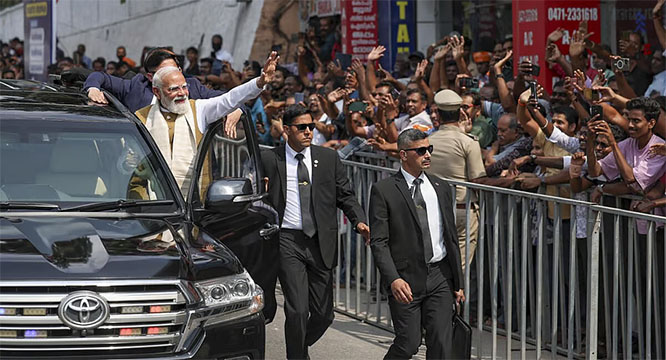
Prime Minister Narendra Modi, during his visit to Thiruvananthapuram on Friday, January 23, indicated that the Bharatiya Janata Party (BJP) is aiming to expand its political footprint in Kerala ahead of the Assembly elections scheduled in the coming months.

Speaking at a BJP-organised public meeting, Modi drew parallels between the party’s early electoral gains in Gujarat and its recent victory in the Thiruvananthapuram Municipal Corporation. The civic body win, which ended decades of Left control, was cited by the Prime Minister as a possible starting point for the party’s broader ambitions in the state.

Recalling BJP’s political trajectory in Gujarat, Modi said the party was largely insignificant before 1987 and received little media attention. He pointed out that the BJP’s first major breakthrough came with its victory in the Ahmedabad Municipal Corporation that year.

“Just as our journey in Gujarat began with one city, Kerala’s journey has also started with a single city,” Modi said, suggesting that the party’s municipal-level success could translate into wider electoral acceptance.

The Prime Minister alleged that successive governments led by the Left Democratic Front (LDF) and the United Democratic Front (UDF) had failed to adequately develop Thiruvananthapuram. He accused both fronts of corruption and neglect, claiming that basic infrastructure and facilities were denied to the capital city for decades.

According to Modi, the BJP’s control of the civic body represents a shift driven by public dissatisfaction with the existing political alternatives. He asserted that the BJP administration in Thiruvananthapuram had begun working towards development, though no specific details or timelines were outlined.

Addressing the gathering at Putharikandam Maidan, Modi said the BJP intended to project Thiruvananthapuram as a “model city,” reiterating his party’s commitment to governance-led change.

The Prime Minister’s visit to Kerala also included the inauguration of several development projects and the flagging off of new train services, as the BJP intensifies its political outreach in the poll-bound state.

Comments

Add new comment

  • Coastaldigest.com reserves the right to delete or block any comments.
  • Coastaldigset.com is not responsible for its readers’ comments.
  • Comments that are abusive, incendiary or irrelevant are strictly prohibited.
  • Please use a genuine email ID and provide your name to avoid reject.