



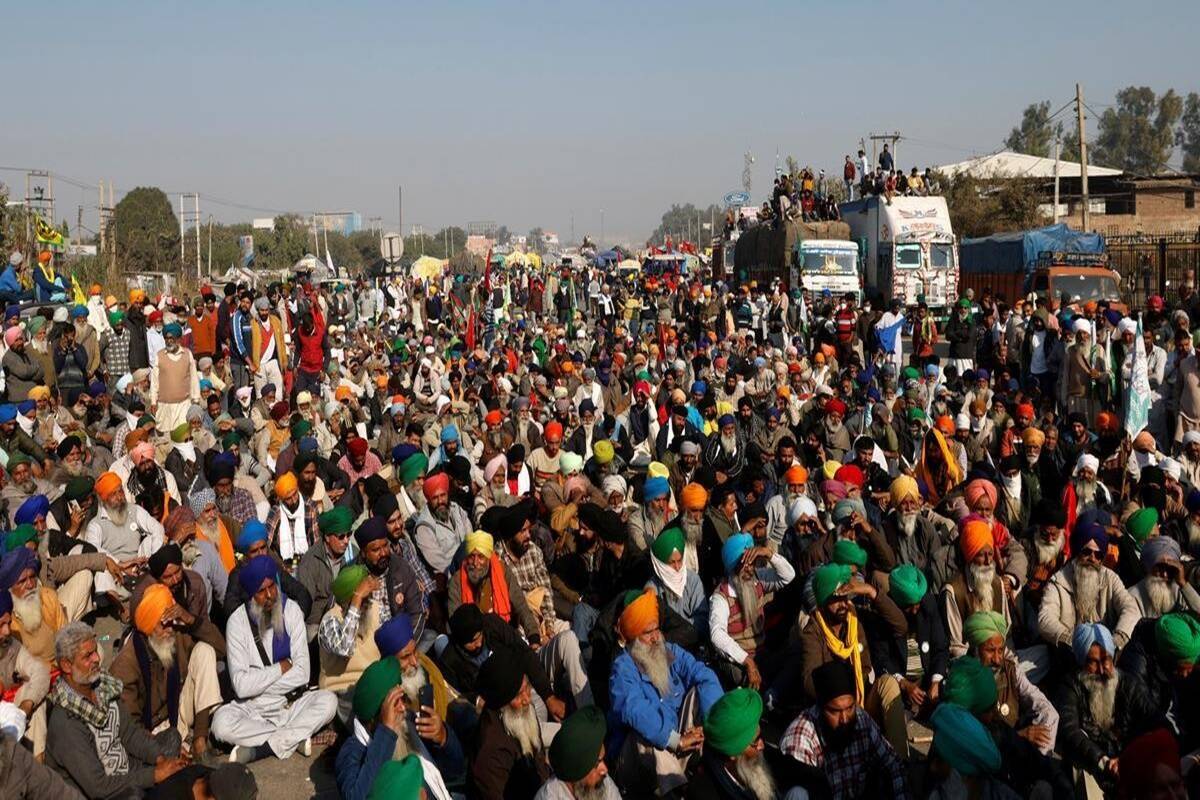
Farmer leaders ready to resume talks with govt, want repeal of farm laws in agenda

Agencies
December 26, 2020

1-467.jpg

New Delhi, Dec 26: The protesting farmer unions on Saturday decided to resume their dialogue with the government and have proposed December 29 as the date for the next round of talks to resolve the deadlock over the Centre's three farm laws.

The decision was taken at a meeting of Sanyukt Kisan Morcha, an umbrella body of 40 farmer unions protesting at various Delhi border points against the new agriculture laws.

Addressing a press conference, farmer leaders made it clear that the modalities for the repeal of three farm laws and guarantee for MSP -- minimum support price at which the government procures crops from farmers -- should be part of the agenda for resuming talks with the government.

At the press conference, farmer leader Darshan Pal said that it was also decided that farmers will hold tractor march on the Kundli-Manesar-Palwal (KMP) highway on December 30 in protest against the Centre's agri laws.

"We request people from Delhi and other parts of country to come and celebrate New Year with protesting farmers," Pal said.

Another farmer leader, Rajinder Singh, said, "We will march from Singhu to Tikri to KMP. We ask farmers from surrounding states to come in huge numbers in their trolleys and tractors. If the govt doesn't want us to block the KMP highway, then they better announce the repeal of the three farm laws."

In a letter to Joint Secretary in the Ministry of Agriculture and Farmers' Welfare Vivek Aggarwal, the Morcha said, "We propose that the next meeting between the farmers' representatives and the Government of India be held on December 29 2020 at 11 am."

"As the government is willing to hold talks with us and asking us for date and our issues, we have proposed to hold dialogue on December 29. Now, the ball is in the court of government when it calls us for talks," Bhartiya Kisan Union leader Rakesh Tikait told PTI.

According to the letter, the agenda proposed by the protesting unions includes amendments to be made and notified in the Commission for the Air Quality Management in National Capital Region and Adjoining Areas Ordinance, 2020 to exclude farmers from its penal provisions.

The farmer unions also demanded that changes in the draft Electricity Amendment Bill 2020 to protect the interests of farmers should also be part of the agenda for the next round of dialogue.

Earlier this week, Aggarwal had written to the 40 protesting unions and invited them for fresh talks, but made it clear that it would not be "logical" to include in the agenda any new demand related to the MSP, which is out of the purview of the three new farm laws.

"Unfortunately, your (Aggarwal's) letter continues the government's attempt to mislead the public by suppressing true facts about the deliberations in the previous meetings. We have consistently demanded the repeal of the three Central Farm Acts, whereas the government has distorted our position as if we were asking for amendments to these Acts.

"If you are sincere about respectfully listening to the farmers, as you say in your letter, the government must not indulge in misinformation about the previous meetings. The campaign launched by the entire state machinery to defame and malign the farmers' movement must stop forthwith," the Sankyukta Kisan Morcha said in its letter.

Thousands of farmers have been camping at three Delhi border points -- Singhu, Tikri and Ghazipur -- for nearly a month, demanding repeal of three agri laws enacted in September and a legal guarantee on minimum support price.

While the government has presented these laws as major reforms aimed at helping farmers, protesting unions have maintained these acts will leave them at the mercy of big corporates by weakening the mandi and MSP systems.

On Wednesday, the Sanyukt Kisan Morcha, had asked the government to not repeat the proposal of "meaningless" amendments that they have already rejected but to come up with a "concrete offer" in writing for the resumption of talks.

Prime Minister Narendra Modi Friday squarely blamed those with a political agenda for the deadlock in the Centre's talks with the protesting farmers and asserted that his government was willing to hold dialogues with all, including those staunchly opposed to it, as long as talks are based on farm issues, facts and logic.

Enacted in September, the three farm laws have been projected by the Centre as major reforms in the agriculture sector that will remove the middlemen and allow farmers to sell their produce anywhere in the country.

However, the protesting farmers have expressed apprehension that the new laws would pave the way for eliminating the safety cushion of the MSP and do away with the "mandi" (wholesale market) system, leaving them at the mercy of big corporates.

Comments

Add new comment

  • Coastaldigest.com reserves the right to delete or block any comments.
  • Coastaldigset.com is not responsible for its readers’ comments.
  • Comments that are abusive, incendiary or irrelevant are strictly prohibited.
  • Please use a genuine email ID and provide your name to avoid reject.
News Network
November 26,2025

students.jpg

Bengaluru, Nov 26: Karnataka is taking its first concrete steps towards lifting a three-decade-old ban on student elections in colleges and universities. Deputy Chief Minister D.K. Shivakumar announced Wednesday that the state government will form a small committee to study the reintroduction of campus polls, a practice halted in 1989 following incidents of violence.

Speaking at a 'Constitution Day' event organised by the Karnataka Congress, Mr. Shivakumar underscored the move's aim: nurturing new political leadership from the grassroots.

"Recently, (Leader of the Opposition in Lok Sabha) Rahul Gandhi wrote a letter to me and Chief Minister (Siddaramaiah) asking us to think about restarting student elections," Shivakumar stated. "I'm announcing today that we'll form a small committee and seek a report on this."

Student elections were banned in Karnataka in 1989, largely due to concerns over violence and the infiltration of political party affiliates into campus life. The ban effectively extinguished vibrant student bodies and the pipeline of young leaders they often produced.

Mr. Shivakumar, who also serves as the Karnataka Congress president, said that former student leaders will be consulted to "study the pros and cons" of the re-introduction.

Acknowledging the history of the ban, he added, "There were many criminal activities taking place back then. We’ll see how we can conduct (student) elections by regulating such criminal activities."

The Deputy CM reminisced about his own journey, which began on campus. He recalled his political activism at Sri Jagadguru Renukacharya College leading to his first Assembly ticket in 1985 at the age of 23. "That's how student leadership was at the time. Such leadership has gone today. College elections have stopped," he lamented, adding that for many, college elections were "like a big movement" where leaders were forged.

The move, driven by the Congress high command's push to cultivate young talent, will face scrutiny from academics and university authorities who have, in the past, expressed concern that the return of polls could disrupt the peaceful academic environment and turn campuses into political battlegrounds.

Comments

Add new comment

  • Coastaldigest.com reserves the right to delete or block any comments.
  • Coastaldigset.com is not responsible for its readers’ comments.
  • Comments that are abusive, incendiary or irrelevant are strictly prohibited.
  • Please use a genuine email ID and provide your name to avoid reject.
News Network
December 6,2025

pilot.jpg

New Delhi: IndiGo, India’s largest airline, faced major operational turbulence this week after failing to prepare for new pilot-fatigue regulations issued by the Directorate General of Civil Aviation (DGCA). The stricter rules—designed to improve flight safety—took effect in phases through 2024, with the latest implementation on November 1. IndiGo has acknowledged that inadequate roster planning led to widespread cancellations and delays.

Below are the key DGCA rules that affected IndiGo’s operations:

1. Longer Mandatory Weekly Rest

Weekly rest for pilots has been increased from 36 hours to 48 hours.

The government says the extended break is essential to curb cumulative fatigue. This rule remains in force despite the current crisis.

2. Cap on Night Landings

Pilots can now perform only two night landings per week—a steep reduction from the earlier limit of six.

Night hours, defined as midnight to early morning, are considered the least alert period for pilots.

Given the disruptions, this rule has been temporarily relaxed for IndiGo until February 10.

3. Reduced Maximum Night Flight Duty

Flight duty that stretches into the night is now capped at 10 hours.

This measure has also been kept on hold for IndiGo until February 10 to stabilize operations.

4. Weekly Rest Cannot Be Replaced With Personal Leave

Airlines can no longer count a pilot’s personal leave as part of the mandatory 48-hour rest.

Pilots say this closes a loophole that previously reduced actual rest time.

Currently, all airlines are exempt from this rule to normalise travel.

5. Mandatory Fatigue Monitoring

Airlines must submit quarterly fatigue reports along with corrective actions to DGCA.

This system aims to create a transparent fatigue-tracking framework across the industry.

The DGCA has stressed that these rules were crafted to strengthen flight safety and align India with global fatigue-management standards. The temporary relaxations are expected to remain until February 2025, giving IndiGo time to stabilise its schedules and restore normal air travel.

Comments

Add new comment

  • Coastaldigest.com reserves the right to delete or block any comments.
  • Coastaldigset.com is not responsible for its readers’ comments.
  • Comments that are abusive, incendiary or irrelevant are strictly prohibited.
  • Please use a genuine email ID and provide your name to avoid reject.
News Network
December 2,2025

A major upgrade in safety and monitoring is planned for Haj 2026, with every Indian pilgrim set to receive a Haj Suvidha smart wristband linked to the official Haj Suvidha mobile app. The initiative aims to support pilgrims—especially senior citizens—who may struggle with smartphones during the 45-day journey.

What the Smart Wristband Will Do

Officials said the device will come with:
•    Location tracking
•    Pedometer
•    SOS emergency button
•    Qibla compass
•    Prayer timings
•    Basic health monitoring

SP Tiwari, secretary of the UP State Haj Committee, said the goal is to make the pilgrimage safer and more comfortable.

“Most Hajis are elderly and not comfortable with mobile apps,” he said. “The smartwatch will help locate pilgrims who forget their way or cannot communicate their location.”

The wristbands will be monitored by the Consulate General of India in Saudi Arabia, similar to mobile tracking via the Haj Suvidha App.

Free Distribution and Training

•    Smart wristbands will be given free of cost.
•    Training for pilgrims will be conducted between January and February 2026.
•    Sample units will reach state Haj committees soon.
•    Final devices will be distributed as pilgrims begin their journey.

New Rules for Accommodation

Two major decisions have also been finalised for Haj 2026:
1.    Separate rooms for men and women – including married couples. They may stay on the same floor but must occupy different rooms, following stricter Saudi guidelines.
2.    Cooking banned – gas cylinders will not be allowed; all meals will be provided through official catering services arranged by the Haj Committee of India.

These decisions were finalised during a meeting of the Haj Committee of India and state representatives in Mumbai.

Haj Suvidha App Launched Earlier

The government launched the Haj Suvidha App in 2024, offering:

•    Training modules
•    Accommodation and flight details
•    Baggage information
•    SOS and translation tools
•    Grievance redressal

Haj 2026 Quota and Key States

•    India’s total Haj quota for 2026: 1,75,025 pilgrims
•    70% (1,25,000) allotted to the Haj Committee of India
•    30% (around 50,000) reserved for Haj Group Organisers

Uttar Pradesh has the largest allocation (around 30,000 seats), though approximately 18,000 pilgrims are expected to go this year. States with high pilgrim numbers include Kerala, Maharashtra and Gujarat.

Dates of Haj 2026

The pilgrimage is scheduled to take place from 24 May to 29 May, 2026 (tentative).
Haj is one of the five pillars of Islam and is mandatory for Muslims who meet the required conditions.

Comments

Add new comment

  • Coastaldigest.com reserves the right to delete or block any comments.
  • Coastaldigset.com is not responsible for its readers’ comments.
  • Comments that are abusive, incendiary or irrelevant are strictly prohibited.
  • Please use a genuine email ID and provide your name to avoid reject.
