Fatal heat waves are testing govt's ability to protect 140 crore Indians

News Network
May 17, 2024

Indiaheat.jpg

In scorching heat on a busy Kolkata street last month, commuters sought refuge inside a glass-walled bus shelter where two air conditioners churned around stifling air. Those inside were visibly sweating, dabbing at their foreheads in sauna-like temperatures that were scarcely cooler than out in the open.

Local authorities initially had plans to install as many as 300 of the cooled cabins under efforts to improve protections from a heat season that typically runs from April until the monsoon hits the subcontinent in June. There are currently only a handful in operation, and some have been stripped of their AC units, leaving any users sweltering.

“It doesn’t work,” Firhad Hakim, mayor of the city of 1.5 crore, said on a searing afternoon when temperatures topped 40C. “You feel suffocated.”

Attempts in Kolkata and across India to improve resilience to extreme heat have often been equally ill-conceived, despite a death toll estimated at more than 24,000 since 1992. Inconsistent or incomplete planning, a lack of funding, and the failure to make timely preparations to shield a population of 140 crore are leaving communities vulnerable as periods of extreme temperatures become more frequent, longer in duration and affect a wider sweep of the country.

Kolkata, with its hot, humid climate and proximity to the Bay of Bengal, is particularly vulnerable to temperature and rainfall extremes, and ranked by the Intergovernmental Panel on Climate Change as among the global locations that are most at risk.

An increase in average global temperatures of 2C could mean the city would experience the equivalent of its record 2015 heat waves every year, according to the IPCC. High humidity can compound the impacts, as it limits the human body’s ability to regulate its temperature.

Even so, the city — one of India's largest urban centres — still lacks a formal strategy to handle heat waves.

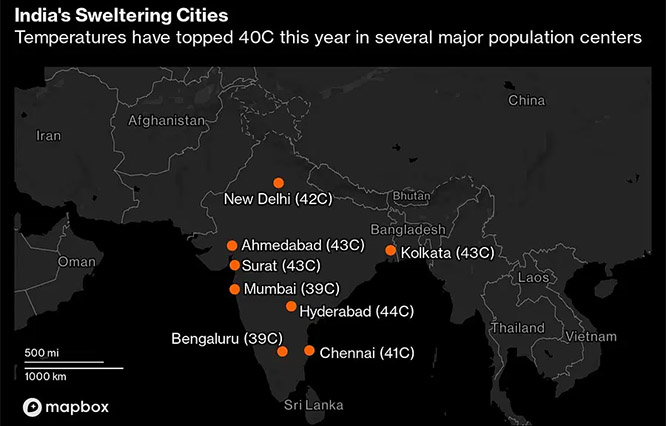
Several regions across India will see as many as 11 heat wave days this month compared to 3 in a typical year, while maximum temperatures in recent weeks have already touched 47.2C in the nation’s east, according to the Indian Meteorological Department. Those extremes come amid the Lok Sabha election during which high temperatures are being cited as among the factors for lower voter turnout.

At SSKM Hospital, one of Kolkata’s busiest, a waiting area teemed last month with people sheltering under colorful umbrellas and thronging a coin-operated water dispenser to refill empty bottles. A weary line snaked back from a government-run kiosk selling a subsidized lunch of rice, lentils, boiled potato and eggs served on foil plates.

“High temperatures can cause heat stroke, skin rashes, cramps and dehydration,” said Niladri Sarkar, professor of medicine at the hospital. “Some of these can turn fatal if not attended to on time, especially for people that have pre-existing conditions.” Extreme heat has an outsized impact on poorer residents, who are often malnourished, lack access to clean drinking water and have jobs that require outdoor work, he said.

Elsewhere in the city, tea sellers sweltered by simmering coal-fired ovens, construction workers toiled under a blistering midday sun, and voters attending rallies for the ongoing national elections draped handkerchiefs across their faces in an effort to stay cool. The state government in April advised some schools to shutter for an early summer vacation to avoid the heat.

Since 2013, states, districts and cities are estimated to have drafted more than 100 heat action plans, intended to improve their ability to mitigate the effects of extreme temperatures. The Centre set out guidelines eight years ago to accelerate adoption of the policies, and a January meeting of the National Disaster Management Authority pledged to do more to strengthen preparedness.

The absence of such planning in Kolkata has also meant a failure to intervene in trends that have made the city more susceptible.

Almost a third of the city’s green cover was lost during the decade through 2021, according to an Indian government survey. Other cities including Mumbai and Bengaluru have experienced similar issues. That’s combined with a decline in local water bodies and a construction boom to deliver an urban heat island effect, according to Saira Shah Halim, a parliamentary candidate in the Kolkata Dakshin electoral district in the city’s south. “What we’re seeing today is a result of this destruction,” she said.

Hakim, the city’s mayor, disputes the idea that Kolkata’s preparations have lagged, arguing recent extreme weather has confounded local authorities. “Such a kind of heat wave is new to us, we’re not used to it,” he said. “We’re locked with elections right now. Once the elections are over, we’ll sit with experts to work on a heat action plan.”

Local authorities are currently ensuring adequate water supplies, and have put paramedics on stand-by to handle heat-induced illnesses, Hakim said.

Focusing on crisis management, rather than on better preparedness, is at the root of the country’s failings, according to Nairwita Bandyopadhyay, a Kolkata-based climatologist and geographer. “Sadly the approach is to wait and watch until the hazard turns into a disaster,” she said.

Even cities and states that already have heat action plans have struggled to make progress in implementing recommendations, the New Delhi-based think tank Centre for Policy Research said in a report last year reviewing 37 of the documents.

Most policies don’t adequately reflect local conditions, they often lack detail on how action should be funded and typically don’t set out a source of legal authority, according to the report.

As many as 9 people have already died as a result of heat extremes this year, according to the meteorological department, though the figure is likely to significantly underestimate the actual total. That follows about 110 fatalities during severe heat waves during April and June last year, the World Meteorological Organization said last month.

Even so, the handling of extreme heat has failed to become a “political lightning rod that can stir governments into action,” said Aditya Valiathan Pillai, among authors of the CPR study and now a fellow at New Delhi-based Sustainable Futures Collaborative.

Modi's government has often moved to contain criticism of its policies, and there is also the question of unreliable data. “When deaths occur, one is not sure whether it was directly caused by heat, or whether heat exacerbated an existing condition,” Pillai said.

In 2022, health ministry data showed 33 people died as a result of heat waves, while the National Crime Records Bureau – another agency that tracks mortality statistics – reported 730 fatalities from heat stroke.

Those discrepancies raise questions about a claim by the Centre that its policies helped cut heat-related deaths from 2,040 in 2015 to 4 in 2020, after national bureaucrats took on more responsibility for disaster risk management.

Local officials in Kolkata are now examining potential solutions and considering the addition of more trees, vertical gardens on building walls and the use of porous concrete, all of which can help combat urban heat.

India’s election is also an opportunity to raise issues around poor preparations, according to Halim, a candidate for the Communist Party of India (Marxist), whose supporters carry bright red flags at campaign events scheduled for the early morning and after sundown to escape extreme temperatures.

“I’m mentioning it,” she said. “It’s become a very, very challenging campaign. The heat is just insufferable.”

Comments

Add new comment

  • Coastaldigest.com reserves the right to delete or block any comments.
  • Coastaldigset.com is not responsible for its readers’ comments.
  • Comments that are abusive, incendiary or irrelevant are strictly prohibited.
  • Please use a genuine email ID and provide your name to avoid reject.
coastaldigest.com news network
December 2,2025

karkala.jpg

Udupi, Dec 2: A wave of regional pride is sweeping through Udupi district as Shagun S Verma Hegde, a talented Class 9 student from Christ King English Medium High School, Karkala, has been named the captain of the Indian National Team for the Under-15 Girls’ Volleyball Championship.

Shagun holds the unique distinction of being the sole player from Karnataka selected to represent the country in the prestigious international tournament. The championship, organized by the School Games Federation, is scheduled to take place in Shangluo, China, from December 3 to 13, where Shagun will lead the national squad.

A Remarkable Journey to the Top

Shagun’s selection is a testament to her dedication and exceptional skill on the court. Her journey included several rigorous rounds of selection:

•    She was the only player from Udupi district to qualify for the state-level selection camp.

•    Out of eight players from Karnataka who advanced to the national selection camp in Pune, Maharashtra, Shagun was the only one to secure a place in the final national squad.

•    The national camp saw participation from approximately 200 players, which was shortlisted to 23. Shagun not only made the final cut but was also ranked as the second-best player overall, solidifying her leadership role.

Shagun, who is the daughter of Sandesh Verma and Shruthiraj of Kallotte, Karkala, has trained under experienced coaches Santosh D’Souza, Jeevan D’Silva, Jairaj Poojary, and Ramesh. Her selection as the team captain has brought profound honour to her family, school, the Udupi district, and the entire state of Karnataka.

Comments

Add new comment

  • Coastaldigest.com reserves the right to delete or block any comments.
  • Coastaldigset.com is not responsible for its readers’ comments.
  • Comments that are abusive, incendiary or irrelevant are strictly prohibited.
  • Please use a genuine email ID and provide your name to avoid reject.
News Network
November 30,2025

The United Nations Committee against Torture (CAT) has condemned the Israeli regime for enforcing a policy of “organized torture” against Palestinians.

In a report published on Friday, CAT stated that the occupying regime enforces a deliberate policy of “organized and widespread torture and ill-treatment” against Palestinian abductees, particularly since October 7, 2023, when Israel launched its genocidal war on Gaza.

The committee expressed “deep concern over repeated severe beatings, dog attacks, electrocution, water-boarding, use of prolonged stress positions [and] sexual violence” inflicted on Palestinians.

Palestinian prisoners were degraded by “being made to act like animals or being urinated on,” systematically denied medical care, and subjected to excessive restraints, “in some cases resulting in amputation,” the report added.

CAT also condemned the routine application of “unlawful combatants law” to justify the prolonged detention without trial of thousands of Palestinian men, women, and children.

More than 10,000 Palestinians, including women and children, are currently held in Israeli prisons, according to Palestinian and international human rights groups, with 3,474 Palestinians in “administrative detention,” meaning they are imprisoned without trial for indefinite periods.

The report highlighted the “high proportion of children who are currently detained without charge or on remand,” noting that while Israel sets the age of criminal responsibility at 12, even younger children have been abducted.

Children designated as security prisoners face severe restrictions on family contact, may be subjected to solitary confinement, and are denied access to education, in clear violation of international law.

The committee further suggested that Israel’s policies across the Occupied Territories constitute collective torture against the Palestinian population.

“A range of policies adopted by Israel in the course of its continued unlawful presence in the Occupied Palestinian Territory amounts to cruel, inhuman or degrading living conditions for the Palestinian population,” the report said.

On Thursday, the Palestinian resistance movement Hamas condemned the systematic killing and torture of Palestinian abductees in Israeli prisons, urging international action to halt these abuses.

Citing human rights data, Hamas stated that 94 Palestinians have been killed in Israeli prisons since the start of Tel Aviv’s genocidal war on Gaza.

“This reflects an organized criminal approach that has turned these prisons into direct killing grounds to eliminate our people,” the resistance movement said.

Hamas called on the international community, the UN, and human rights organizations to immediately pressure Israel to end crimes against prisoners and uphold their rights as guaranteed by all international conventions and norms.

Comments

Add new comment

  • Coastaldigest.com reserves the right to delete or block any comments.
  • Coastaldigset.com is not responsible for its readers’ comments.
  • Comments that are abusive, incendiary or irrelevant are strictly prohibited.
  • Please use a genuine email ID and provide your name to avoid reject.
News Network
November 27,2025

siddDKS.jpg

Congress president Mallikarjun Kharge on Thursday announced that he will convene a high-level meeting in New Delhi with senior leaders — including Rahul Gandhi, Karnataka Chief Minister Siddaramaiah and Deputy Chief Minister D.K. Shivakumar — to resolve the escalating leadership turmoil in Karnataka and “put an end to the confusion.”

Kharge said the discussions would focus on the way forward for the ruling party, as rumours of a possible leadership change continue to swirl. The speculation has intensified after the Congress government crossed the halfway mark of its five-year term on November 20, reviving talk of an alleged 2023 “power-sharing agreement” between Siddaramaiah and Shivakumar.

“After reaching Delhi, I will call three or four important leaders and hold discussions. Once we talk, we will decide how to move ahead and end this confusion,” Kharge told reporters in Bengaluru, according to PTI.

When asked specifically about calling Siddaramaiah and Shivakumar to Delhi, he responded: “Certainly, we should call them. We will discuss with them and settle the issue.”

He confirmed that Rahul Gandhi, the Chief Minister, the Deputy Chief Minister and other senior members would be part of the deliberations. “After discussing with everyone, a decision will be made,” he said.

Meanwhile, Siddaramaiah held a separate strategy meeting at his Bengaluru residence with ministers and leaders seen as his close confidants, including G. Parameshwara, Satish Jarkiholi, H.C. Mahadevappa, K. Venkatesh and K.N. Rajanna.
Signalling calm, the Chief Minister told reporters, “Will go to Delhi if the high command calls.”

Shivakumar echoed a similar stance, saying he too would head to the national capital if summoned by the party leadership.

Comments

Add new comment

  • Coastaldigest.com reserves the right to delete or block any comments.
  • Coastaldigset.com is not responsible for its readers’ comments.
  • Comments that are abusive, incendiary or irrelevant are strictly prohibited.
  • Please use a genuine email ID and provide your name to avoid reject.