Fatal heat waves are testing govt's ability to protect 140 crore Indians

News Network
May 17, 2024

Indiaheat.jpg

In scorching heat on a busy Kolkata street last month, commuters sought refuge inside a glass-walled bus shelter where two air conditioners churned around stifling air. Those inside were visibly sweating, dabbing at their foreheads in sauna-like temperatures that were scarcely cooler than out in the open.

Local authorities initially had plans to install as many as 300 of the cooled cabins under efforts to improve protections from a heat season that typically runs from April until the monsoon hits the subcontinent in June. There are currently only a handful in operation, and some have been stripped of their AC units, leaving any users sweltering.

“It doesn’t work,” Firhad Hakim, mayor of the city of 1.5 crore, said on a searing afternoon when temperatures topped 40C. “You feel suffocated.”

Attempts in Kolkata and across India to improve resilience to extreme heat have often been equally ill-conceived, despite a death toll estimated at more than 24,000 since 1992. Inconsistent or incomplete planning, a lack of funding, and the failure to make timely preparations to shield a population of 140 crore are leaving communities vulnerable as periods of extreme temperatures become more frequent, longer in duration and affect a wider sweep of the country.

Kolkata, with its hot, humid climate and proximity to the Bay of Bengal, is particularly vulnerable to temperature and rainfall extremes, and ranked by the Intergovernmental Panel on Climate Change as among the global locations that are most at risk.

An increase in average global temperatures of 2C could mean the city would experience the equivalent of its record 2015 heat waves every year, according to the IPCC. High humidity can compound the impacts, as it limits the human body’s ability to regulate its temperature.

Even so, the city — one of India's largest urban centres — still lacks a formal strategy to handle heat waves.

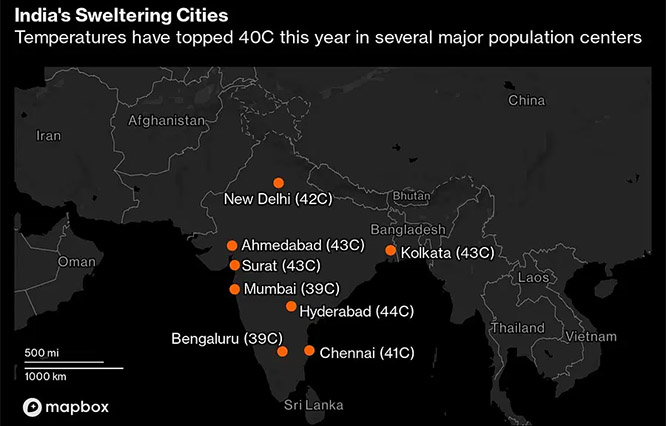
Several regions across India will see as many as 11 heat wave days this month compared to 3 in a typical year, while maximum temperatures in recent weeks have already touched 47.2C in the nation’s east, according to the Indian Meteorological Department. Those extremes come amid the Lok Sabha election during which high temperatures are being cited as among the factors for lower voter turnout.

At SSKM Hospital, one of Kolkata’s busiest, a waiting area teemed last month with people sheltering under colorful umbrellas and thronging a coin-operated water dispenser to refill empty bottles. A weary line snaked back from a government-run kiosk selling a subsidized lunch of rice, lentils, boiled potato and eggs served on foil plates.

“High temperatures can cause heat stroke, skin rashes, cramps and dehydration,” said Niladri Sarkar, professor of medicine at the hospital. “Some of these can turn fatal if not attended to on time, especially for people that have pre-existing conditions.” Extreme heat has an outsized impact on poorer residents, who are often malnourished, lack access to clean drinking water and have jobs that require outdoor work, he said.

Elsewhere in the city, tea sellers sweltered by simmering coal-fired ovens, construction workers toiled under a blistering midday sun, and voters attending rallies for the ongoing national elections draped handkerchiefs across their faces in an effort to stay cool. The state government in April advised some schools to shutter for an early summer vacation to avoid the heat.

Since 2013, states, districts and cities are estimated to have drafted more than 100 heat action plans, intended to improve their ability to mitigate the effects of extreme temperatures. The Centre set out guidelines eight years ago to accelerate adoption of the policies, and a January meeting of the National Disaster Management Authority pledged to do more to strengthen preparedness.

The absence of such planning in Kolkata has also meant a failure to intervene in trends that have made the city more susceptible.

Almost a third of the city’s green cover was lost during the decade through 2021, according to an Indian government survey. Other cities including Mumbai and Bengaluru have experienced similar issues. That’s combined with a decline in local water bodies and a construction boom to deliver an urban heat island effect, according to Saira Shah Halim, a parliamentary candidate in the Kolkata Dakshin electoral district in the city’s south. “What we’re seeing today is a result of this destruction,” she said.

Hakim, the city’s mayor, disputes the idea that Kolkata’s preparations have lagged, arguing recent extreme weather has confounded local authorities. “Such a kind of heat wave is new to us, we’re not used to it,” he said. “We’re locked with elections right now. Once the elections are over, we’ll sit with experts to work on a heat action plan.”

Local authorities are currently ensuring adequate water supplies, and have put paramedics on stand-by to handle heat-induced illnesses, Hakim said.

Focusing on crisis management, rather than on better preparedness, is at the root of the country’s failings, according to Nairwita Bandyopadhyay, a Kolkata-based climatologist and geographer. “Sadly the approach is to wait and watch until the hazard turns into a disaster,” she said.

Even cities and states that already have heat action plans have struggled to make progress in implementing recommendations, the New Delhi-based think tank Centre for Policy Research said in a report last year reviewing 37 of the documents.

Most policies don’t adequately reflect local conditions, they often lack detail on how action should be funded and typically don’t set out a source of legal authority, according to the report.

As many as 9 people have already died as a result of heat extremes this year, according to the meteorological department, though the figure is likely to significantly underestimate the actual total. That follows about 110 fatalities during severe heat waves during April and June last year, the World Meteorological Organization said last month.

Even so, the handling of extreme heat has failed to become a “political lightning rod that can stir governments into action,” said Aditya Valiathan Pillai, among authors of the CPR study and now a fellow at New Delhi-based Sustainable Futures Collaborative.

Modi's government has often moved to contain criticism of its policies, and there is also the question of unreliable data. “When deaths occur, one is not sure whether it was directly caused by heat, or whether heat exacerbated an existing condition,” Pillai said.

In 2022, health ministry data showed 33 people died as a result of heat waves, while the National Crime Records Bureau – another agency that tracks mortality statistics – reported 730 fatalities from heat stroke.

Those discrepancies raise questions about a claim by the Centre that its policies helped cut heat-related deaths from 2,040 in 2015 to 4 in 2020, after national bureaucrats took on more responsibility for disaster risk management.

Local officials in Kolkata are now examining potential solutions and considering the addition of more trees, vertical gardens on building walls and the use of porous concrete, all of which can help combat urban heat.

India’s election is also an opportunity to raise issues around poor preparations, according to Halim, a candidate for the Communist Party of India (Marxist), whose supporters carry bright red flags at campaign events scheduled for the early morning and after sundown to escape extreme temperatures.

“I’m mentioning it,” she said. “It’s become a very, very challenging campaign. The heat is just insufferable.”


Comments

Add new comment

  • Coastaldigest.com reserves the right to delete or block any comments.
  • Coastaldigset.com is not responsible for its readers’ comments.
  • Comments that are abusive, incendiary or irrelevant are strictly prohibited.
  • Please use a genuine email ID and provide your name to avoid reject.
coastaldigest.com news network
November 28,2025

roadshow.jpg

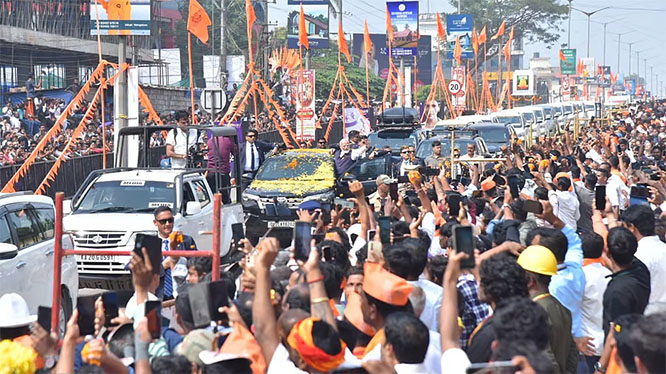
Udupi district transformed into a sea of saffron and celebration on Friday, November 28, as Prime Minister Narendra Modi’s roadshow swept through the coastal temple town. Thousands of residents lined the streets, turning the event into a vibrant public spectacle filled with cheers, flags, and festive energy.

The procession route—from the helipad to the historic Sri Krishna Math—was decked with buntings, saffron flags, and multilayered security barricades. One of the district’s largest-ever security deployments was put in place for the high-profile visit, with over 3,000 police personnel on duty. The arrangement included ten SPs, 27 DSPs, 49 inspectors, 127 sub-inspectors, 232 assistant sub-inspectors, 1,608 constables, and 39 women staff.

Six platoons of the Karnataka State Reserve Police, six Quick Response Teams, bomb detection units, and dog squads were stationed across Udupi. Enhanced surveillance covered Adi Udupi, Bannanje bus stand, and the Sri Krishna Math parking zone, with combing operations carried out along the roadshow corridor.

At the 800-year-old Sri Krishna Math, preparations reached a ceremonial peak. Paryaya Puttige Math seer Sugunendra Teertha Swamiji said the Prime Minister would take part in the Laksha Kantha Geetha Parayana, a mass chanting of the Bhagavad Gita by one lakh devotees, and inaugurate the new Suvarna Teertha Mantapa.

“He will first offer floral tributes to saint-poet Kanakadasa and then unveil the golden covering over the Kanakana Kindi,” the seer said.

The Prime Minister will also receive a Poorna Kumbha welcome and have darshan of Lord Sri Krishna, Mukhyaprana Devaru, and the Suvarna Paduke. Union Minister Pralhad Joshi, Karnataka Governor Thaawarchand Gehlot, Minister Bairathi Suresh, Dharmadhikari D. Veerendra Heggade, and seers from the Ashta Maths are expected to join the ceremony.

Ahead of his arrival, the Prime Minister posted on X that he felt “honoured” to attend the spiritually significant gathering. “This is a special occasion that brings together people from different sections of society for a recital of the Gita. This Matha has a very special significance in our cultural life,” he wrote, noting the institution’s long-standing legacy rooted in the teachings of Sri Madhvacharya.

roadshow2.jpg

Comments

Add new comment

  • Coastaldigest.com reserves the right to delete or block any comments.
  • Coastaldigset.com is not responsible for its readers’ comments.
  • Comments that are abusive, incendiary or irrelevant are strictly prohibited.
  • Please use a genuine email ID and provide your name to avoid reject.
coastaldigest.com news network
December 2,2025

karkala.jpg

Udupi, Dec 2: A wave of regional pride is sweeping through Udupi district as Shagun S Verma Hegde, a talented Class 9 student from Christ King English Medium High School, Karkala, has been named the captain of the Indian National Team for the Under-15 Girls’ Volleyball Championship.

Shagun holds the unique distinction of being the sole player from Karnataka selected to represent the country in the prestigious international tournament. The championship, organized by the School Games Federation, is scheduled to take place in Shangluo, China, from December 3 to 13, where Shagun will lead the national squad.

A Remarkable Journey to the Top

Shagun’s selection is a testament to her dedication and exceptional skill on the court. Her journey included several rigorous rounds of selection:

•    She was the only player from Udupi district to qualify for the state-level selection camp.

•    Out of eight players from Karnataka who advanced to the national selection camp in Pune, Maharashtra, Shagun was the only one to secure a place in the final national squad.

•    The national camp saw participation from approximately 200 players, which was shortlisted to 23. Shagun not only made the final cut but was also ranked as the second-best player overall, solidifying her leadership role.

Shagun, who is the daughter of Sandesh Verma and Shruthiraj of Kallotte, Karkala, has trained under experienced coaches Santosh D’Souza, Jeevan D’Silva, Jairaj Poojary, and Ramesh. Her selection as the team captain has brought profound honour to her family, school, the Udupi district, and the entire state of Karnataka.

Comments

Add new comment

  • Coastaldigest.com reserves the right to delete or block any comments.
  • Coastaldigset.com is not responsible for its readers’ comments.
  • Comments that are abusive, incendiary or irrelevant are strictly prohibited.
  • Please use a genuine email ID and provide your name to avoid reject.
News Network
December 4,2025

indigocrisis.jpg

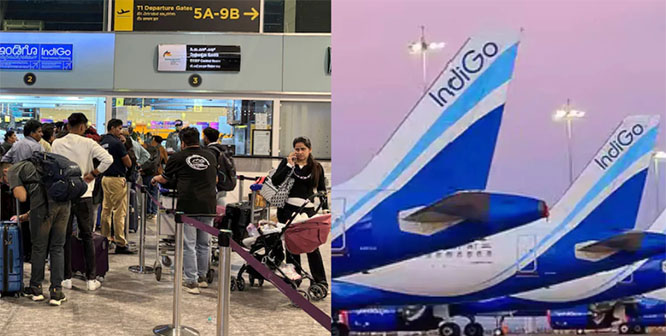
Angry outbursts, long queues, and desperate appeals filled airports across India today as IndiGo grappled with a severe operational breakdown. Hundreds of flights have been cancelled or delayed, leaving thousands of passengers stranded through the night and forcing many to spend long hours at helpdesks.

Social media was flooded with videos of fliers pleading for assistance, accusing the airline of misleading updates, and demanding accommodation after being stuck for 10 to 12 hours at airports such as Hyderabad and Bengaluru.

What Triggered the Meltdown?

IndiGo has attributed the widespread disruption to “a multitude of unforeseen operational challenges.” These include:

•    Minor technology glitches
•    Winter-season schedule adjustments
•    Bad weather
•    Congestion in the aviation network
•    New crew rostering rules (Flight Duty Time Limitations or FDTL)

Among these, the most disruptive has been the implementation of the updated FDTL norms introduced by the Directorate General of Civil Aviation (DGCA) in January 2024.

These rules were designed to reduce pilot fatigue and improve passenger safety. Key changes include:

•    Longer weekly rest periods for flight crew
•    A revised definition of “night,” extending it by an extra hour
•    Tighter caps on flight duty timing and night landings
•    Cutting night shifts for pilots and crew from six per roster cycle to just two

Once these norms became fully enforceable, airlines were required to overhaul rosters well in advance. For IndiGo, this triggered a sudden shortage of crew available for duty, leading to cascading delays and cancellations.

Why IndiGo Was Hit the Hardest

IndiGo is India’s largest airline by a wide margin, operating over 2,200 flights daily. That’s roughly double the number operated by Air India.

When an airline of this size experiences even a 10–20% disruption, it translates to 200–400 flights being delayed or grounded — producing massive spillover effects across the country.

IndiGo also relies heavily on high-frequency overnight operations, a model typical of low-cost carriers that aim to maximise aircraft utilisation and reduce downtime. The stricter FDTL norms clash with these overnight-heavy schedules, forcing the airline to pull back services.

Aviation bodies have also criticised IndiGo’s preparedness. The Airline Pilots' Association of India (ALPA) said airlines were given a two-year window to plan for the new rules but “started preparing rather late.” IndiGo, it said, failed to rebuild crew rosters 15 days in advance as required.

The Federation of Indian Pilots (FIP) went further, calling the crisis the result of IndiGo’s “prolonged and unorthodox lean manpower strategy,” and alleging that the airline adopted a hiring freeze even as it knew the new rules would require more careful staffing.

How Many Flights Are Affected?

In the past 48 hours, over 300 flights have been cancelled. At least 100 more are expected to be cancelled today.

City-wise impact:

•    Hyderabad: 33 expected cancellations; several fliers stranded overnight
•    Bengaluru: over 70 expected cancellations
•    Delhi, Mumbai, Chennai, Kolkata: widespread delays and missed connections

Passengers shared distressing accounts online.

One customer at Hyderabad airport said they waited from 6 PM to 9 AM with “no action taken” regarding their delayed Pune flight. Another said IndiGo repeatedly told them the crew was “arriving soon,” only for the delay to stretch over 12 hours.

IndiGo has apologised for the disruption and promised that operations will stabilise within 48 hours, adding that “calibrated adjustments” are being made to contain the chaos.

What Should Passengers Do Now?

For those flying in the next few days, especially with IndiGo, here are key precautions:

1. Keep Checking Flight Status
Monitor your flight closely before leaving for the airport, as delays may be announced last-minute.

2. Arrive Early
Expect long queues at counters and security due to crowding and rescheduling.

3. Carry Essentials
Pack snacks, water, basic medicines, chargers, and items for children or senior citizens. Extended waiting times should be anticipated.

4. Use Flexible Booking Options
If you booked tickets with a free-date-change or cancellation option, consider using them.
If you haven’t booked yet, prefer refundable or flexible fares, or even consider alternate airlines.

5. Follow IndiGo’s Updates
Keep an eye on IndiGo’s official social media channels and contact customer support for rebooking and refund queries.

What Needs to Change?

Pilot groups have raised concerns not just about staffing but also the planning practices behind it.
The Federation of Indian Pilots accused IndiGo of:

•    Imposing an unexplained hiring freeze despite knowing the FDTL changes were coming
•    Entering non-poaching agreements that limited talent movement
•    Keeping pilot pay frozen
•    Underestimating the need to restructure operations in advance

They have urged DGCA to approve seasonal schedules only after airlines prove they have adequate pilot strength under the new norms.

ALPA also warned that some airlines might be using the delays as an “immature pressure tactic” to push DGCA for relaxations in the new rules — which, if granted, could compromise the very safety standards the norms were meant to protect.

Both pilot bodies stressed that no exemption should dilute safety, and any deviations should be based solely on scientific risk assessment.

Is a Solution in Sight?

While IndiGo says normalcy will return within two days, aviation experts believe that fully stabilising operations could take longer, depending on how quickly the airline can:
•    Re-align rosters
•    Mobilise rested crew
•    Boost staffing
•    Adjust its winter schedule to match regulatory requirements
Passengers are advised to remain prepared for continued delays over the next few days as the airline works through its backlog. 

Comments

Add new comment

  • Coastaldigest.com reserves the right to delete or block any comments.
  • Coastaldigset.com is not responsible for its readers’ comments.
  • Comments that are abusive, incendiary or irrelevant are strictly prohibited.
  • Please use a genuine email ID and provide your name to avoid reject.