Forced marriages up in countries like India, says UN report

News Network
September 13, 2022

Kabul, Sept 13: Around 50 million people globally were living in "modern slavery" in 2021, according to a report by the UN, which said that the Covid-19 pandemic has led to an increased risk of forced marriages in countries like India, Afghanistan, Bangladesh, and Egypt.

‘The Global Estimates Of Modern Slavery’, a report published by the International Labour Organization (ILO), International Organisation for Migration (IOM) and international human rights group Walk Free, said 50 million people were living in modern slavery in 2021.

Of these, 28 million were in forced labour and 22 million trapped in forced marriage.

“Forced marriages take place in every region in the world. Nearly two-thirds of all forced marriages, an estimated 14.2 million people, are in Asia and the Pacific. This is followed by 14.5 per cent in Africa (3.2 million) and 10.4 per cent in Europe and Central Asia (2.3 million),” the report released on Monday said.

It noted that when regional population is accounted for, the Arab States is the region with the highest prevalence at 4.8 per thousand people, followed by Asia and the Pacific at 3.3 per thousand.

The Americas has the lowest prevalence of forced marriage at 1.5 per thousand people.

“Covid-19 has led to increased risk of forced marriage in every region. The collection of official statistics, including civil registration systems, was interrupted during the pandemic due to mobility restrictions, safety and ethical considerations, delays in response services, or deprioritisation.

"Where data is available, increases in child and forced marriages have been reported in Afghanistan, Bangladesh, India, Indonesia, Sudan, Egypt, Yemen, Jordan, Senegal, Uganda, and Democratic Republic of the Congo,” it said.

The report added that the number of people in modern slavery has risen significantly in the last five years, with 10 million more people in modern slavery in 2021 compared to 2016, with women and children remaining disproportionately vulnerable.

“Modern slavery occurs in almost every country in the world, and cuts across ethnic, cultural and religious lines. More than half (52 per cent) of all forced labour and a quarter of all forced marriages can be found in upper-middle income or high-income countries,” it said.

“It is shocking that the situation of modern slavery is not improving. Nothing can justify the persistence of this fundamental abuse of human rights,” said ILO Director-General Guy Ryder.

“We know what needs to be done, and we know it can be done. Effective national policies and regulation are fundamental. But governments cannot do this alone. International standards provide a sound basis, and an all-hands-on-deck approach is needed. Trade unions, employers' organisations, civil society and ordinary people all have critical roles to play,” Ryder said.

At 86 per cent, most cases of forced labour are found in the private sector, the report said.

Forced labour in sectors other than commercial sexual exploitation accounts for 63 per cent of all forced labour, while forced commercial sexual exploitation represents 23 per cent of all forced labour, it said.

Almost four out of five of those in forced commercial sexual exploitation are women or girls, it said.

State-imposed forced labour accounts for 14 per cent of people in forced labour.

Almost one in eight of all those in forced labour are children (3.3 million).

More than half of these are in commercial sexual exploitation.

Migrant workers are more than three times more likely to be in forced labour than non-migrant adult workers.

While labour migration has a largely positive effect on individuals, households, communities and societies, this finding demonstrates how migrants are particularly vulnerable to forced labour and trafficking, whether because of irregular or poorly governed migration, or unfair and unethical recruitment practices.

An estimated 22 million people were living in forced marriage on any given day in 2021, a number indicating an increase of 6.6 million since the 2016 global estimates.

The true incidence of forced marriage, particularly involving children aged 16 and younger, is likely far greater than current estimates can capture; these are based on a narrow definition and do not include all child marriages.

Child marriages are considered to be forced because a child cannot legally give consent to marry, the report said.

It added that forced marriage is closely linked to long-established patriarchal attitudes and practices and is highly context specific.

The overwhelming majority of forced marriages (more than 85 per cent) was driven by family pressure.

Although two-thirds (65 per cent) of forced marriages are found in Asia and the Pacific, when regional population size is considered, the prevalence is highest in the Arab States, with 4.8 people out of every 1,000 in the region in forced marriage.

Antonio Vitorino, IOM Director-General, said the report underscores the urgency of ensuring that all migration is safe, orderly, and regular.

The report proposes a number of recommended actions which, taken together and swiftly, would mark significant progress towards ending modern slavery.

These include: improving and enforcing laws and labour inspections; ending state-imposed forced labour; stronger measures to combat forced labour and trafficking in business and supply chains; extending social protection, and strengthening legal protections, including raising the legal age of marriage to 18 without exception.

Other measures include addressing the increased risk of trafficking and forced labour for migrant workers, promoting fair and ethical recruitment, and greater support for women, girls and vulnerable individuals.


Comments

Add new comment

  • Coastaldigest.com reserves the right to delete or block any comments.
  • Coastaldigset.com is not responsible for its readers’ comments.
  • Comments that are abusive, incendiary or irrelevant are strictly prohibited.
  • Please use a genuine email ID and provide your name to avoid reject.
News Network
December 3,2025

arrival.jpg

Mangaluru, Dec 3: A group of Congress workers gathered at the Mangaluru International Airport on Wednesday to welcome AICC general secretary K C Venugopal, but the reception quickly turned into a display of support for Deputy Chief Minister D K Shivakumar.

Venugopal arrived in the city to participate in the centenary commemoration of the historic dialogue between Mahatma Gandhi and Narayana Guru. The event, organised by the Sivagiri Mutt, Varkala, in association with the Mangalore University Sri Narayana Guru Study Chair, is being held on the university’s Konaje campus.

KPCC general secretary Mithun Rai and several party workers had assembled at the airport to receive Venugopal. However, the moment he stepped out, workers began raising slogans backing Shivakumar.

The university programme will be inaugurated by Chief Minister Siddaramaiah.

This show of support comes just a day after Siddaramaiah remarked that Shivakumar would lead the government “when the high command decides.” The chief minister made the comment after a breakfast meeting at Shivakumar’s residence—another public display of camaraderie between the two leaders amid ongoing attempts by the party high command to downplay their leadership rivalry.

Comments

Add new comment

  • Coastaldigest.com reserves the right to delete or block any comments.
  • Coastaldigset.com is not responsible for its readers’ comments.
  • Comments that are abusive, incendiary or irrelevant are strictly prohibited.
  • Please use a genuine email ID and provide your name to avoid reject.
coastaldigest.com news network
November 28,2025

roadshow.jpg

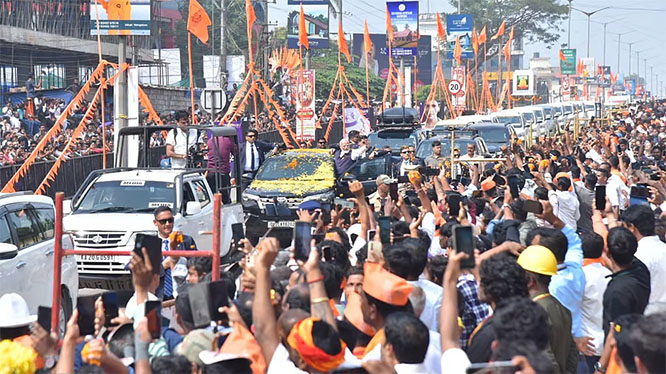
Udupi district transformed into a sea of saffron and celebration on Friday, November 28, as Prime Minister Narendra Modi’s roadshow swept through the coastal temple town. Thousands of residents lined the streets, turning the event into a vibrant public spectacle filled with cheers, flags, and festive energy.

The procession route—from the helipad to the historic Sri Krishna Math—was decked with buntings, saffron flags, and multilayered security barricades. One of the district’s largest-ever security deployments was put in place for the high-profile visit, with over 3,000 police personnel on duty. The arrangement included ten SPs, 27 DSPs, 49 inspectors, 127 sub-inspectors, 232 assistant sub-inspectors, 1,608 constables, and 39 women staff.

Six platoons of the Karnataka State Reserve Police, six Quick Response Teams, bomb detection units, and dog squads were stationed across Udupi. Enhanced surveillance covered Adi Udupi, Bannanje bus stand, and the Sri Krishna Math parking zone, with combing operations carried out along the roadshow corridor.

At the 800-year-old Sri Krishna Math, preparations reached a ceremonial peak. Paryaya Puttige Math seer Sugunendra Teertha Swamiji said the Prime Minister would take part in the Laksha Kantha Geetha Parayana, a mass chanting of the Bhagavad Gita by one lakh devotees, and inaugurate the new Suvarna Teertha Mantapa.

“He will first offer floral tributes to saint-poet Kanakadasa and then unveil the golden covering over the Kanakana Kindi,” the seer said.

The Prime Minister will also receive a Poorna Kumbha welcome and have darshan of Lord Sri Krishna, Mukhyaprana Devaru, and the Suvarna Paduke. Union Minister Pralhad Joshi, Karnataka Governor Thaawarchand Gehlot, Minister Bairathi Suresh, Dharmadhikari D. Veerendra Heggade, and seers from the Ashta Maths are expected to join the ceremony.

Ahead of his arrival, the Prime Minister posted on X that he felt “honoured” to attend the spiritually significant gathering. “This is a special occasion that brings together people from different sections of society for a recital of the Gita. This Matha has a very special significance in our cultural life,” he wrote, noting the institution’s long-standing legacy rooted in the teachings of Sri Madhvacharya.

roadshow2.jpg

Comments

Add new comment

  • Coastaldigest.com reserves the right to delete or block any comments.
  • Coastaldigset.com is not responsible for its readers’ comments.
  • Comments that are abusive, incendiary or irrelevant are strictly prohibited.
  • Please use a genuine email ID and provide your name to avoid reject.
News Network
December 2,2025

A major upgrade in safety and monitoring is planned for Haj 2026, with every Indian pilgrim set to receive a Haj Suvidha smart wristband linked to the official Haj Suvidha mobile app. The initiative aims to support pilgrims—especially senior citizens—who may struggle with smartphones during the 45-day journey.

What the Smart Wristband Will Do

Officials said the device will come with:
•    Location tracking
•    Pedometer
•    SOS emergency button
•    Qibla compass
•    Prayer timings
•    Basic health monitoring

SP Tiwari, secretary of the UP State Haj Committee, said the goal is to make the pilgrimage safer and more comfortable.

“Most Hajis are elderly and not comfortable with mobile apps,” he said. “The smartwatch will help locate pilgrims who forget their way or cannot communicate their location.”

The wristbands will be monitored by the Consulate General of India in Saudi Arabia, similar to mobile tracking via the Haj Suvidha App.

Free Distribution and Training

•    Smart wristbands will be given free of cost.
•    Training for pilgrims will be conducted between January and February 2026.
•    Sample units will reach state Haj committees soon.
•    Final devices will be distributed as pilgrims begin their journey.

New Rules for Accommodation

Two major decisions have also been finalised for Haj 2026:
1.    Separate rooms for men and women – including married couples. They may stay on the same floor but must occupy different rooms, following stricter Saudi guidelines.
2.    Cooking banned – gas cylinders will not be allowed; all meals will be provided through official catering services arranged by the Haj Committee of India.

These decisions were finalised during a meeting of the Haj Committee of India and state representatives in Mumbai.

Haj Suvidha App Launched Earlier

The government launched the Haj Suvidha App in 2024, offering:

•    Training modules
•    Accommodation and flight details
•    Baggage information
•    SOS and translation tools
•    Grievance redressal

Haj 2026 Quota and Key States

•    India’s total Haj quota for 2026: 1,75,025 pilgrims
•    70% (1,25,000) allotted to the Haj Committee of India
•    30% (around 50,000) reserved for Haj Group Organisers

Uttar Pradesh has the largest allocation (around 30,000 seats), though approximately 18,000 pilgrims are expected to go this year. States with high pilgrim numbers include Kerala, Maharashtra and Gujarat.

Dates of Haj 2026

The pilgrimage is scheduled to take place from 24 May to 29 May, 2026 (tentative).
Haj is one of the five pillars of Islam and is mandatory for Muslims who meet the required conditions.

Comments

Add new comment

  • Coastaldigest.com reserves the right to delete or block any comments.
  • Coastaldigset.com is not responsible for its readers’ comments.
  • Comments that are abusive, incendiary or irrelevant are strictly prohibited.
  • Please use a genuine email ID and provide your name to avoid reject.