How hatemongers used fake news and rumours to unleash violence in Manipur

News Network
July 23, 2023

violence.jpg

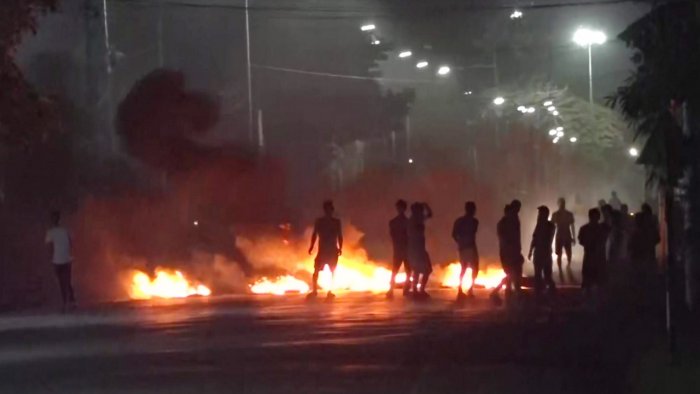
Imphal, July 23: The ethnic violence in Manipur that erupted on May 3 and has left over 160 dead has been largely fuelled by rumours and fake news, according to officials from various security agencies who have been monitoring the situation in the restive northeastern state.

The despicable May 4 incident in Kangpokpi district, where two women were paraded naked and assaulted by several people, was among the spate of sexual attacks that occurred after a picture of a body wrapped in polythene was circulated in the Imphal valley with a false claim that the victim had been murdered by tribals in Churachandpur.

The picture was later found to be that of a woman murdered in the national capital but the fire had engulfed the valley by that time, and what was witnessed the next day put humanity to shame, says an official while referring to the video of the Kangpokpi incident that appeared on social media last week and has sparked massive outrage in the country.

On the same day, barely 30 km away, two more women in their 20s were brutally raped and murdered.

The lawlessness because of the fake picture spread like jungle fire and was one of the reasons for the state government to shut down the Internet on May 3, the officials said.

A section of parties and activists have opposed the suspension of the Internet. Refusing to interfere, the Supreme Court on July 17 asked the Manipur government to raise its grievance before the high court against the HC's earlier order on a limited restoration of the Internet in the state.

Analysis by various security agencies engaged in dousing the fire in Manipur, which has been on the boil since May 3, has led to the conclusion that there is "no control on fake or one-sided news being circulated even by local newspapers".

Citing a recent example, they said one of the prominent dailies had claimed that tribal men, armed with weapons, had planned to attack the members of the majority community at Kwatha village of Chandel district.

Alarmed by the news report, Manipur police swung into action, only to find that the news report was false.

The police issued a statement saying that there was no attempt to burn any village as reported in some local dailies and again appealed that only verified information in sensitive cases should be published.

Police have dedicated 'Rumour Free Number' 9233522822 for verifying any information emerging either through social media or word of mouth and checking the spread of disinformation.

Another video showing tribal youths marching in Churachandpur a few days back was circulated in the valley with subtitles claiming that the tribals will snatch women and children from the majority community.

However, since the video was in Mizo language, which is the most widely spoken of the Kuki-Chin areas, some anti-social elements took advantage and put subtitles to raise tempers in the Imphal valley, where Manipuri Meiteilon is generally spoken.

What was actually spoken in the video was a demand for a separate administration which ended with a tribal hymn, the officials said.

Another fake news being peddled and circulated in the Imphal valley was that some tribals had torched a religious place - Kongba Maru Laiphamlen.

Security agencies took some of the members of the majority community and showed them that no damage had been done to the religious place. However, armed clashes were reported between the ethnic groups in which two tribals were injured. Things subsided after the news was denied.

Another video was circulated which showed some dead people lying on the ground and termed as members of the majority community mowed down by the tribals. This video was also circulated after the shocking 26-second clip of the assault on two tribal women appeared on social media.

The fact, officials said, was that the dead were members of the majority community who had attempted to burn a tribal village in the hills and were killed in retaliatory action.

In the early phase of violence, a video showing a young woman being brutally assaulted and finally shot to death was circulated with a claim that she was a tribal woman who was tortured by the majority community.

It was immediately clarified that the video was that of a woman killed in Tamu town of Myanmar last year and had no links with the ethnic clashes in Manipur.

Earlier this month, a vehicle, which was a part of Manipur Police's Inspector General (CID), was set afire after a fake rumour that some tribals were being escorted out of the Imphal valley. However, police took strong action and arrested people in this connection,

The majority community held a protest in the national capital where they had shown a woman from their community being targeted by the tribals. However, the picture was that of an Arunachal Pradesh woman who had been abused domestically, the officials said.

Officials feel that with the rumour mills working overtime, it will take a long time before the Internet could be fully restored in the state.

"The semblance of sanity has to arrive first. As of now, we are very far from that," a senior official said. 

Comments

Add new comment

  • Coastaldigest.com reserves the right to delete or block any comments.
  • Coastaldigset.com is not responsible for its readers’ comments.
  • Comments that are abusive, incendiary or irrelevant are strictly prohibited.
  • Please use a genuine email ID and provide your name to avoid reject.
News Network
February 3,2026

wind.jpg

Dakshina Kannada MP Capt Brijesh Chowta has urged the Centre to give high priority to offshore wind energy generation along the Mangaluru coast, citing its strategic importance to India’s green energy and port-led development goals.

Raising the issue in the Lok Sabha under Rule 377, Chowta said studies by the National Institute of Oceanography have identified the Mangaluru coastline as part of India’s promising offshore wind ‘Zone-2’, covering nearly 6,490 sq km. He noted that the region’s relatively low exposure to cyclones and earthquakes makes it suitable for long-term offshore wind projects and called for its development as a dedicated offshore wind energy zone.

Highlighting the role of New Mangalore Port, Chowta said its modern infrastructure, multiple berths and heavy cargo-handling capacity position it well as a logistics hub for transporting and assembling large wind energy equipment.

He also pointed to the presence of major industrial units such as MRPL, OMPL, UPCL and the Mangaluru SEZ, which could serve as direct buyers of green power through power purchase agreements, improving project viability and speeding up execution.

With Karnataka’s peak power demand crossing 18,000 MW in early 2025, Chowta stressed the need to diversify renewable energy sources. He added that offshore wind projects in the Arabian Sea are strategically safer compared to the cyclone-prone Bay of Bengal.

Calling the project vital to India’s target of 500 GW of renewable energy by 2030, Chowta urged the Ministry of New and Renewable Energy to initiate resource assessments, pilot projects and stakeholder consultations at the earliest.

Comments

Add new comment

  • Coastaldigest.com reserves the right to delete or block any comments.
  • Coastaldigset.com is not responsible for its readers’ comments.
  • Comments that are abusive, incendiary or irrelevant are strictly prohibited.
  • Please use a genuine email ID and provide your name to avoid reject.
News Network
February 4,2026

Mangaluru: Urban local bodies and gram panchayats should make the use of Kannada on signboards mandatory while issuing trade licences to commercial establishments, Dakshina Kannada Deputy Commissioner Darshan HV said. He also called for regular inspections to ensure compliance.

Presiding over the District Kannada Awareness Committee meeting at the deputy commissioner’s office, Darshan said the city corporation would be directed to ensure that shops operating in malls prominently display their names in Kannada. “All commercial establishments, including shops, companies, offices and hotels, must mandatorily display their names in Kannada on signboards,” he said.

The deputy commissioner added that the National Highways Authority of India (NHAI) would be instructed to include Kannada on signboards along national highways. Banks, he said, would be directed through committee meetings to provide application forms in Kannada.

“Even if English-medium schools and colleges impart education in English, their signboards must display the institution’s name in Kannada. Steps will also be taken to ensure that private buses display place names in Kannada,” Darshan said.

During the meeting, committee members raised concerns over the closure of Kannada-medium schools in rural areas due to a shortage of teachers and stressed the need for immediate corrective measures. They also pointed out that several industries employ workers from other states while overlooking local candidates.

Members further demanded that nationalised banks provide deposit and withdrawal slips in Kannada. It was brought to the deputy commissioner’s notice that the presence of staff without knowledge of Kannada in rural branches of nationalised banks is causing hardship to local customers.

Meanwhile, MP Srinath, president of the District Kannada Sahitya Parishat, urged the district administration to allot land for the construction of a district Kannada Bhavana in Mangaluru.

Comments

Add new comment

  • Coastaldigest.com reserves the right to delete or block any comments.
  • Coastaldigset.com is not responsible for its readers’ comments.
  • Comments that are abusive, incendiary or irrelevant are strictly prohibited.
  • Please use a genuine email ID and provide your name to avoid reject.
News Network
February 1,2026

Bengaluru, Feb 1: For travelers landing at Kempegowda International Airport (KIA), the sleek, wood-paneled curves of Terminal 2 promise a world-class welcome. But the famed “Garden City” charm quickly withers at the curb. As India’s aviation sector swells to record numbers—handling over 43 million passengers in Bengaluru alone this past year—the “last mile” has turned into a marathon of frustration.

The Bengaluru Logjam: Rules vs Reality

While the city awaits the 2027 completion of the Namma Metro Blue Line, the interim has been chaotic. Recent “decongestion” rules at Terminal 1 have pushed app-based cab pickups to distant parking zones, forcing weary passengers into a 20-minute walk with luggage.

“I landed after ten months away and felt like a stranger in my own city,” says Ruchitha Jain, a Koramangala resident. “My driver couldn’t find me, staff couldn’t guide me, and the so-called ‘Premium’ lane is just a fancy tax on convenience.”

•    The Cost of Distance: A 40-km cab ride can now easily cross ₹1,500, driven by demand pricing and airport surcharges.

•    The Bus Gap: While Vayu Vajra remains a lifeline, its ₹300–₹400 fare is often cited as the most expensive airport bus service in the country.

A National Pattern of Disconnect

The struggle is not unique to Karnataka. From Chennai’s coast to Hyderabad’s plateau, India’s airports tell a familiar story: brilliant runways, broken exits.

City:    Primary Issue   |    Recent Development

Bengaluru:    Cab pickup restrictions & distance  |    App-based taxis shifted to far parking zones; long walks and fare spikes reported

Chennai:    Multi-Level Parking (MLCP) hike  |    Passengers report 40-minute walks to reach cab pickup points

Hyderabad:    “Taxi mafia” & touting  |    Over 440 touting cases reported; security presence intensified

Mumbai:    Fare scams  |     Tourists charged ₹18,000 for just 400 metres, triggering police action

In Hyderabad, travelers continue to battle entrenched local groups that intimidate Uber and Ola drivers, pushing passengers toward overpriced private taxis. Chennai flyers, meanwhile, complain that reaching the designated pickup zones now takes longer than short-haul flights from cities like Coimbatore.

The ‘Budget Day’ Hope

As Finance Minister Nirmala Sitharaman presents the Union Budget 2026 today, the aviation sector is watching closely. With the government’s renewed emphasis on multimodal integration, there is cautious hope for funding toward seamless airport-metro-bus hubs.

The vision is clear: a future where planes, trains, and metros speak the same language. Until then, passengers at KIA—and airports across India—will continue to discover that the hardest part of flying isn’t the thousands of kilometres in the air, but the last few on the ground.

Comments

Add new comment

  • Coastaldigest.com reserves the right to delete or block any comments.
  • Coastaldigset.com is not responsible for its readers’ comments.
  • Comments that are abusive, incendiary or irrelevant are strictly prohibited.
  • Please use a genuine email ID and provide your name to avoid reject.