‘Increasingly gloomy developments’: IMF slashes India's 2022 growth forecast to 7.4%

News Network
July 26, 2022

imfund.jpg

Washington, July 26: The International Monetary Fund (IMF) on Tuesday slashed its annual growth projection for India by 0.8 percentage points to 7.4 per cent for 2022 and forecast "increasingly gloomy developments" for the global economy such as high inflation, downturn in China because of Covid-19 and spillovers from the war in Ukraine.

The fund cut its 2023 projection for India also by 0.8 percentage points to 6.1 per cent. These revised forecasts are relative to those in the fund's April world outlook report.

The 2022 cut for India "reflects mainly less favorable external conditions and more rapid policy tightening", said the fund's World Economic Outlook Update, titled "Gloomy and More Uncertain".

The World Bank has also slashed its projections for India to 7.5 per cent from 8 per cent for 2022-23, blaming it on a surge in Covid-19 cases, related mobility restrictions and the war in Ukraine.

The IMF forecast for India was called "rational" by an official who spoke on background.

"Given the gloomy global outlook and inflation contagion, IMF's growth forecast for India moderating it down by 0.8 percentage point is rational. Indian economy seems to be far more resilient at this point in time as others like US and China are talking a bigger hit with the forecast cut down to 1.4 and 1.1 percentage points respectively," the official said.

"Further, IMF continues to project India's growth rate in 2022 as the fastest growing major economy with 7.4 per cent and only other country around this rate is Saudi Arabia with 7.6 per cent. Nearest to this ASEAN-5 at 5.3 per cent while China is way down to 3.3 per cent."

The IMF projected a rather grim outlook for the world at large, saying it was facing "increasingly gloomy developments in 2022 as risks (that it had warned in April) began to materialise".

And they are: higher inflation worldwide, specially in the US and major European economies, triggering a sharp tightening in global financial conditions; a sharper-than anticipated slowdown in China, reflecting Covid-19 outbreaks and lockdowns; and further negative cross-border effects from the war in Ukraine.

The IMF slashed its global growth forecast to 3.2 per cent for 2022 and 2.9 per cent in 2023, down from April estimates of 3.6 per cent for both years.

"The outlook has darkened significantly since April," IMF Chief Economist Pierre-Olivier Gourinchas said in a statement. "The world may soon be teetering on the edge of a global recession, only two years after the last one."

The report acknowledged that though it had warned of inflation, it had not expected it to go so high. At 9.1 per cent for both, inflation has been the highest for the US and the UK in 40 years and at 9.8 per cent in the euro area, it's the highest since the inception of the unified monetary system; and, the report said, emerging and developing economies are also expected to be experiencing inflation at the rate of 9.8 per cent.

With wages not keeping pace in both advanced and emerging markets and developing economies, the report shows that household purchasing power will be eroded.

In China, ongoing Covid-19 outbreaks and mobility restrictions have "disrupted economic activity widely and severely", the fund said, and slowdown in China "has global consequences".

It added: "Lockdowns added to global supply chain disruptions and the decline in domestic spending are reducing demand for goods and services from China's trade partners."

The continuing war in Ukraine is causing "widespread hardship", the report said, detailing the disruptive and debilitating effect it's having on life -- 9 million Ukrainians fleeing the country, for instance -- and economy with existing sanctions on Russia and those coming on its energy export to Europe. 

Comments

Add new comment

  • Coastaldigest.com reserves the right to delete or block any comments.
  • Coastaldigset.com is not responsible for its readers’ comments.
  • Comments that are abusive, incendiary or irrelevant are strictly prohibited.
  • Please use a genuine email ID and provide your name to avoid reject.
News Network
November 26,2025

Mangaluru, Nov 26: Assembly Speaker and local MLA U.T. Khader has initiated a high-level push to resolve one of Mangaluru’s longest-standing traffic headaches: the narrow, high-density stretch of National Highway-66 between Nanthoor and Talapady.

He announced on Tuesday that a formal proposal has been submitted to the Union Ministry of Road Transport and Highways (MoRTH) seeking approval to prepare a Detailed Project Report (DPR) for the widening of this crucial corridor.

The plan specifically aims to expand the existing 45-meter road width to a full 60 meters, coupled with the construction of dedicated service roads. Khader highlighted that land for a 60-meter highway was originally acquired during the initial four-laning project, but only 45 meters were developed, leading to a perpetual bottleneck.

"With vehicle density rising sharply, the expansion has become unavoidable," Khader stated, stressing that the upgrade is essential for ensuring smoother traffic flow and improving safety at the city's main entry and exit points.

The stretch between Nanthoor and Talapady is a vital link on the busy Kochi-Panvel coastal highway and connects to major city junctions. The move to utilize the previously acquired land for the full 60-meter width is seen as a necessary measure to catch up with the region's rapid vehicular growth and prevent further traffic gridlocks.

Comments

Add new comment

  • Coastaldigest.com reserves the right to delete or block any comments.
  • Coastaldigset.com is not responsible for its readers’ comments.
  • Comments that are abusive, incendiary or irrelevant are strictly prohibited.
  • Please use a genuine email ID and provide your name to avoid reject.
News Network
November 21,2025

Bengaluru, Nov 21: The Karnataka government is facing pressure to overhaul its employment system after a high-level Cabinet sub-committee recommended the complete phase-out of job outsourcing in government offices, boards, and corporations by March 2028. The move is aimed at tackling a systemic issue that has led to the potential violation of constitutional reservation policies and the exploitation of workers.

The Call for Systemic Change

With over three lakh vacant posts currently being filled through private agencies on an outsource, insource, or daily wage basis, the sub-committee highlighted a significant lapse. "As a result, reservations are not being followed as per the Constitution and state laws. It’s an urgent need to take serious steps to change the system. It has been recommended to completely stop the system of outsourcing by March 2028," the panel stated in a document.

The practice of outsourcing involves private companies hiring workers to perform duties for a government agency. Critics argue this model results in lesser salaries, a lack of social security benefits (otherwise available to permanent government employees), and a failure to adhere to the provisions of Articles 14 and 15 of the Constitution, which guarantee equality before the law and prohibit discrimination.

The 'Bidar Model' as a Stop-Gap Solution

To regulate the current mode of employment and reduce worker exploitation until the 2028 deadline, the government plans to establish workers’ services multi-purpose cooperative societies across all districts, following the successful "Bidar Model."

The Bidar District Services of Labour Multi-purpose Cooperative Society Ltd., which operates under the District Commissioner, is cited as a successful example of providing a measure of social security to outsourced staff. Labour Department officials argue this society ensures workers receive their due wages and statutory facilities like ESI (Employees' State Insurance) and PF (Provident Fund), in exchange for a 1% service fee collected from the employees.

legislative push and Priority Insourcing

The recommendations, led by the sub-committee headed by Law and Parliamentary Affairs Minister H K Patil, are set to be discussed at the next Cabinet meeting. The committee has proposed the introduction of the Karnataka Outsourced Employees (Regulation, Placement and Welfare) Bill 2025.

In a move addressing immediate concerns, Labour Minister Santosh Lad, a member of the sub-committee, has reportedly assured that steps will be taken over the next 2-3 years to insource workers in "life-threatening services" on a priority basis. This includes essential personnel like pourakarmikas (sanitation workers), drivers, electrical staff in the Energy Department, and Health Department staff handling contagious diseases. The transition aims to grant these workers the long-term security and benefits they currently lack under the outsourcing system. 

Comments

Add new comment

  • Coastaldigest.com reserves the right to delete or block any comments.
  • Coastaldigset.com is not responsible for its readers’ comments.
  • Comments that are abusive, incendiary or irrelevant are strictly prohibited.
  • Please use a genuine email ID and provide your name to avoid reject.
News Network
December 5,2025

indigoCEO.jpg

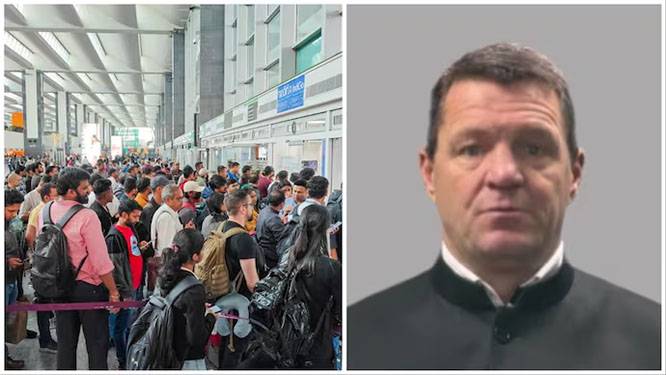
New Delhi, Dec 5: IndiGo CEO Pieter Elbers issued a public apology this evening after more than a thousand flights were cancelled today, making it the "most severely impacted day" in terms of cancellations. The biggest airline of the country cancelled "more than half" of its daily number of flights on Friday, said Elbers. He also said that even though the crisis will persist on Saturday, the airline anticipates fewer than 1,000 flight cancellations.

"Full normalisation is expected between December 10 and 15, though IndiGo cautions that recovery will take time due to the scale of operations," the IndiGo CEO said. 

IndiGo operates around 2,300 domestic and international flights daily.

Pieter Elbers, while apologising for the major inconvenience due to delays and cancellations, said the situation is a result of various causes.

The crisis at IndiGo stems from new regulations that boost pilots' weekly rest requirements by 12 hours to 48 and allow only two night-time landings per week, down from six. IndiGo has attributed the mass cancellations to "misjudgment and planning gaps".

Elbers also listed three lines of action that the airline will adopt to address the issue.

"Firstly, customer communication and addressing your needs, for this, messages have been sent on social media. And just now, a more detailed communication with information, refunds, cancellations and other customer support measures was sent," he said.

The airline has also stepped up its call centre capacity.

"Secondly, due to yesterday's situation, we had customers stranded mostly at the nation's largest airports. Our focus was for all of them to be able to travel today itself, which will be achieved. For this, we also ask customers whose flights are cancelled not to come to the airports as notifications are sent," the CEO said.

"Thirdly, cancellations were made for today to align our crew and planes to be where they need to start tomorrow morning afresh. Earlier measures of the last few days, regrettable, have proven not to be enough, but we have decided today to reboot all our systems and schedules, resulting in the highest numbers of cancellations so far, but imperative for progressive improvements starting from tomorrow," he added.

As airports witnessed chaotic scenes, the Directorate General of Civil Aviation (DGCA) stepped in to grant IndiGo a temporary exemption from stricter night duty rules for pilots. It also allowed substitution of leaves with a weekly rest period. 

Civil Aviation Minister Ram Mohan Naidu has said a high-level inquiry will be ordered and accountability will be fixed.

Comments

Add new comment

  • Coastaldigest.com reserves the right to delete or block any comments.
  • Coastaldigset.com is not responsible for its readers’ comments.
  • Comments that are abusive, incendiary or irrelevant are strictly prohibited.
  • Please use a genuine email ID and provide your name to avoid reject.