



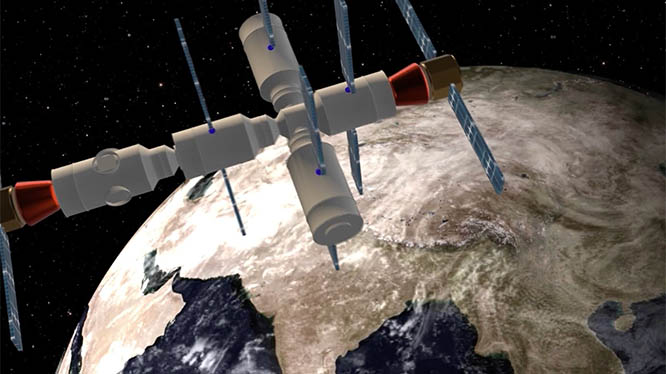
India becoming self-reliant in space: Gaganyaan in 2027; full-fledged Bharatiya Antariksh Station by 2035

Agencies
August 15, 2025

station.jpg

New Delhi: India is working towards becoming self-reliant in the space sector and preparing for the launch of Gaganyaan, its indigenous human space flight mission, Prime Minister Narendra Modi said on Friday.

Addressing the 79th Independence Day celebrations at the Red Fort, he said India was also developing its own space station and recalled that Group Captain Shubhanshu Shukla has returned from a space mission.

"Our Group Captain Shubhanshu Shukla has returned from the space station. In the coming days, he is returning to India," Modi said.

The prime minister said it was a matter of pride that India has been making strides in the space sector and 300 start-ups were working only in this sector. "This is the strength of the youth of the country and our confidence in them," Modi said.

ISRO is working on India's first indigenous human spaceflight mission -- Gaganyaan -- which is expected to be launched in 2027.

The first module of India's own space station is planned for launch in 2028 and a full-fledged Bharatiya Antariksh Station by 2035.

Shukla was part of the Axiom-4 private space mission that lifted off from Florida on June 25 and docked at the International Space Station on June 26. He returned to Earth on July 15.

Along with three other astronauts -- Peggy Whitson (US), Slawosz Uznanski-Wisniewski (Poland), and Tibor Kapu (Hungary) -- Shukla conducted over 60 experiments and 20 outreach sessions during the 18-day mission.

Comments

Add new comment

  • Coastaldigest.com reserves the right to delete or block any comments.
  • Coastaldigset.com is not responsible for its readers’ comments.
  • Comments that are abusive, incendiary or irrelevant are strictly prohibited.
  • Please use a genuine email ID and provide your name to avoid reject.
News Network
January 23,2026

Mangaluru: The Karnataka Government Polytechnic (KPT), Mangaluru, has achieved autonomous status from the All India Council for Technical Education (AICTE), becoming the first government polytechnic in the country to receive such recognition in its 78-year history. The status was granted by AICTE, New Delhi, and subsequently approved by the Karnataka Board of Technical Education in October last year.

Officials said the autonomy was conferred a few months ago. Until recently, AICTE extended autonomous status only to engineering colleges, excluding diploma institutions. However, with a renewed national focus on skill development, several government polytechnics across India have now been granted autonomy.

KPT, the second-largest polytechnic in Karnataka, was established in 1946 with four branches and has since expanded to offer eight diploma programmes, including computer science and polymer technology. The institution is spread across a 19-acre campus.

Ravindra M Keni, the first dean of the institution, told The Times of India that AICTE had proposed autonomous status for polytechnic institutions that are over 25 years old. “Many colleges applied. In the first round, 100 institutions were shortlisted, which was further narrowed down to 15 in the second round. We have already completed one semester after becoming an autonomous institution,” he said. He added that nearly 500 students are admitted annually across eight three-year diploma courses.

Explaining the factors that helped KPT secure autonomy, Keni said the institution has consistently recorded 100 per cent admissions and placements for its graduates. He also noted its strong performance in sports, with the college emerging champions for 12 consecutive years, along with active student participation in NCC and NSS activities.

Autonomous status allows KPT to design industry-oriented curricula, conduct examinations, prepare question papers, and manage academic documentation independently. The institution can also directly collaborate with industries and receive priority funding from AICTE or the Ministry of Education. While academic autonomy has been granted, financial control will continue to rest with the state government.

“There will be separate committees for examinations, question paper setting, boards of studies, and boards of examiners. The institution will now have the freedom to conduct admissions without government notifications and issue its own marks cards,” Keni said, adding that new academic initiatives would be planned after a year of functioning under the autonomous framework.

Comments

Add new comment

  • Coastaldigest.com reserves the right to delete or block any comments.
  • Coastaldigset.com is not responsible for its readers’ comments.
  • Comments that are abusive, incendiary or irrelevant are strictly prohibited.
  • Please use a genuine email ID and provide your name to avoid reject.