



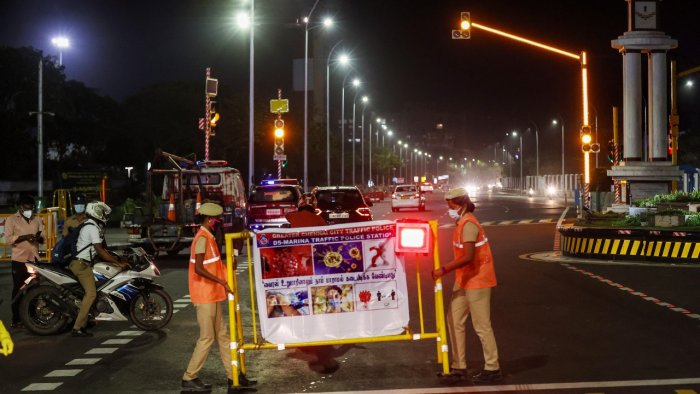
India fears another covid catastrophe as cases continue to rise

Agencies
January 7, 2022

catastrophy.jpg

Haunted by the spectre of last year's crisis, India is bracing for a deluge of Covid-19 cases, with authorities of various megacities bringing in restrictions in a bid to keep infections in check.

Case numbers have yet to match the enormous figures seen last spring, when thousands died each day and the Hindu holy city of Varanasi maintained round-the-clock funeral pyres for the mass cremation of virus victims.

But daily infections nearly tripled over two days this week to more than 90,000, a surge driven by the highly contagious Omicron variant that some experts worry could again see the country's hospitals overwhelmed.

An overnight curfew has been imposed in the Delhi area that includes the capital, where weekend movement restrictions will begin on Friday evening, with all non-essential workers asked to stay home.

Tech hub Bangalore has also declared a weekend curfew, while sprawling financial centre Mumbai introduced a night curfew.

"Even a small percentage of a large number of cases translates to a large number in absolute terms," Gautam Menon, a professor at India's Ashoka University who has worked on Covid infection modelling, told AFP.

"This could potentially stress out health care systems to levels comparable to or worse than the second wave."

Doctors and nurses who spoke to AFP have so far been optimistic, with fewer severe cases among those patients admitted to hospital -- and with the benefit of experience.

"Last year, we didn't know what exactly we were dealing with. I think now, mentally, it's a little better," one frontline worker at a Delhi hospital said.

Suresh Kumar, director of Lok Nayak Jai Prakash Hospital in the capital, where cases have quadrupled from a handful at the start of the week to 20, said the rise was "not a cause for panic".

Prime Minister Narendra Modi's administration has so far shied away from the drastic nationwide lockdown introduced during last year's catastrophic outbreak.

But local officials have watched the sharply rising case numbers with alarm and some of India's biggest urban centres have moved to impose restrictions again.

Earlier virus lockdowns were a hammer blow to the Indian economy and many are worried about the financial impact of new restrictions.

"I will be working only for 15 days this month," said Delhi resident Tumul Srivastava, whose office is subject to the 50 percent occupancy limits imposed by the city.

"My salary may be deducted. All this is adding to my anxiety."

India appears better placed to weather Omicron than it was ahead of the calamitous Delta wave it suffered last spring, when more than 200,000 people died in a matter of weeks.

Back then, hospitals ran out of oxygen and patients desperately scrambled to source medicine after a run on pharmacies.

In the time since, Indian health workers have injected nearly 1.5 billion vaccine doses, with government data showing nearly two-thirds of the country fully vaccinated.

That campaign, combined with last year's Delta sweep of towns and villages around the country, may help lessen the impact of the latest spread.

"Though we do not have data, this may give strong hybrid immunity against severe outcomes," University of Michigan epidemiologist Bhramar Mukherjee told AFP.

Preliminary studies have so far suggested the Omicron variant has led to less severe health consequences among those infected, despite its rapid spread.

Mukherjee warned however that an uncontrolled spread of new infections could still pose serious problems for India, even if the direct virus toll is a fraction of that seen last year.

"As you are witnessing in the US and UK, a major chunk of the working population being sick is affecting the societal infrastructure and leading to chaos," she said.

"I am afraid there may be a period in India when we see the same thing -- just the sheer volume may make the system crumble."

Comments

Add new comment

  • Coastaldigest.com reserves the right to delete or block any comments.
  • Coastaldigset.com is not responsible for its readers’ comments.
  • Comments that are abusive, incendiary or irrelevant are strictly prohibited.
  • Please use a genuine email ID and provide your name to avoid reject.
News Network
November 22,2025

The Karnataka government has announced a 50% rebate on pending traffic and transport fines. The discount is available from November 21 to December 12.

The rebate applies to all traffic e-challans and violation cases booked by the RTO between 1991–92 and 2019–20. Officials clarified that the offer is not applicable to pending tax dues and is restricted only to traffic-violation fines.

Across Karnataka, more than 4 lakh RTO cases remain pending, including those involving transport vehicles. While thousands of vehicle owners have already cleared their dues, the department expects to generate substantial revenue through this limited-period rebate.

How to Pay and Avail the Discount

There are three ways to check and pay your pending fines:

1. Through Mobile Apps
Available on both Play Store and App Store:
•    Karnataka State Police (KSP) app
•    KarnatakaOne app
•    ASTraM app

Steps:
•    Enter your vehicle number in any of the above apps
•    Verify the photo/details of your vehicle
•    Pay the fine with the 50% discount applied

2. Visit a Traffic Police Station

You can pay your pending fine at any nearby traffic police station.

3. Visit the Traffic Management Centre (TMC)

•    Location: First Floor, Infantry Road, near Indian Express, Bengaluru

Transport Commissioner Yogeesh A M said, “We don't issue e-challans, so there's no online payment system.”

The department estimates ₹52 crore in pending RTO fines up to March 2020. “With the 50% rebate, we expect to collect around ₹25 crore if all dues are cleared,” he added.

Comments

Add new comment

  • Coastaldigest.com reserves the right to delete or block any comments.
  • Coastaldigset.com is not responsible for its readers’ comments.
  • Comments that are abusive, incendiary or irrelevant are strictly prohibited.
  • Please use a genuine email ID and provide your name to avoid reject.
News Network
December 2,2025

A major upgrade in safety and monitoring is planned for Haj 2026, with every Indian pilgrim set to receive a Haj Suvidha smart wristband linked to the official Haj Suvidha mobile app. The initiative aims to support pilgrims—especially senior citizens—who may struggle with smartphones during the 45-day journey.

What the Smart Wristband Will Do

Officials said the device will come with:
•    Location tracking
•    Pedometer
•    SOS emergency button
•    Qibla compass
•    Prayer timings
•    Basic health monitoring

SP Tiwari, secretary of the UP State Haj Committee, said the goal is to make the pilgrimage safer and more comfortable.

“Most Hajis are elderly and not comfortable with mobile apps,” he said. “The smartwatch will help locate pilgrims who forget their way or cannot communicate their location.”

The wristbands will be monitored by the Consulate General of India in Saudi Arabia, similar to mobile tracking via the Haj Suvidha App.

Free Distribution and Training

•    Smart wristbands will be given free of cost.
•    Training for pilgrims will be conducted between January and February 2026.
•    Sample units will reach state Haj committees soon.
•    Final devices will be distributed as pilgrims begin their journey.

New Rules for Accommodation

Two major decisions have also been finalised for Haj 2026:
1.    Separate rooms for men and women – including married couples. They may stay on the same floor but must occupy different rooms, following stricter Saudi guidelines.
2.    Cooking banned – gas cylinders will not be allowed; all meals will be provided through official catering services arranged by the Haj Committee of India.

These decisions were finalised during a meeting of the Haj Committee of India and state representatives in Mumbai.

Haj Suvidha App Launched Earlier

The government launched the Haj Suvidha App in 2024, offering:

•    Training modules
•    Accommodation and flight details
•    Baggage information
•    SOS and translation tools
•    Grievance redressal

Haj 2026 Quota and Key States

•    India’s total Haj quota for 2026: 1,75,025 pilgrims
•    70% (1,25,000) allotted to the Haj Committee of India
•    30% (around 50,000) reserved for Haj Group Organisers

Uttar Pradesh has the largest allocation (around 30,000 seats), though approximately 18,000 pilgrims are expected to go this year. States with high pilgrim numbers include Kerala, Maharashtra and Gujarat.

Dates of Haj 2026

The pilgrimage is scheduled to take place from 24 May to 29 May, 2026 (tentative).
Haj is one of the five pillars of Islam and is mandatory for Muslims who meet the required conditions.

Comments

Add new comment

  • Coastaldigest.com reserves the right to delete or block any comments.
  • Coastaldigset.com is not responsible for its readers’ comments.
  • Comments that are abusive, incendiary or irrelevant are strictly prohibited.
  • Please use a genuine email ID and provide your name to avoid reject.
News Network
December 4,2025

Udupi: A 40-year-old NRI from Udupi has reportedly lost more than Rs 12.25 lakh in an online investment scam operated through Telegram.

According to a complaint filed at the CEN police station, Leo Jerome Mendonsa, who has been working in Dubai for the past 15 years in computer accessories sales, maintains NRI accounts in Karkala and Nitte.

On November 12, 2025, Mendonsa was added to a Telegram group called Instaflow Earnings by unknown individuals. Users identified as Priya and Dipannita persuaded him to invest in “Revenue Tasks.” Initially, Mendonsa transferred Rs 1,100 multiple times and received the promised returns, encouraging him to continue.

On November 14, another user, Nishmitha Shetty, directed him to register on a website, digitvisionuoce.cc, and invest Rs 4 lakh in various shares. Over the next few days, he made multiple transfers totaling Rs 12,25,000, including Rs 50,000 via Google Pay, believing the scheme was legitimate.

After receiving the money, the alleged handlers stopped responding, and neither the invested amount nor the promised profits were returned.

The CEN police have registered a case under Sections 66(C) and 66(D) of the IT Act and Section 318(4) of the Bharatiya Nyaya Sanhita (BNS), and investigations are ongoing.

Comments

Add new comment

  • Coastaldigest.com reserves the right to delete or block any comments.
  • Coastaldigset.com is not responsible for its readers’ comments.
  • Comments that are abusive, incendiary or irrelevant are strictly prohibited.
  • Please use a genuine email ID and provide your name to avoid reject.