India is hungry as Modi talks of feeding the world

Agencies
May 26, 2022

hungryindia.jpg

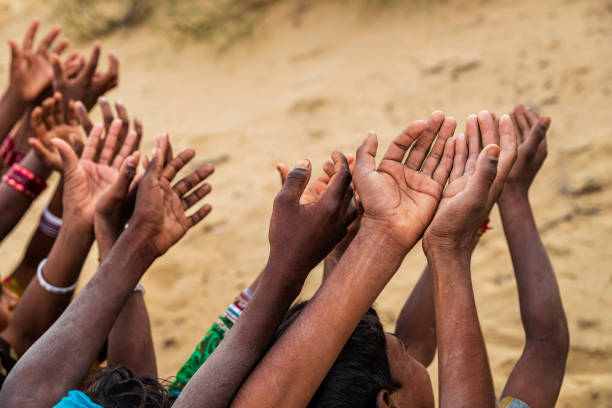
The only thing India can possibly do during this year’s global food crisis is to not make it any worse for its own poor. As the cost of basic nutrition balloons everywhere, the second-most-populous nation’s best bet is to fall back on its extensive system of state procurement and public distribution to soften the blow.

But, around mid-April, Prime Minister Narendra Modi promised US President Joe Biden that India could feed the world. If the World Trade Organisation allowed it, “India is ready to supply food stocks to the world from tomorrow,” Modi said, recalling the conversation.

Modi’s ministers and advisers ought to have known better. Just as the Indian leader was talking to Biden, the north Indian wheat crop was being scorched by a deadly heat wave. The Ukraine war and the resulting grain shortage may have presented India with an opportunity to script a role for itself in international trade, but climate change and a brewing chapati crisis should have been reasons to curb the enthusiasm.

Eventually it had to do just that: In mid-May, India imposed a hasty ban on wheat exports to ensure its own food security. It was a repeat of the Covid-19 fiasco when Modi bragged about how India, the world’s pharmacy, will save humanity. But a vicious outbreak of the delta variant forced it to backtrack. By March 31, India’s share of the global vaccine trade was just 2.3 per cent. Just as with the pandemic, the ripples of New Delhi’s wheat flip-flop are being felt internationally. The Group of Seven nations criticized the embargo. "If everyone starts to impose export restrictions or to close markets, that would worsen the crisis," German agriculture minister Cem Ozdemir said.

Actually, the opposite might be true. From Indonesia’s restrictions on palm-oil shipments to Malaysia’s ban on chicken exports, some 30 countries have resorted to such measures. Had India not closed its markets, the country might have faced a shortage of chapatis — India’s ubiquitous, unleavened daily bread. People, rich or poor, don’t consume wheat; they buy flour to make chapatis. And this year, there may be 6.5 per cent fewer chapatis for the same crop as previous harvests, while wheat output itself will likely see its first dip in seven years. 

In a nutshell, the problem is this: Last year, one kilo of Indian wheat resulted in about 770 grams of flour. This year, that might go down to 720 grams. The hottest March in 122 years has stunted grain formation. In fact, traders are buying wheat that is below their normal flour-yield cut-off level — that would be a score below 76 on a hectoliter test. Now, inferior readings of 72 are acceptable because of the scarcity of good wheat, according to industry sources.

Blame can be laid to the unusually early heat wave that engulfed India and Pakistan, weather that was made at least 30 times more likely by human-caused climate change, according to scientists at the World Weather Attribution initiative. India’s crop will be lucky to exceed 100 million tons this year, a steep decline from the initial government estimate of a record 111 million-ton harvest.

Taking 15 million metric tons from this total to export to the world — as the government boasted — was more than a little shortsighted. For one, the Food Corporation of India, the state-buying agency, has neglected to fill out its granaries. Last year, it bought 43 million metric tons for its stockpiles. This year’s target has been slashed to less than half of that. Those 19.5 million tons of purchases, plus the 30 million tons currently in FCI storage will mostly go into public distribution if the Modi administration extends the free grain program it started during the pandemic. There will be little left in the state’s wheat pool to tamp down any speculative fervor in the domestic open market.

The government isn’t without tools. If prices skyrocket, New Delhi can impose stock limits to force traders to release their hoards. The FCI could also offload more rice than wheat into the subsidised public distribution system. Most Indian diets nowadays can accommodate both. This could free up about 10 million tons of wheat to accommodate government-to-government supply deals such as with Egypt.

Still, these are stopgap solutions. The premise of Modi’s failed farm-reform legislation was to give more freedom to farmers to discover free-market prices for their produce. The about-face over wheat shows that when it comes to India’s agriculture, primacy of markets remains a pipe dream. A limit on sugar exports has also come up. Unlike wheat, where India is a bit player in global trade, the country is No. 2 in sugar shipments after Brazil. That’s a perfidy in itself because the sweetener guzzles water — and by selling it overseas, India exports its precious rain.

Maybe the current wheat shortage will ease if, as Lithuania has proposed, a protective corridor for grain shipments from Ukraine ends up breaking a Russian blockade of the Black Sea. With that, the pressure to feed India’s 1.4 billion people may also lift. But the long-term threat of climate change won’t go away. As global temperatures rise 2 degrees Celsius or more above pre-industrial levels, the country’s chapati challenge is only going to become more urgent.

Comments

Add new comment

  • Coastaldigest.com reserves the right to delete or block any comments.
  • Coastaldigset.com is not responsible for its readers’ comments.
  • Comments that are abusive, incendiary or irrelevant are strictly prohibited.
  • Please use a genuine email ID and provide your name to avoid reject.
News Network
December 2,2025

DKSsiddu.jpg

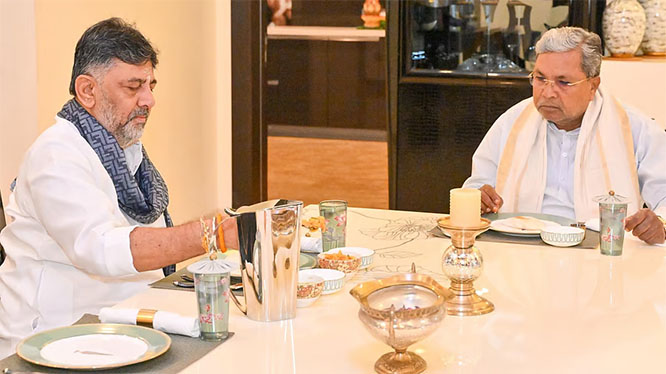
Bengaluru: 'Nati koli saaru' (country chicken curry) considered one of Chief Minister Siddaramaiah’s favourites along with steaming hot idlis was on the breakfast menu at Deputy CM D K Shivakumar’s residence on Tuesday, according to official sources.

The spread also included 'nati koli' fry, vada and pongal, among other items, they said.

In an apparent show of unity, Siddaramaiah visited Shivakumar’s residence for breakfast, just days after the two leaders shared a meal amid a simmering power tussle in the state Congress.

Siddaramaiah drove to the Deputy CM’s residence in Sadashivanagar, where he was received by Shivakumar and his brother D K Suresh, who is a former Congress MP.

Suresh and Kunigal MLA H D Ranganath, a relative of Shivakumar, joined them for breakfast, which featured a mix of vegetarian and non-vegetarian dishes.

Speaking to reporters later, Siddaramaiah said Shivakumar had invited him during his visit to the CM’s residence for breakfast on Saturday.

Asked about the difference between the two meals, the chief minister said, "At his (Shivakumar’s) house it was non-veg, while at my house it was veg. He is a vegetarian, I am a non-vegetarian. I had not prepared non-veg. I told DK to get chicken from the village as you won’t get the original in Bengaluru."

Shivakumar said he had initially invited Siddaramaiah to his residence, but the CM had suggested visiting his place first and reciprocating later. "It was a vegetarian breakfast at the CM’s house on Saturday," he noted.

"Today, I invited him (the CM) to my house. He enjoyed the breakfast, which had his Mysuru taste," Shivakumar added. At this point, Siddaramaiah remarked that Shivakumar’s wife is also from Mysuru.

Saturday’s breakfast at Siddaramaiah’s official residence, held as part of efforts by the Congress high command to ease tensions in the leadership dispute between the two, reportedly included idlis and sambar, according to official sources.

Comments

Add new comment

  • Coastaldigest.com reserves the right to delete or block any comments.
  • Coastaldigset.com is not responsible for its readers’ comments.
  • Comments that are abusive, incendiary or irrelevant are strictly prohibited.
  • Please use a genuine email ID and provide your name to avoid reject.
P A Hameed Padubidri
November 26,2025

CD.jpg

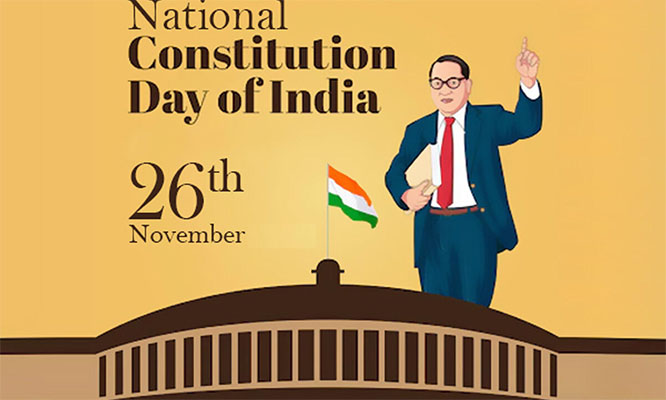
Constitution Day, also known as Samvidhan Divas, is observed every year on November 26 to honor the adoption of the Constitution of India and to recognize the visionary effort that shaped the world’s largest democracy.

Historical Background

It’s on November 26, 1949, the Constituent Assembly of India formally adopted the Constitution.This date is commemorated to acknowledge the completion of nearly three years of drafting, debate, and refinement.

On January 26, 1950, the Constitution came into force, marking India’s transition from a dominion to a sovereign republic.

The date 26 January was chosen to honor the “Purna Swaraj” declaration made in 1930 that marked the relentless efforts & sacrifices of the many. 

Why Constitution Day is Celebrated

* To honor & remember the framers of the Constitution, especially Dr. B. R. Ambedkar, the Chairman of the Drafting Committee, & many others. 

* To remind the citizens of the values, responsibilities, and rights enshrined in the Constitution.

* To promote constitutional values & literacy among students, institutions, and the general public.

* To reaffirm the nation’s commitment to justice, equality, liberty, fraternity and secular values. 

Vision and Significance of the Constitution

It establishes the fundamental political and legal framework for the nation.

Defines the structure, powers and functions of:
    •    The Executive
    •    The Legislature
    •    The Judiciary
    •    Guarantees a comprehensive set of Fundamental Rights, including:

-Equality before law
-Freedom of speech & expression
-Protection of life and personal liberty
-Freedom of religion
-Embeds Directive Principles of State Policy, guiding governance toward social justice and welfare.
-Introduces Fundamental Duties to ensure civic responsibility among citizens.

Key Features Celebrated on Constitution Day

-The Indian constitution is considered one of the longest written constitutions of the world. It’s systematically drafted considering almost all aspects that properly fits to the country. 

-Blend of multiple global constitutional principles while staying rooted in Indian values and realities.

-Framework that balances Federalism, Secularism, Democracy and Rule of Law. This makes everyone-from President to common man-below the law & are equal in the sight of law. 

-Another feature is that it’s based on built-in mechanisms for amendments, ensuring the Constitution grows with changing needs.

Message of the Day

The core ethos of this  Constitution Day is not merely about looking back at history-it’s a reminder of the continuous duty to protect democratic values, respect diversity and uphold the principles that define India as a sovereign, socialist, secular and democratic republic.

Happy Constitution Day to all my compatriots

Comments

Add new comment

  • Coastaldigest.com reserves the right to delete or block any comments.
  • Coastaldigset.com is not responsible for its readers’ comments.
  • Comments that are abusive, incendiary or irrelevant are strictly prohibited.
  • Please use a genuine email ID and provide your name to avoid reject.
News Network
November 26,2025

students.jpg

Bengaluru, Nov 26: Karnataka is taking its first concrete steps towards lifting a three-decade-old ban on student elections in colleges and universities. Deputy Chief Minister D.K. Shivakumar announced Wednesday that the state government will form a small committee to study the reintroduction of campus polls, a practice halted in 1989 following incidents of violence.

Speaking at a 'Constitution Day' event organised by the Karnataka Congress, Mr. Shivakumar underscored the move's aim: nurturing new political leadership from the grassroots.

"Recently, (Leader of the Opposition in Lok Sabha) Rahul Gandhi wrote a letter to me and Chief Minister (Siddaramaiah) asking us to think about restarting student elections," Shivakumar stated. "I'm announcing today that we'll form a small committee and seek a report on this."

Student elections were banned in Karnataka in 1989, largely due to concerns over violence and the infiltration of political party affiliates into campus life. The ban effectively extinguished vibrant student bodies and the pipeline of young leaders they often produced.

Mr. Shivakumar, who also serves as the Karnataka Congress president, said that former student leaders will be consulted to "study the pros and cons" of the re-introduction.

Acknowledging the history of the ban, he added, "There were many criminal activities taking place back then. We’ll see how we can conduct (student) elections by regulating such criminal activities."

The Deputy CM reminisced about his own journey, which began on campus. He recalled his political activism at Sri Jagadguru Renukacharya College leading to his first Assembly ticket in 1985 at the age of 23. "That's how student leadership was at the time. Such leadership has gone today. College elections have stopped," he lamented, adding that for many, college elections were "like a big movement" where leaders were forged.

The move, driven by the Congress high command's push to cultivate young talent, will face scrutiny from academics and university authorities who have, in the past, expressed concern that the return of polls could disrupt the peaceful academic environment and turn campuses into political battlegrounds.

Comments

Add new comment

  • Coastaldigest.com reserves the right to delete or block any comments.
  • Coastaldigset.com is not responsible for its readers’ comments.
  • Comments that are abusive, incendiary or irrelevant are strictly prohibited.
  • Please use a genuine email ID and provide your name to avoid reject.