‘India's actual covid death toll at least 3 million – nearly 10 times the official toll’

Agencies
July 21, 2021

The number of people who have died in the coronavirus pandemic in India is likely to exceed 3 million — nearly 10 times the official Covid-19 death toll — making it one of the worst human tragedies in the country’s history, according to a new study.

In an examination of the true toll of the pandemic in the sprawling country of 1.4 billion, the Center for Global Development, a Washington research institute, attempted to quantify excess deaths from all causes during the pandemic based on state data, international estimates, serological studies and household surveys.

“True deaths are likely to be in the several millions, not hundreds of thousands, making this arguably India’s worst human tragedy,” said its authors, one of whom is a former chief economic adviser to the government of Prime Minister Narendra Modi.

The official government numbers have been called into question repeatedly. Even as funeral pyres lit up the night sky and bodies washed up along the Ganges River, with death all around, the government was widely underreporting the scale of the devastation.

A chorus of experts have said the country’s official estimates are a gross understatement.

The study released Tuesday estimated that between 3.4 and 4.7 million more people than would normally be expected died between January 2020 and June 2021, and includes an estimate suggesting that deaths from Covid-19 may have reached 4 million.

“Estimating Covid deaths with statistical confidence may prove elusive,” the authors wrote. “But all estimates suggest that the death toll from the pandemic is likely to be an order of magnitude greater than the official count of 400,000; they also suggest that the first wave was more lethal than is believed.”

The authors said the undercount of death after the first wave of infections last year may have resulted, in part, from the fact that it was “spread out in time,” as opposed to the sharp curve of the second wave when hundreds of thousands of people died amid shortages of oxygen, beds and vaccines.

The study has said that the country’s inability to grasp the “scale of the tragedy in real time” during its first wave from March 2020 to February 2021 may have caused “the collective complacency that led to the horrors of the second wave.”

At the height of the second wave, interviews by New York Times reporters at cremation grounds in India exposed an extensive pattern of deaths far exceeding the official figures.

Nervous politicians and hospital administrators may also have undercounted or overlooked large numbers of dead, analysts said. And grieving families may be hiding Covid connections as well, out of shame, adding to the confusion.

India is still reporting nearly 40,000 new cases and about 500 deaths a day, according to a New York Times database. Less than 7% of the population is fully vaccinated.

 “The challenge of the pandemic is far from over,” said Arvind Subramanian, Modi’s former chief economic adviser and a senior fellow at Brown University who is a co-author of the study. “Vaccination offers the best hope but its pace needs to be ramped up considerably.”

Modi’s government has warned of an impending third wave of infections, which government scientists say could strike as early as August.

“The spirit of this paper is not to privilege any one estimate but simply to lay them out with transparency,” the authors of the excess deaths study, Abhishek Anand, Justin Sandefur and Subramanian, said.

“Given all the difficulties, getting at the true estimate will be difficult and only by piecing together data from different sources will we improve our understanding of the reality of the pandemic.”


Comments

Ramesh Mishra
 - 
Thursday, 29 Jul 2021

COVID-19, DEATH IN INDIA: Since the British left India in 1947, India failed to establish a skilled life and death records registry. The administration is monitored by IAS and PCS as the justices are completely deficient and corrupt. Most politicians of India are illiterates, unskilled, uncivilised, takes bribes with the criminal record and criminal minds. Covid-19, the pandemic is mismanaged resulting in massive death and causing economic catastrophe all over India. The BJP is a tyrannical regime and the people of India have no trust in the ruling elites and in desperation to save their lives and family leaving India " Like Rats Fleeing A Sinking Ship". India is a doomed Nation, its survival is uncertain.
Ramesh Mishra
Victoria BC CANADA
{" A UP NRI and Victime of the BJP tyrannical regime residing in Canada since 1975"]

Add new comment

  • Coastaldigest.com reserves the right to delete or block any comments.
  • Coastaldigset.com is not responsible for its readers’ comments.
  • Comments that are abusive, incendiary or irrelevant are strictly prohibited.
  • Please use a genuine email ID and provide your name to avoid reject.
News Network
December 6,2025

pilot.jpg

New Delhi: IndiGo, India’s largest airline, faced major operational turbulence this week after failing to prepare for new pilot-fatigue regulations issued by the Directorate General of Civil Aviation (DGCA). The stricter rules—designed to improve flight safety—took effect in phases through 2024, with the latest implementation on November 1. IndiGo has acknowledged that inadequate roster planning led to widespread cancellations and delays.

Below are the key DGCA rules that affected IndiGo’s operations:

1. Longer Mandatory Weekly Rest

Weekly rest for pilots has been increased from 36 hours to 48 hours.

The government says the extended break is essential to curb cumulative fatigue. This rule remains in force despite the current crisis.

2. Cap on Night Landings

Pilots can now perform only two night landings per week—a steep reduction from the earlier limit of six.

Night hours, defined as midnight to early morning, are considered the least alert period for pilots.

Given the disruptions, this rule has been temporarily relaxed for IndiGo until February 10.

3. Reduced Maximum Night Flight Duty

Flight duty that stretches into the night is now capped at 10 hours.

This measure has also been kept on hold for IndiGo until February 10 to stabilize operations.

4. Weekly Rest Cannot Be Replaced With Personal Leave

Airlines can no longer count a pilot’s personal leave as part of the mandatory 48-hour rest.

Pilots say this closes a loophole that previously reduced actual rest time.

Currently, all airlines are exempt from this rule to normalise travel.

5. Mandatory Fatigue Monitoring

Airlines must submit quarterly fatigue reports along with corrective actions to DGCA.

This system aims to create a transparent fatigue-tracking framework across the industry.

The DGCA has stressed that these rules were crafted to strengthen flight safety and align India with global fatigue-management standards. The temporary relaxations are expected to remain until February 2025, giving IndiGo time to stabilise its schedules and restore normal air travel.

Comments

Add new comment

  • Coastaldigest.com reserves the right to delete or block any comments.
  • Coastaldigset.com is not responsible for its readers’ comments.
  • Comments that are abusive, incendiary or irrelevant are strictly prohibited.
  • Please use a genuine email ID and provide your name to avoid reject.
News Network
November 30,2025

airportmetro.jpg

Udupi: The pontiffs of Sri Paryaya Puttige Mutt, the sacred seat of Jagadguru Shrimad Madhvacharya Moola Samsthanam, have submitted a proposal to the Prime Minister seeking comprehensive development for Udupi district. 

Proposal for International Airport

A key request is the establishment of an international airport. Highlighting that around 1,000 acres of land are available and suitable, the pontiffs noted that the existing Mangalore Airport provides limited international connectivity. They suggested the airport be developed under a Public-Private Partnership (PPP) or as a Greenfield Airport to boost trade, education, healthcare, and spiritual tourism.

Metro and Rapid Transit Connectivity

The proposal also calls for Metro Rail or Rapid Transit between Mangaluru and Udupi. The 55 km coastal stretch experiences heavy daily commuter traffic, causing congestion. The district administration is ready to prepare an initial project report for a Mass Rapid Transit corridor and requested inclusion under national urban mobility programmes to ensure safe, green, and time-efficient regional transport.

Port and Coastal Development

The pontiffs urged the development of an international-standard port with a cruise terminal along Udupi’s coast. They also requested fast-tracking of pending coastal tourism projects and revising Coastal Regulation Zone (CRZ) norms to encourage sustainable infrastructure and hospitality investment.

IT, AI and Technological Infrastructure

Support was sought for an IT and AI Innovation Park with incubation facilities under Digital India and Startup India initiatives. The proposal also emphasized the need for strengthened data security and cloud computing infrastructure to boost India’s technological independence.

Sports and Education Initiatives

The pontiffs requested national sports status for Kambala, along with financial and infrastructure support. They also sought the establishment of an AIIMS in Udupi, a new IIT campus, and approval for an IIM to promote higher education in the district.

Representation to the Prime Minister

Sri Sugunendra Tirtha Pontiff and Sri Sushrendra Tirtha Swamiji represented the pontiffs in submitting the comprehensive development proposal to the Prime Minister during his recent visit.

Comments

Add new comment

  • Coastaldigest.com reserves the right to delete or block any comments.
  • Coastaldigset.com is not responsible for its readers’ comments.
  • Comments that are abusive, incendiary or irrelevant are strictly prohibited.
  • Please use a genuine email ID and provide your name to avoid reject.
coastaldigest.com news network
November 28,2025

roadshow.jpg

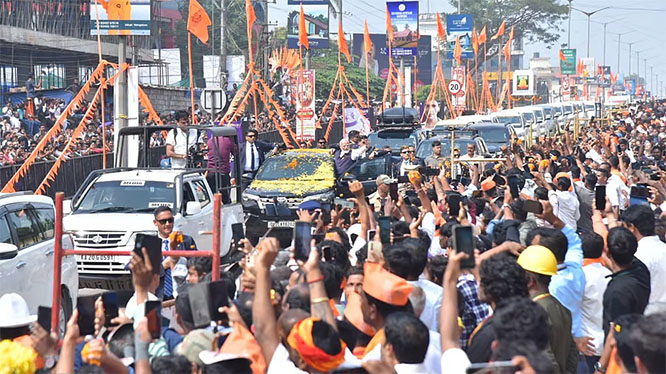
Udupi district transformed into a sea of saffron and celebration on Friday, November 28, as Prime Minister Narendra Modi’s roadshow swept through the coastal temple town. Thousands of residents lined the streets, turning the event into a vibrant public spectacle filled with cheers, flags, and festive energy.

The procession route—from the helipad to the historic Sri Krishna Math—was decked with buntings, saffron flags, and multilayered security barricades. One of the district’s largest-ever security deployments was put in place for the high-profile visit, with over 3,000 police personnel on duty. The arrangement included ten SPs, 27 DSPs, 49 inspectors, 127 sub-inspectors, 232 assistant sub-inspectors, 1,608 constables, and 39 women staff.

Six platoons of the Karnataka State Reserve Police, six Quick Response Teams, bomb detection units, and dog squads were stationed across Udupi. Enhanced surveillance covered Adi Udupi, Bannanje bus stand, and the Sri Krishna Math parking zone, with combing operations carried out along the roadshow corridor.

At the 800-year-old Sri Krishna Math, preparations reached a ceremonial peak. Paryaya Puttige Math seer Sugunendra Teertha Swamiji said the Prime Minister would take part in the Laksha Kantha Geetha Parayana, a mass chanting of the Bhagavad Gita by one lakh devotees, and inaugurate the new Suvarna Teertha Mantapa.

“He will first offer floral tributes to saint-poet Kanakadasa and then unveil the golden covering over the Kanakana Kindi,” the seer said.

The Prime Minister will also receive a Poorna Kumbha welcome and have darshan of Lord Sri Krishna, Mukhyaprana Devaru, and the Suvarna Paduke. Union Minister Pralhad Joshi, Karnataka Governor Thaawarchand Gehlot, Minister Bairathi Suresh, Dharmadhikari D. Veerendra Heggade, and seers from the Ashta Maths are expected to join the ceremony.

Ahead of his arrival, the Prime Minister posted on X that he felt “honoured” to attend the spiritually significant gathering. “This is a special occasion that brings together people from different sections of society for a recital of the Gita. This Matha has a very special significance in our cultural life,” he wrote, noting the institution’s long-standing legacy rooted in the teachings of Sri Madhvacharya.

roadshow2.jpg

Comments

Add new comment

  • Coastaldigest.com reserves the right to delete or block any comments.
  • Coastaldigset.com is not responsible for its readers’ comments.
  • Comments that are abusive, incendiary or irrelevant are strictly prohibited.
  • Please use a genuine email ID and provide your name to avoid reject.