India’s Chandrayaan-3 blasts off to the moon from Sriharikota

News Network
July 14, 2023

chandrayan.jpg

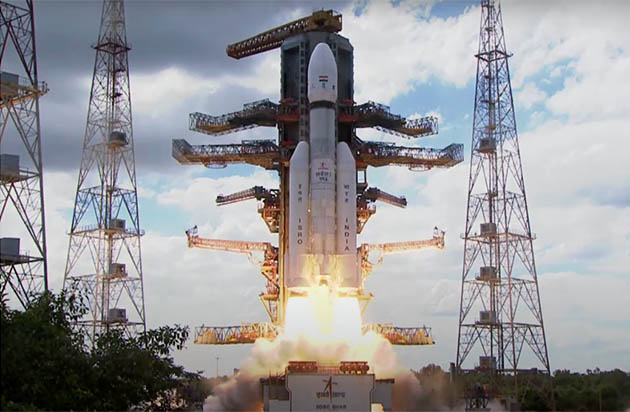
New Delhi, July 14: India’s third unmanned lunar mission, Chandrayaan-3, aimed at exploring the south polar region of the moon, soared into the sky successfully at 2.35 pm on Friday as planned from the second launch pad of the Satish Dhawan Space Centre (SDSC) here. 
 
The precise goal is to make a soft and safe landing on the lunar surface, and if the mission is successful, India will only be the fourth country to have achieved the feat, joining the elite club of the US, Russia, and China. The south-polar region of the moon is of intense interest due to the presence of many permanently shadowed craters which could contain water ice and precious minerals. 
 
At the end of the 25-hour and 30-minute countdown, LVM3-M4, India’s largest and heaviest launch vehicle, LVM3-M4, lifted off at 2:35 pm with the 3,900-kg Chandrayaan-3 spacecraft, including the lander. Minutes later, it transferred the satellites into the Geo Transfer orbit as scientists, including ISRO Chairman S Somnath and his predecessors, were watching the launch from the Control Command Centre. 

Billed as a follow-up mission to Chandrayaan-2 which failed after the lander crash-landed on the moon 48 days later, Chandrayaan-3 will seek to demonstrate end-to-end landing and roving capabilities. The spacecraft will take about 40 days to make a soft landing on the lunar surface which is expected to be between August 23 and 24, eight days lesser than what the Chandrayaan-2 mission took. 
 
The success of Chandrayaan-3 will also help the ISRO fast-tracking its planned manned mission to the space, named Gaganyaan. 
 
The Chandrayaan-3 lander carrying a rover within it will be carried into an orbit around the moon by the propulsion module. A little later, the lander will separate from that module and will attempt to make a soft landing in the south polar region of the moon, which is of intense interest as it has many permanently shadowed craters which could contain water ice and precious minerals. 
 
India’s first unmanned mission, Chandrayaan-1, which took off on October 22, 2008, demonstrated the country’s ability to reach the surface of the moon and discover water on the lunar surface, while the Chandrayaan-2 mission’s aim was to make a soft landing on the moon. 
 
Learning lessons from the failure, the ISRO has made several significant modifications to Friday's mission with officials attributing the 2019 failure to malfunctioning of the onboard computer and propulsion system. 
 
This time around, the lander’s legs have been strengthened, a fifth engine has been removed to reduce the weight, and the landing area has been expanded from 500mx500m (in Chandrayaan-2) to 4kmx2.4 km area in Chandrayaan-3. Several special tests like Integrated Cold and Integrated Hot tests and Lander Leg mechanism performance tests have also been conducted to ensure the success of the mission, the officials added.
 
The Chandrayaan-3 mission is yet another attempt to achieve the goal with the help of a rover. The spacecraft, according to officials, will have four payloads which will study moon quakes, how the surface of the moon allows heat to flow through it, the plasma environment near the moon's surface, and enable scientists to measure the distance between Earth and moon “very accurately.”
 
The two rover payloads study composition of the moon’s surface using X-rays and LASER, while the propulsion module payload will explore the Spectro-polarimetric signatures of the habitable planet, Earth. The mission is divided into three phases -- Earth Centric, Lunar Transfer, and Moon Centric. 
 
The work on Chandrayaan-3 began just a few months after the failure of Chandrayaan-2, but the Covid-19 pandemic and the subsequent lockdown delayed ISRO’s plans. By demonstrating its capabilities to soft-land on the moon, the ISRO is also hoping to expand its business as it is already launching private satellites from Sriharikota.

Comments

Add new comment

  • Coastaldigest.com reserves the right to delete or block any comments.
  • Coastaldigset.com is not responsible for its readers’ comments.
  • Comments that are abusive, incendiary or irrelevant are strictly prohibited.
  • Please use a genuine email ID and provide your name to avoid reject.
News Network
November 21,2025

Tejas.jpg

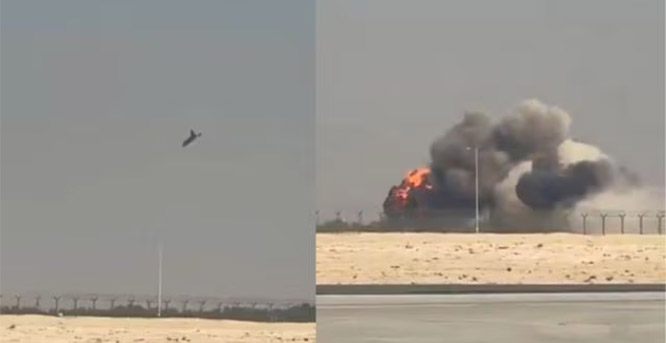
An Indian Air Force (IAF) Tejas fighter jet crashed on Friday, November 21, afternoon during its aerial demonstration at the Dubai Air Show, plunging to the ground at around 2:10 pm local time while performing a manoeuvre before thousands of spectators.

The IAF confirmed the incident, stating that a Tejas aircraft participating in the show had crashed and that further details were being gathered. An Air Force spokesperson said more information would be shared after initial assessments.

The crash sent thick black smoke billowing into the sky near the airport, causing panic among visitors, including families and children who had gathered to watch the display. Authorities have not yet confirmed whether the pilot managed to eject before the aircraft went down. Emergency response teams rushed to the scene, and officials have not released information on casualties or damage so far.

The Tejas is a 4.5-generation, multi-role fighter aircraft developed indigenously by Hindustan Aeronautics Limited (HAL). Designed for versatility, it is capable of offensive air support, close combat, ground attack missions and maritime operations. The aircraft family includes single-seat fighters and twin-seat trainers for both the Air Force and Navy.

HAL describes the latest version, the LCA Mk1A, as the most advanced in the series, featuring an AESA radar, an upgraded electronic warfare suite with radar-warning and self-protection jamming, smart multifunction displays, a digital map generator, a combined interrogator–transponder system and a modern radio altimeter. These enhancements significantly improve the aircraft’s combat capability and survivability.

Further updates from IAF and UAE authorities are awaited.

Comments

Add new comment

  • Coastaldigest.com reserves the right to delete or block any comments.
  • Coastaldigset.com is not responsible for its readers’ comments.
  • Comments that are abusive, incendiary or irrelevant are strictly prohibited.
  • Please use a genuine email ID and provide your name to avoid reject.
News Network
December 2,2025

A major upgrade in safety and monitoring is planned for Haj 2026, with every Indian pilgrim set to receive a Haj Suvidha smart wristband linked to the official Haj Suvidha mobile app. The initiative aims to support pilgrims—especially senior citizens—who may struggle with smartphones during the 45-day journey.

What the Smart Wristband Will Do

Officials said the device will come with:
•    Location tracking
•    Pedometer
•    SOS emergency button
•    Qibla compass
•    Prayer timings
•    Basic health monitoring

SP Tiwari, secretary of the UP State Haj Committee, said the goal is to make the pilgrimage safer and more comfortable.

“Most Hajis are elderly and not comfortable with mobile apps,” he said. “The smartwatch will help locate pilgrims who forget their way or cannot communicate their location.”

The wristbands will be monitored by the Consulate General of India in Saudi Arabia, similar to mobile tracking via the Haj Suvidha App.

Free Distribution and Training

•    Smart wristbands will be given free of cost.
•    Training for pilgrims will be conducted between January and February 2026.
•    Sample units will reach state Haj committees soon.
•    Final devices will be distributed as pilgrims begin their journey.

New Rules for Accommodation

Two major decisions have also been finalised for Haj 2026:
1.    Separate rooms for men and women – including married couples. They may stay on the same floor but must occupy different rooms, following stricter Saudi guidelines.
2.    Cooking banned – gas cylinders will not be allowed; all meals will be provided through official catering services arranged by the Haj Committee of India.

These decisions were finalised during a meeting of the Haj Committee of India and state representatives in Mumbai.

Haj Suvidha App Launched Earlier

The government launched the Haj Suvidha App in 2024, offering:

•    Training modules
•    Accommodation and flight details
•    Baggage information
•    SOS and translation tools
•    Grievance redressal

Haj 2026 Quota and Key States

•    India’s total Haj quota for 2026: 1,75,025 pilgrims
•    70% (1,25,000) allotted to the Haj Committee of India
•    30% (around 50,000) reserved for Haj Group Organisers

Uttar Pradesh has the largest allocation (around 30,000 seats), though approximately 18,000 pilgrims are expected to go this year. States with high pilgrim numbers include Kerala, Maharashtra and Gujarat.

Dates of Haj 2026

The pilgrimage is scheduled to take place from 24 May to 29 May, 2026 (tentative).
Haj is one of the five pillars of Islam and is mandatory for Muslims who meet the required conditions.

Comments

Add new comment

  • Coastaldigest.com reserves the right to delete or block any comments.
  • Coastaldigset.com is not responsible for its readers’ comments.
  • Comments that are abusive, incendiary or irrelevant are strictly prohibited.
  • Please use a genuine email ID and provide your name to avoid reject.
coastaldigest.com news network
December 2,2025

karkala.jpg

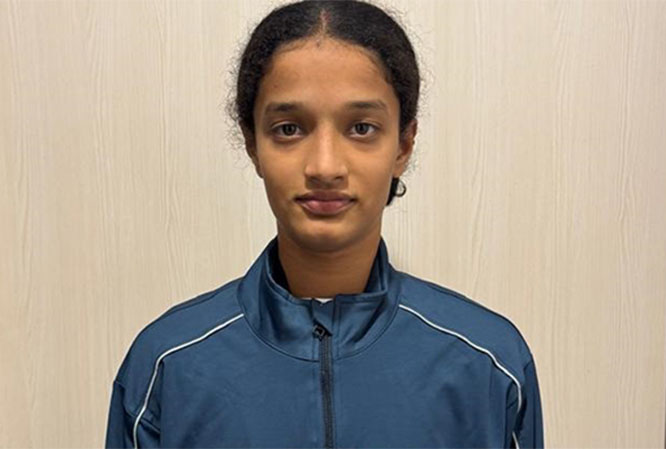
Udupi, Dec 2: A wave of regional pride is sweeping through Udupi district as Shagun S Verma Hegde, a talented Class 9 student from Christ King English Medium High School, Karkala, has been named the captain of the Indian National Team for the Under-15 Girls’ Volleyball Championship.

Shagun holds the unique distinction of being the sole player from Karnataka selected to represent the country in the prestigious international tournament. The championship, organized by the School Games Federation, is scheduled to take place in Shangluo, China, from December 3 to 13, where Shagun will lead the national squad.

A Remarkable Journey to the Top

Shagun’s selection is a testament to her dedication and exceptional skill on the court. Her journey included several rigorous rounds of selection:

•    She was the only player from Udupi district to qualify for the state-level selection camp.

•    Out of eight players from Karnataka who advanced to the national selection camp in Pune, Maharashtra, Shagun was the only one to secure a place in the final national squad.

•    The national camp saw participation from approximately 200 players, which was shortlisted to 23. Shagun not only made the final cut but was also ranked as the second-best player overall, solidifying her leadership role.

Shagun, who is the daughter of Sandesh Verma and Shruthiraj of Kallotte, Karkala, has trained under experienced coaches Santosh D’Souza, Jeevan D’Silva, Jairaj Poojary, and Ramesh. Her selection as the team captain has brought profound honour to her family, school, the Udupi district, and the entire state of Karnataka.

Comments

Add new comment

  • Coastaldigest.com reserves the right to delete or block any comments.
  • Coastaldigset.com is not responsible for its readers’ comments.
  • Comments that are abusive, incendiary or irrelevant are strictly prohibited.
  • Please use a genuine email ID and provide your name to avoid reject.