



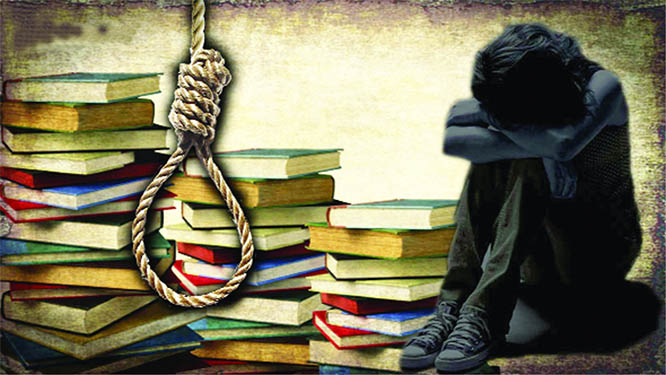
New Delhi: Incidents of student suicides in India have grown at an alarming annual rate, surpassing the population growth rate and overall suicide trends, according to a new report.
Based on the National Crime Records Bureau (NCRB) data, the "Student suicides: An epidemic sweeping India" report was launched on Wednesday at the Annual IC3 Conference and Expo 2024.
The report pointed out that while the overall suicide numbers increased by 2 per cent annually, student suicides cases surged by 4 per cent, despite a likely "under reporting" of student suicide cases. "Over the past two decades, student suicides have grown at an alarming annual rate of 4 per cent, double the national average. In 2022, male students constituted 53 pc (per cent) of the total student suicides. Between 2021 and 2022, male student suicides decreased by 6 per cent while female student suicides increased by 7 per cent," noted the report compiled by IC3 Institute.
"The incidence of student suicides continues to surpass both population growth rates and overall suicide trends. Over the last decade, while the population of 0-24-year-olds reduced from 582 million to 581 million, the number of student suicides increased from 6,654 to 13,044," it added.
The IC3 Institute is a volunteer-based organisation that provides support to high schools around the world through guidance and training resources for their administrators, teachers and counsellors to help establish and maintain robust career and college counselling departments.
According to the report, Maharashtra, Tamil Nadu, and Madhya Pradesh are identified as the states with the highest number of student suicides, together accounting for one-third of the national total.
Southern states and union territories collectively contribute 29 per cent of these cases, while Rajasthan, known for its high-stakes academic environment, ranks 10th, highlighting the intense pressure associated with coaching hubs like Kota.
"The data compiled by the NCRB is based on police-recorded first information reports (FIRs). However, it is important to acknowledge that the actual number of student suicides is likely underreported. This under-reporting can be attributed to several factors, including the social stigma surrounding suicide and the criminalisation of attempted and assisted suicide under Section 309 of the Indian Penal Code.
Although the 2017 Mental Healthcare Act decriminalises suicide attempts for individuals with mental illness, the legacy of criminalisation continues to impact reporting practices, it said.
"Moreover, there are significant data discrepancies due to the lack of a robust data collection system, particularly in rural areas, where reporting is less consistent compared to urban regions," it said.
Ganesh Kohli, the Founder of the IC3 Movement, said the report serves as a reminder of the urgent need to address mental health challenges within our learning institutions.
"Our educational focus must shift to fostering the competencies of our learners such that it supports their overall well-being, versus pushing them to compete amongst each other.
"It is imperative that we build a systematic, comprehensive, and robust career and college counselling system within each institution, while seamlessly integrating the same within the learning curriculum," he said.
Additionally, the report noted a dramatic increase in student suicides, with male suicides rising by 50 per cent and female suicides by 61 per cent over the past decade.
"Both genders have experienced an average annual increase of 5 pc (per cent) in the last five years. These alarming statistics underscore the critical need for enhanced counseling infrastructure and a deeper understanding of student aspirations.
"Addressing these gaps is essential for shifting the focus from competitive pressures to nurturing core competencies and well- being, thereby supporting students more effectively and preventing such tragedies," the report said.


Comments
Add new comment