



Millions of women face health risks thanks to Modi govt’s LPG subsidy cuts

By Debjit Chakraborty, Saket Sundria and Dhwani Pandya
March 9, 2021

women.jpg

Five years ago, Prime Minister Narendra Modi’s government offered Indian women a chance to dramatically improve their lives with cooking fuel subsidies in what became one of his administration’s most celebrated campaigns.

Now, hamstrung by a widening fiscal deficit, New Delhi has been slowly reducing the size of those handouts -- a shift that risks upsetting women voters and potentially exposing millions to heavier levels of pollution.

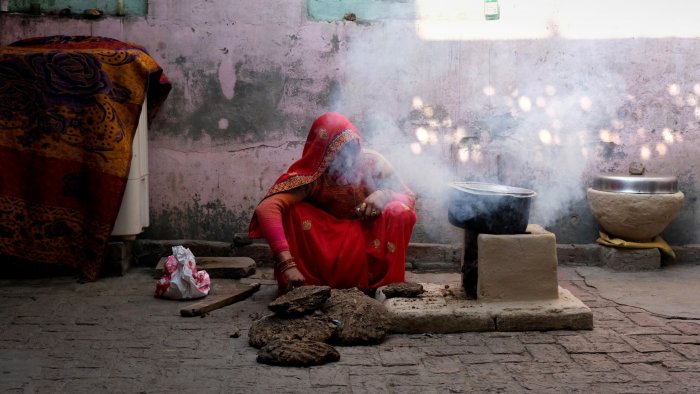
In Allauddinnagar, a village in India’s Uttar Pradesh state, Laxmi Kishore, a 35-year-old homemaker, is worried. Cooking food for her family used to be an ordeal that involved using cheap fuels like cow dung, crops and wood, which burn with a sooty flame and left her teary eyed and choking. When Modi’s program made liquefied petroleum gas cylinders affordable to her some years ago, she breathed more easily.

Now Kishore is preparing to return to her earthen stove and the smoggier fuels her ancestors used because the subsidy that landed in her account each time she refilled a cylinder has stopped arriving. Her husband lost his job as a cashier in a highway restaurant during last year’s Covid-19 lockdown, making a cooking cylinder unaffordable to them without the handout.

“I’m dreading a return to my earlier pain,” she said. “It will mean less sleep and suffering in the smoke again.”

Provisions for the LPG cooking fuel subsidies were halved in the federal budget for the fiscal year ending March 2022 to 124.8 billion rupees ($1.7 billion) from 255 billion rupees a year earlier. A spokesperson at India’s oil ministry didn’t respond to a request for comment.

The government continues to modulate the “effective price” for subsidized domestic LPG, Oil Minister Dharmendra Pradhan said in a written response to questions from parliament. “The subsidy on the product increases/decreases with the increase/decrease in the product price in international market and decision of government on subsidy,” he added.

The program launched in 2016 by the Modi government offered cash rebates for purchasing an LPG connection and a loan for the first canister of the fuel and stove. More than 80 million women from extremely poor households had received such LPG connections by Jan. 1 this year. The government announced plans in the latest federal budget to extend the benefit to another 10 million households, mostly located in the remote forests and hilly areas.

To help the poor struggling with lockdowns, the government last year also offered free LPG refills of three cylinders. India’s LPG consumption in 2020 surpassed gasoline for the first time ever over a calendar year, government data show.

But the free supplies were a one-off move and the finance director of Indian Oil Corp., the largest retailer of the cylinders, said last month that the government had last year stopped subsidizing the fuel for consumers except in the most remote areas.

Meanwhile, prices of LPG have surged across the country. Cost of a typical LPG cylinder sold by Indian Oil in Delhi has increased by 40% since November to Rs 819. Some opposition parties are focusing on the issue of high LPG prices for regional elections against Modi’s Bharatiya Janata Party.
Providing cooking gas has been one of the biggest successes of Modi’s flagship welfare programs which also included building toilets and houses for the poor.

“The elephant in the room is the price rise,” said Arati Jerath, a New Delhi-based author and political analyst. “The LPG program started as a very popular scheme, but has been petering out because of the price increase. Modi will have to come up with a new emotive issue as the government is running out of money to indulge in populism measures.”
LPG is crucial for reducing domestic pollution in India. The country has the highest instances of premature deaths in the world due to emissions from burning fossil fuels, including coal and oil products, according to research done by Harvard University in collaboration with other academic institutions.

“Withdrawal of subsidy and increase in prices is likely to affect LPG consumption, particularly in rural areas where alternatives such as firewood, agricultural residue, dung cakes are readily available,” according to Ashok Sreenivas, a senior fellow at Prayas, an Indian advocacy group that works in energy policy.

An increase in the use of alternative solid fuels will “definitely impact the health” of rural women and children as these release particulate matters that can cause illnesses including lung cancer, heart ailments and even stroke, he said.

India faces issues other than price in getting poorer populations to adopt cleaner fuel. Availability is also a problem in far flung areas that are hard to reach, Prayas said in a December report. India’s oil ministry has said beneficiaries of the program availed of less than two refills of the three free ones offered over nine months last year.

Air pollution inside houses, primarily due to burning solid fuels like wood, dried dung and biomass, contributed to more than 1 million deaths in 2010, making it the second- biggest health risk factor in India, according to a 2015 report by Steering Committee on Air Pollution and Health Related Issues.

The International Energy Agency in a special report last month said that despite the recent success in expanding coverage of LPG in rural areas, 660 million Indians haven’t fully switched to modern, clean cooking fuels. Higher costs and fewer subsidies might only make it harder to draw new users. Vehicular exhaust, industrial emissions and other factors have already made India home to 14 of the 20 most polluted cities in the world.

The task of encouraging the poor to use the cleaner fuel becomes even more challenging with millions losing their jobs during the pandemic. Poor households are more sensitive to higher fuel prices as they can easily shift to cheaper alternatives for which they need to pay just a few cents every day, rather than spending as much as $11 per cylinder upfront.

“Prices are rising and the government has stopped compensating us,” said Kaushal Kishore, Laxmi’s husband. “I can’t afford LPG any further and this is my last cylinder till I find myself a job.”

Comments

Add new comment

  • Coastaldigest.com reserves the right to delete or block any comments.
  • Coastaldigset.com is not responsible for its readers’ comments.
  • Comments that are abusive, incendiary or irrelevant are strictly prohibited.
  • Please use a genuine email ID and provide your name to avoid reject.
News Network
November 26,2025

students.jpg

Bengaluru, Nov 26: Karnataka is taking its first concrete steps towards lifting a three-decade-old ban on student elections in colleges and universities. Deputy Chief Minister D.K. Shivakumar announced Wednesday that the state government will form a small committee to study the reintroduction of campus polls, a practice halted in 1989 following incidents of violence.

Speaking at a 'Constitution Day' event organised by the Karnataka Congress, Mr. Shivakumar underscored the move's aim: nurturing new political leadership from the grassroots.

"Recently, (Leader of the Opposition in Lok Sabha) Rahul Gandhi wrote a letter to me and Chief Minister (Siddaramaiah) asking us to think about restarting student elections," Shivakumar stated. "I'm announcing today that we'll form a small committee and seek a report on this."

Student elections were banned in Karnataka in 1989, largely due to concerns over violence and the infiltration of political party affiliates into campus life. The ban effectively extinguished vibrant student bodies and the pipeline of young leaders they often produced.

Mr. Shivakumar, who also serves as the Karnataka Congress president, said that former student leaders will be consulted to "study the pros and cons" of the re-introduction.

Acknowledging the history of the ban, he added, "There were many criminal activities taking place back then. We’ll see how we can conduct (student) elections by regulating such criminal activities."

The Deputy CM reminisced about his own journey, which began on campus. He recalled his political activism at Sri Jagadguru Renukacharya College leading to his first Assembly ticket in 1985 at the age of 23. "That's how student leadership was at the time. Such leadership has gone today. College elections have stopped," he lamented, adding that for many, college elections were "like a big movement" where leaders were forged.

The move, driven by the Congress high command's push to cultivate young talent, will face scrutiny from academics and university authorities who have, in the past, expressed concern that the return of polls could disrupt the peaceful academic environment and turn campuses into political battlegrounds.

Comments

Add new comment

  • Coastaldigest.com reserves the right to delete or block any comments.
  • Coastaldigset.com is not responsible for its readers’ comments.
  • Comments that are abusive, incendiary or irrelevant are strictly prohibited.
  • Please use a genuine email ID and provide your name to avoid reject.
News Network
November 26,2025

Mangaluru, Nov 26: Assembly Speaker and local MLA U.T. Khader has initiated a high-level push to resolve one of Mangaluru’s longest-standing traffic headaches: the narrow, high-density stretch of National Highway-66 between Nanthoor and Talapady.

He announced on Tuesday that a formal proposal has been submitted to the Union Ministry of Road Transport and Highways (MoRTH) seeking approval to prepare a Detailed Project Report (DPR) for the widening of this crucial corridor.

The plan specifically aims to expand the existing 45-meter road width to a full 60 meters, coupled with the construction of dedicated service roads. Khader highlighted that land for a 60-meter highway was originally acquired during the initial four-laning project, but only 45 meters were developed, leading to a perpetual bottleneck.

"With vehicle density rising sharply, the expansion has become unavoidable," Khader stated, stressing that the upgrade is essential for ensuring smoother traffic flow and improving safety at the city's main entry and exit points.

The stretch between Nanthoor and Talapady is a vital link on the busy Kochi-Panvel coastal highway and connects to major city junctions. The move to utilize the previously acquired land for the full 60-meter width is seen as a necessary measure to catch up with the region's rapid vehicular growth and prevent further traffic gridlocks.

Comments

Add new comment

  • Coastaldigest.com reserves the right to delete or block any comments.
  • Coastaldigset.com is not responsible for its readers’ comments.
  • Comments that are abusive, incendiary or irrelevant are strictly prohibited.
  • Please use a genuine email ID and provide your name to avoid reject.
News Network
December 7,2025

Mangaluru, Dec 7: A 34-year-old fruit and vegetable trader in Mangaluru has reportedly lost ₹33.1 lakh after falling victim to an online investment scam run through a fake mobile app.

Police said the scam began in September, when the victim received a link on Facebook. Clicking it connected him to a WhatsApp number, where an unidentified person introduced a high-return investment scheme and instructed him to download an app.

To build trust, the fraudster asked him to invest ₹30,000 on September 24. The trader soon received ₹34,000 as “profit,” convincing him the scheme was genuine. Over the next two months, he transferred money in multiple instalments via Google Pay and IMPS to different scanner codes and bank accounts shared by the scammers. Between September 24 and December 3, he ended up sending a total of ₹33.1 lakh.

When he later requested a refund of his investment and promised returns, the scammers demanded additional payments, claiming he needed to pay a “service tax” first. Even after he paid a small amount, no money was returned, and the scammers continued pressuring him for more.

A case has been registered at the CEN Crime Police Station.

Comments

Add new comment

  • Coastaldigest.com reserves the right to delete or block any comments.
  • Coastaldigset.com is not responsible for its readers’ comments.
  • Comments that are abusive, incendiary or irrelevant are strictly prohibited.
  • Please use a genuine email ID and provide your name to avoid reject.