Modi govt 3.0 has 27 OBC ministers, 21 from ‘upper’ castes, 10 Dalits, 5 tribals, 2 Sikhs, 2 Buddhists, 1 Christian and ZERO Muslim

News Network
June 10, 2024

muslimlady.jpg

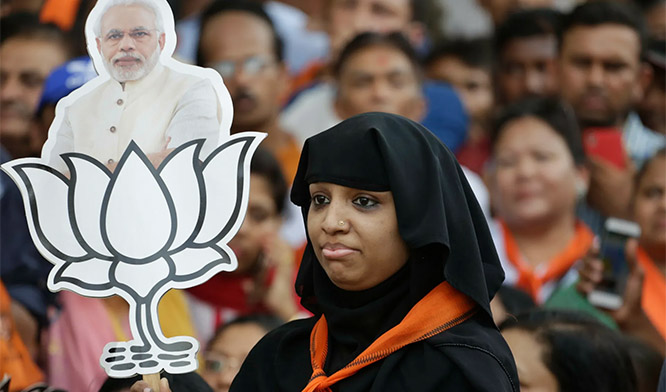
New Delhi: The 71 Union ministers who were sworn in alongside Prime Minister Narendra Modi Sunday include 10 Dalits, 27 from the Other Backward Classes (OBCs), 21 from the ‘upper’ castes, five from tribal groups and five representing religious minorities. However, there are no Muslims. 

In the previous term of the Bharatiya Janata Party (BJP)-led National Democratic Alliance, Mukhtar Abbas Naqvi was the minority affairs minister, but he resigned in 2022 after his term in the Rajya Sabha came to an end and was replaced by Smriti Irani. This time, no Muslim minister has been sworn in. No Muslim MPs from the NDA were elected to the Lok Sabha this time.

The five ministers from minority communities in the Modi Government 3.0 include Hardeep Singh Puri, Ravneet Singh Bittu, George Kurian, Kiren Rijiju and Ramdas Athawale. While Puri and Athawale are Rajya Sabha MPs and Rijiju won the Lok Sabha elections from Arunachal Pradesh, Bittu lost the elections from Punjab and Kurian, a Kerala BJP general secretary, did not contest.

After the 2019 general election, 57 ministers were sworn in, of whom 32 were from ‘upper’ castes, 13 from OBCs, six from Scheduled Castes and four from Scheduled Tribes. However, the Council of Ministers was subsequently expanded in 2021 and included 27 OBCs, 12 SCs, eight STs and 30 from the ‘upper’ castes. 

The share of representatives of the ‘upper’ castes is down after many ‘upper-caste’ candidates lost in Uttar Pradesh.

Dalit and tribal groups

In Modi’s second term, the late Ram Vilas Paswan, Thawar Chand Gehlot and Virendra Kumar were among the Dalit ministers. Kumar, who had succeeded Gehlot as the minister for social justice and empowerment, has made it to the cabinet this time, too, after winning his eighth Lok Sabha election from Madhya Pradesh. 

Besides him, Paswan’s son and Lok Janshakti Party (LJP) leader Chirag Paswan, and former Bihar chief minister Jitan Ram Manjhi, are among the new Dalit cabinet ministers.

Arjun Ram Meghwal from Rajasthan, who was serving as the law minister in the previous term, has been inducted this time as minister of state (independent charge). In addition, Athawale, S.P. Singh Baghel, L. Murugan and Kamlesh Paswan will be ministers of state.

 A senior BJP leader said, “More Dalit ministers have been added this time, which was necessary since the party lost a significant chunk of Dalit votes. Not just that, religious minorities ranging from Sikhs to Christians have been given representation.” 

There are also five ministers from tribal groups, same as the 2019-2024 term. Jual Oram from Odisha, who had also served as a minister in the Atal Bihari Vajpayee cabinet and has won the Lok Sabha elections six times, has been elevated to the position of a cabinet minister. Arjun Munda, another prominent tribal leader from the party, lost the election this time.

Sarbananda Sonowal, Savitri Thakur and Durga Das Uikey are other ministers from tribal groups.

Comments

Add new comment

  • Coastaldigest.com reserves the right to delete or block any comments.
  • Coastaldigset.com is not responsible for its readers’ comments.
  • Comments that are abusive, incendiary or irrelevant are strictly prohibited.
  • Please use a genuine email ID and provide your name to avoid reject.
News Network
December 6,2025

pilot.jpg

New Delhi: IndiGo, India’s largest airline, faced major operational turbulence this week after failing to prepare for new pilot-fatigue regulations issued by the Directorate General of Civil Aviation (DGCA). The stricter rules—designed to improve flight safety—took effect in phases through 2024, with the latest implementation on November 1. IndiGo has acknowledged that inadequate roster planning led to widespread cancellations and delays.

Below are the key DGCA rules that affected IndiGo’s operations:

1. Longer Mandatory Weekly Rest

Weekly rest for pilots has been increased from 36 hours to 48 hours.

The government says the extended break is essential to curb cumulative fatigue. This rule remains in force despite the current crisis.

2. Cap on Night Landings

Pilots can now perform only two night landings per week—a steep reduction from the earlier limit of six.

Night hours, defined as midnight to early morning, are considered the least alert period for pilots.

Given the disruptions, this rule has been temporarily relaxed for IndiGo until February 10.

3. Reduced Maximum Night Flight Duty

Flight duty that stretches into the night is now capped at 10 hours.

This measure has also been kept on hold for IndiGo until February 10 to stabilize operations.

4. Weekly Rest Cannot Be Replaced With Personal Leave

Airlines can no longer count a pilot’s personal leave as part of the mandatory 48-hour rest.

Pilots say this closes a loophole that previously reduced actual rest time.

Currently, all airlines are exempt from this rule to normalise travel.

5. Mandatory Fatigue Monitoring

Airlines must submit quarterly fatigue reports along with corrective actions to DGCA.

This system aims to create a transparent fatigue-tracking framework across the industry.

The DGCA has stressed that these rules were crafted to strengthen flight safety and align India with global fatigue-management standards. The temporary relaxations are expected to remain until February 2025, giving IndiGo time to stabilise its schedules and restore normal air travel.

Comments

Add new comment

  • Coastaldigest.com reserves the right to delete or block any comments.
  • Coastaldigset.com is not responsible for its readers’ comments.
  • Comments that are abusive, incendiary or irrelevant are strictly prohibited.
  • Please use a genuine email ID and provide your name to avoid reject.
News Network
December 4,2025

Mangaluru: Chaos erupted at Mangaluru International Airport (MIA) after IndiGo flight 6E 5150, bound for Mumbai, was repeatedly delayed and ultimately cancelled, leaving around 100 passengers stranded overnight. The incident highlights the ongoing country-wide operational disruptions affecting the airline, largely due to the implementation of new Flight Duty Time Limitations (FDTL) norms for crew.

The flight was initially scheduled for 9:25 PM on Tuesday but was first postponed to 11:40 PM, then midnight, before being cancelled around 3:00 AM. Passengers expressed frustration over last-minute communication and the lack of clarity, with elderly and ailing travellers particularly affected. “Though the airline arranged food, there was no proper communication, leaving us confused,” said one family member.

An IndiGo executive at MIA cited the FDTL rules, designed to prevent pilot fatigue by limiting crew working hours, as the cause of the cancellation. While alternative arrangements, including hotel stays, were offered, about 100 passengers chose to remain at the airport, creating tension. A replacement flight was arranged but also faced delays due to the same constraints, finally departing for Mumbai around 1:45 PM on Wednesday. Passengers either flew, requested refunds, or postponed their travel.

The Mangaluru delay is part of a broader crisis for IndiGo. The airline has been forced to make “calibrated schedule adjustments”—a euphemism for widespread cancellations and delays—after stricter FDTL norms came into effect on November 1.

While an IndiGo spokesperson acknowledged unavoidable flight disruptions due to technology issues, operational requirements, and the updated crew rostering rules, the DGCA has intervened, summoning senior airline officials to explain the chaos and outline corrective measures.

The ripple effect has been felt across the country, with major hubs like Bengaluru and Mumbai reporting numerous cancellations. The Mangaluru incident underscores the systemic operational strain currently confronting India’s largest carrier, leaving passengers nationwide grappling with uncertainty and delays.

Comments

Add new comment

  • Coastaldigest.com reserves the right to delete or block any comments.
  • Coastaldigset.com is not responsible for its readers’ comments.
  • Comments that are abusive, incendiary or irrelevant are strictly prohibited.
  • Please use a genuine email ID and provide your name to avoid reject.
News Network
December 7,2025

SHRIMP.jpg

Mangaluru, Dec 7: A rare bamboo shrimp has been rediscovered on mainland India more than 70 years after it was last reported, confirming for the first time the presence of Atyopsis spinipes in the country. The find was made by researchers from the Centre for Climate Change Studies at Sathyabama Institute of Science and Technology, Chennai, during surveys in Karnataka and Odisha.

The team — shrimp expert Dr S Prakash, PhD scholar K Kunjulakshmi, and Mangaluru-based researcher Maclean Antony Santos — combined field surveys, ecological assessments and DNA analysis to identify the elusive species. Their findings, published in Zootaxa, resolve decades of taxonomic confusion stemming from a 1951 report that misidentified the species as Atyopsis moluccensis without strong evidence.

The shrimp has now been confirmed at two locations: the Mulki–Pavanje estuary near Mangaluru and the Kuakhai River in Bhubaneswar. Historical specimens from the Andaman Islands, previously labelled as A. moluccensis, were also found to be misidentified and actually belong to A. spinipes.

The rediscovery began after an aquarium hobbyist in Odisha spotted a shrimp in 2022, prompting systematic surveys across Udupi, Karwar and Mangaluru. Four female specimens were collected in Mulki and one in Odisha, all genetically matching.

Researchers warn the species may exist in very small, vulnerable populations as freshwater habitats face increasing pressure from pollution, sand mining and infrastructure development. All verified specimens have been deposited with the Zoological Survey of India for future reference.

Comments

Add new comment

  • Coastaldigest.com reserves the right to delete or block any comments.
  • Coastaldigset.com is not responsible for its readers’ comments.
  • Comments that are abusive, incendiary or irrelevant are strictly prohibited.
  • Please use a genuine email ID and provide your name to avoid reject.