



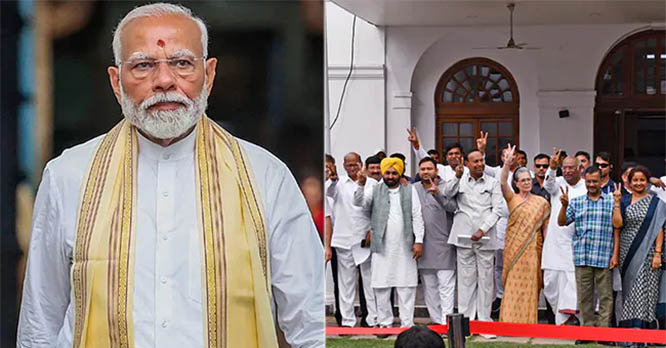
NDA nowhere near ‘400 par’, but PM Modi set to win historic 3rd term even as INDIA makes big gains

News Network
June 4, 2024

modiback.jpg

New Delhi: The BJP-led NDA was ahead with leads in 296 seats and the opposition I.N.D.I.A. bloc not far behind in 227 seats as votes were counted for the Lok Sabha elections on Tuesday, setting the course for a third consecutive term as prime minister for Narendra Modi but with a stronger opposition.

While the BJP was ahead in 236 of 542 seats, the Congress had leads in 97, signaling a dip for the ruling party from the 303 score in 2019 and a spike for the opposition party’s 52 from the last election. An election marked by acridity and acrimony could end with the treasury benches in reduced numbers and an opposition with more teeth.

In trends available till 11:45 am, the NDA was close to the 300 mark, comfortably over the magic figure of 272 with the opposition I.N.D.I.A. bloc making significant gains.

The country’s most politically significant state Uttar Pradesh, which sends 80 MPs to the Lok Sabha, and the BJP’s bastion of power was poised to be the game changer, bringing the ruling NDA down from the promise of ‘400 par’ with which Election 2024 had started.

While the BJP was ahead in 36 seats, down from 62 the last time, the Samajwadi Party was tantalisingly close at 33, a far cry from the five in 2019. The Congress, which had bagged just one seat in the last election, could win eight seats this time, according to trends available on the Election Commission website.

Prime Minister Narendra Modi, who is set to equal Jawaharlal Nehru’s record of being prime minister for a third term, was trailing behind his Congress rival Ajay Rai in Varanasi in the initial rounds but gained soon after.

His party colleague Smriti Irani was trailing behind Congress candidate and the relatively unknown Gandhi family aide Kishori Lal Sharma in Amethi by more than 39,000 votes. Among those leading from the state, where Yogi Adityanath had steered the Hindutva ship for his party, were Rahul Gandhi from Rae Bareli, Rajnath Singh from Lucknow and Akhilesh Yadav from Kannauj.

As SP chief Akhilesh Yadav kept the I.N.D.I.A. bloc morale high in Uttar Pradesh, the Trinamool Congress, another key ally of the opposition alliance, was leading in 29 seats in West Bengal, a tad higher than its 22 in 2019. The BJP, which had 18 seats in the last Lok Sabha election, was ahead in 10 seats.

In neighbouring Bihar, the BJP was ahead in 11 and its partner JD-U in 14, a vote of confidence for its leader Nitish Kumar who swung from INDIA back to the NDA ahead of the elections. The RJD was poised to win five seats.

Maharashtra, with 48 Lok Sabha seats, saw the Shiv Sena split down the middle since the last election. The BJP, which won 23 seats five years ago, was down with leads in 11 seats, while its ally Shiv Sena could get six. On the other end of the spectrum, the Congress was ahead in 11 seats, up from one, and the Shiv Sena (UBT) in 11.

In Andhra Pradesh, the Chandrababu Naidu-led TDP was ahead in 16 seats of 25, the BJP in three and the YSRCP in four.

Trends for Karnataka showed potential gains for the Congress, with leads in seven seats, up from one last time. The BJP, which got 25 seats in 2019, was ahead in 19.

Deeper south in Kerala, the BJP could make its much-debated electoral entry with trends showing it could bag two seats. In parallel, the Congress, which got 15 seats last time, was ahead in 13, including in Wayanad from where Rahul Gandhi was contesting. The CPI-M had gains in one.

Tamil Nadu seemed to be scripting another story, not ceding any space to the saffron party. The ruling DMK was ahead in 20 and the Congress in eight, exactly where they were in 2019.

Assembly elections also wrote their own narrative.

In Odisha, Naveen Patnaik-led BJD was headed for an unexpected defeat, stymieing Patnaik’s bid for a record sixth term as chief minister. The BJP established early leads in at least 50 assembly seats in Odisha. The BJD nominees, on the other hand, were leading in 35 constituencies in 94 of 147 assembly seats in the state for which trends were available.

In Andhra Pradesh, Chandrababu Naidu’s Telugu Desam Party raced towards power with leads in 125 seats in the house of 175, poised to dislodge Y S Jagan Reddy’s YSRCP, which was ahead only in 21 seats.

As the results came in, showing reverses for the BJP and a score far less than it had predicted, BJP MP Tejasvi Surya said, “It is a historic day for the country in many respects. Perhaps there is no parallel in the world in any democratic country where a democratically elected leader of the nation has been consecutively elected for the third time and with an equal or bigger manner than the preceding two times.”

Congress leader Salman Khurshid added, 'I am not saying we have won, I am not saying they have lost. But this is a clear message about facts on the ground.'

According to Shiv Sena (UBT) MP Sanjay Raut, the I.N.D.I.A. alliance had surpassed the numbers predicted by the exit polls and claimed the opposition bloc will win 295 Lok Sabha seats.


Comments

Add new comment

  • Coastaldigest.com reserves the right to delete or block any comments.
  • Coastaldigset.com is not responsible for its readers’ comments.
  • Comments that are abusive, incendiary or irrelevant are strictly prohibited.
  • Please use a genuine email ID and provide your name to avoid reject.
News Network
January 23,2026

Karnataka Governor Thaawarchand Gehlot read only three lines from the 122-paragraph address prepared by the Congress-led state government while addressing the joint session of the Legislature on Thursday, effectively bypassing large sections critical of the BJP-led Union government.

The omitted portions of the customary Governor’s address outlined what the state government described as a “suppressive situation in economic and policy matters” under India’s federal framework. The speech also sharply criticised the Centre’s move to replace the Mahatma Gandhi National Rural Employment Guarantee Act (MGNREGA) with the Viksit Bharat–Guarantee for Rozgar and Ajeevika Mission (Gramin) Act, commonly referred to as the VB-GRAM (G) Act.

Governor Gehlot had earlier conveyed his objection to several paragraphs that were explicitly critical of the Union government. On Thursday, he confined himself to the opening lines — “I extend a warm welcome to all of you to the joint session of the State legislature. I am extremely pleased to address this august House” — before jumping directly to the concluding sentence of the final paragraph.

He ended the address by reading the last line of paragraph 122: “Overall, my government is firmly committed to doubling the pace of the State’s economic, social and physical development. Jai Hind — Jai Karnataka.”

According to the prepared speech, the Karnataka government demanded the scrapping of the VB-GRAM (G) Act, describing it as “contractor-centric” and detrimental to rural livelihoods, and called for the full restoration of MGNREGA. The state government argued that the new law undermines decentralisation, weakens labour protections, and centralises decision-making in violation of constitutional norms.

Key points from the unread sections of the speech:

•    Karnataka facing a “suppressive” economic and policy environment within the federal system

•    Repeal of MGNREGA described as a blow to rural livelihoods

•    VB-GRAM (G) Act accused of protecting corporate and contractor interests

•    New law alleged to weaken decentralised governance

•    Decision-making said to be imposed by the Centre without consulting states

•    Rights of Adivasis, women, backward classes and agrarian communities curtailed

•    Labourers allegedly placed under contractor control

•    States facing mounting fiscal stress due to central policies

•    VB-GRAM (G) Act accused of enabling large-scale corruption

Comments

Add new comment

  • Coastaldigest.com reserves the right to delete or block any comments.
  • Coastaldigset.com is not responsible for its readers’ comments.
  • Comments that are abusive, incendiary or irrelevant are strictly prohibited.
  • Please use a genuine email ID and provide your name to avoid reject.
News Network
January 20,2026

iran.jpg

Iranian security and intelligence forces have captured more than 470 individuals in three provinces, identified as key figures behind the recent wave of violent unrest and terrorist activities linked to foreign-backed networks.

The Intelligence Ministry's provincial office in Khorasan Razavi announced on Monday the arrest of 192 armed terrorists, identified as the main agents behind recent riots in the region. 

According to an official statement, the detainees were involved in the killing of several security personnel and civilians, setting fire to mosques, public service facilities, and buses, as well as attacks on military and law enforcement centers.

The seized items from the group include several bulletproof vests, Kalashnikov rifles, hunting weapons, Winchester rifles, and various cold weapons such as daggers, swords, brass knuckles, tactical knives, crossbows, and chains.

Evidence indicates that some of the individuals were tied to hostile movements and terrorist organizations, with links overseas. Others were identified as members of violent criminal gangs, actively taking part in the unrest alongside their associates.

Simultaneously, in the western province of Lorestan, the IRGC announced the arrest of 134 individuals as the main leaders and influential field agents of a US-Israeli terrorist network.

The IRGC statement stated that these individuals formed terrorist cells during the recent unrest, committing "Daesh-like" acts.

They wounded security forces with firearms and cold weapons, and burned and destroyed public and private properties, including mosques, shops, banks, and private and public vehicles.

In the northwestern province of Zanjan, the police reported detaining 150 people identified as principal leaders and agents behind recent riots.

Authorities noted that these individuals were responsible for destroying public and private property and intentionally setting fire to vehicles in the province's squares.

Their crimes include shedding the blood of innocent people, destroying public and private property, attempting to enter military sites, disrupting public order, and spreading terror among citizens.

A variety of cold weapons were reportedly seized from the detainees.

What began late last month as peaceful protests over economic hardship across Iran turned violent after public statements by US and Israeli regime figures encouraged vandalism and disorder.

During the unrest, foreign-backed mercenaries rampaged through cities, killing security forces and civilians and damaging public property.

Comments

Add new comment

  • Coastaldigest.com reserves the right to delete or block any comments.
  • Coastaldigset.com is not responsible for its readers’ comments.
  • Comments that are abusive, incendiary or irrelevant are strictly prohibited.
  • Please use a genuine email ID and provide your name to avoid reject.
News Network
January 23,2026

oscar.jpg

The Voice of Hind Rajab, inspired by the tragic final moments of a young Palestinian girl killed by Israeli fire in Gaza, has been nominated for an Academy Award in the Best International Feature Film category.

Directed by Tunisian filmmaker Kaouther Ben Hania, the film recounts the true story of five-year-old Hind Rajab, who lost her life in January 2024 while fleeing Israeli bombardment with her family.

The film features the real audio of Hind’s desperate call to the Palestinian Red Crescent Society, where she pleaded for help moments before the vehicle she was in was struck by 355 bullets.

The haunting narrative begins with a brief call made from the besieged Tel al-Hawa neighborhood of Gaza, where gunfire and armored vehicles drowned out every sound.

After witnessing the brutal killing of her family, she made a trembling call, her voice reduced to a whisper as she spoke of the massacre and her unbearable loneliness as the sole survivor.

Premiering at the Venice International Film Festival in September 2025, The Voice of Hind Rajab garnered widespread acclaim, receiving a record-setting 23-minute standing ovation and the Silver Lion Grand Jury Prize, the festival’s second-highest honor.

In her acceptance speech, Ben Hania dedicated the film to humanitarian workers and first responders in Gaza, emphasizing that Hind's voice symbolizes countless civilians affected by war.

She aims to give voice to victims often reduced to mere statistics, highlighting the broader suffering of civilians in war zones.

The film’s Oscar nomination underscores its powerful storytelling and ethical approach to depicting real-life tragedy, making it a crucial piece of contemporary cinema.

It serves not only as a narration of individual tragedy but also as an artistic and documentary response to the silence and censorship that often overshadow West Asian struggles and wars.

Using an innovative method she calls docufiction, Ben Hania bridges unvarnished reality and narrative structure, creating a work that is both artistically valuable and socially impactful.

Born in 1977 in Sidi Bouzid—later the epicenter of the Arab revolution—her background profoundly influenced her worldview and artistic approach.

She is a graduate of the Higher School of Audiovisual Arts of Tunis, Pantheon-Sorbonne University, and La Fémis in Paris, where her studies equipped her with the technical and theoretical tools needed to address complex subjects. 

Comments

Add new comment

  • Coastaldigest.com reserves the right to delete or block any comments.
  • Coastaldigset.com is not responsible for its readers’ comments.
  • Comments that are abusive, incendiary or irrelevant are strictly prohibited.
  • Please use a genuine email ID and provide your name to avoid reject.
