‘No material to link with Al-Qaeda’: HC grants bail to Maulana who was in jail for over a year under UAPA

News Network
November 17, 2020

hc.jpg

The Jharkhand High Court has granted bail to a Maulana as he was charged under various sections of the Unlawful Activities (Prevention) Act [UAPA]. The police made out a case that the co-accused met at the house of the Maulana, the petitioner and he received money from Gujarat for committing anti-national work, being a “jihadi”. And thus, arrested him on September 9, 2019 and he has since been in custody.

Maulana Kalimuddin Muzahiri was arrested and charged under sections 121 [Waging, or attempting to wage war against the state], 121(A) [Conspiracy to commit offences punishable by section 121], 124(A) [sedition], 120-B [criminal conspiracy], 34 [Acts done by several persons in furtherance of common intention] of the Indian penal Code (IPC) read with Sections 25(1-B)a [in possession of firearms], 26 [secret contraventions], 35 [Criminal responsibility of persons in occupation of premises in certain cases] of Arms Act, Sections 16 [terrorist act], 17 [Punishment for raising funds for terrorist act], 18 [Punishment for conspiracy], 18-B [Punishment for recruiting of any person or persons for terrorist act], 19 [Punishment for harbouring], 20 [Punishment for being member of terrorist gang or organisation], 21 [Punishment for holding proceeds of terrorism], 23 [enhanced penalties] of U.P.A. Act and Section 17 of C.L.A. Act.

The counsel for the petitioner argued that during the investigation police did not follow through the investigation about the money sent to the petitioner or about any anti-national work being carried out by the petitioner.

The single judge bench of Justice Kailash Prasad Deo accepted the counsel’s contention and agreed that no material has been collected with regard to involvement of the petitioner in any activities of Al-Qaeda outfit, nor Investigating Officer has collected any material with regard to the money given to this petitioner by any Organization, who was involved in unlawful activities.

The Unlawful Activities (Prevention) Act (UAPA) is a national security legislation that gives unbridled powers to the government authorities to detain an individual based on vague and arbitrary grounds such as “in the interest of national security”. After invoking multiple stringent charges against the Maulana, the police were ultimately unable to submit any proof to establish the severe and grave allegations made against the petitioner who had to stay on in prison for about 14 months due to some misguided investigation or merely prejudiced biases of the investigating personnel. One cannot even fathom how many such weak cases of UAPA are waiting to be unravelled before some court of law where the court finds that there was, in fact, no case made out against the accused during the investigation. While the law enforcement agencies wash their hands of such cases after the bail is made, the personal and social life of the accused person effectively stands to be ruined. The law enforcement agencies are not required to establish a substantial case against anybody before deeming them to be involved in terrorist activity which effectively has made the law to be a tool of intimidation against the weaker sections of the society.

The Sessions court in Delhi has had a pattern of denying bails to persons allegedly involved in the north-east Delhi riots of February 2020 basis the accused persons’ act of blocking the road. Individuals like Safoora Zargar, Devangana Kalita, Asif lqbal Tanha were denied bail by the same court in Delhi pertaining to the Delhi riots case for the exact same reason. In an analysis piece done by SabrangIndia it was found that bails under UAPA were granted on basis of logic and of a reasoned and sound order, with basis on rule of law and precedents set out by the Supreme Court. So, most commonly, an order granting bail under UAPA is found to be more reasoned and based on rule of law than orders of denial of bail which seem mechanical in approach and rely solely on prosecution’s version and witness statements in the case.

During the monsoon session of the Parliament, the Ministry of Home Affairs (MHA) was forced to reveal data related to UAPA cases as questions were put forth during the session. The MHA presented data from National Crime Records Bureau (NCRB) 2018 report “Crimes in India”. As per NCRB’s 2018 report, between 2016-18 a total of 3,974 persons were arrested under UAPA and 3,005 cases were registered. Out of these, only 821 chargesheets were filed in three years, i.e. 2016-18.


Comments

Add new comment

  • Coastaldigest.com reserves the right to delete or block any comments.
  • Coastaldigset.com is not responsible for its readers’ comments.
  • Comments that are abusive, incendiary or irrelevant are strictly prohibited.
  • Please use a genuine email ID and provide your name to avoid reject.
News Network
December 6,2025

pilot.jpg

New Delhi: IndiGo, India’s largest airline, faced major operational turbulence this week after failing to prepare for new pilot-fatigue regulations issued by the Directorate General of Civil Aviation (DGCA). The stricter rules—designed to improve flight safety—took effect in phases through 2024, with the latest implementation on November 1. IndiGo has acknowledged that inadequate roster planning led to widespread cancellations and delays.

Below are the key DGCA rules that affected IndiGo’s operations:

1. Longer Mandatory Weekly Rest

Weekly rest for pilots has been increased from 36 hours to 48 hours.

The government says the extended break is essential to curb cumulative fatigue. This rule remains in force despite the current crisis.

2. Cap on Night Landings

Pilots can now perform only two night landings per week—a steep reduction from the earlier limit of six.

Night hours, defined as midnight to early morning, are considered the least alert period for pilots.

Given the disruptions, this rule has been temporarily relaxed for IndiGo until February 10.

3. Reduced Maximum Night Flight Duty

Flight duty that stretches into the night is now capped at 10 hours.

This measure has also been kept on hold for IndiGo until February 10 to stabilize operations.

4. Weekly Rest Cannot Be Replaced With Personal Leave

Airlines can no longer count a pilot’s personal leave as part of the mandatory 48-hour rest.

Pilots say this closes a loophole that previously reduced actual rest time.

Currently, all airlines are exempt from this rule to normalise travel.

5. Mandatory Fatigue Monitoring

Airlines must submit quarterly fatigue reports along with corrective actions to DGCA.

This system aims to create a transparent fatigue-tracking framework across the industry.

The DGCA has stressed that these rules were crafted to strengthen flight safety and align India with global fatigue-management standards. The temporary relaxations are expected to remain until February 2025, giving IndiGo time to stabilise its schedules and restore normal air travel.

Comments

Add new comment

  • Coastaldigest.com reserves the right to delete or block any comments.
  • Coastaldigset.com is not responsible for its readers’ comments.
  • Comments that are abusive, incendiary or irrelevant are strictly prohibited.
  • Please use a genuine email ID and provide your name to avoid reject.
News Network
December 2,2025

DKSsiddu.jpg

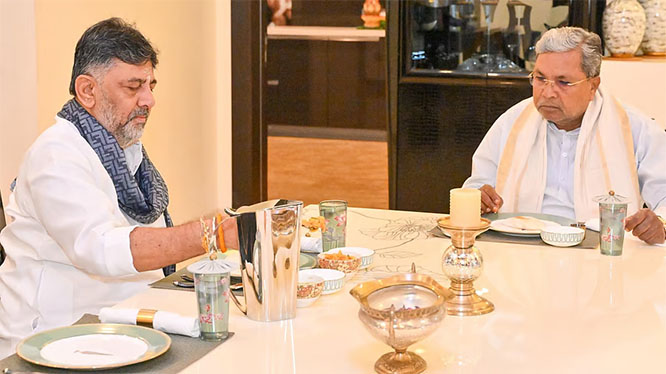
Bengaluru: 'Nati koli saaru' (country chicken curry) considered one of Chief Minister Siddaramaiah’s favourites along with steaming hot idlis was on the breakfast menu at Deputy CM D K Shivakumar’s residence on Tuesday, according to official sources.

The spread also included 'nati koli' fry, vada and pongal, among other items, they said.

In an apparent show of unity, Siddaramaiah visited Shivakumar’s residence for breakfast, just days after the two leaders shared a meal amid a simmering power tussle in the state Congress.

Siddaramaiah drove to the Deputy CM’s residence in Sadashivanagar, where he was received by Shivakumar and his brother D K Suresh, who is a former Congress MP.

Suresh and Kunigal MLA H D Ranganath, a relative of Shivakumar, joined them for breakfast, which featured a mix of vegetarian and non-vegetarian dishes.

Speaking to reporters later, Siddaramaiah said Shivakumar had invited him during his visit to the CM’s residence for breakfast on Saturday.

Asked about the difference between the two meals, the chief minister said, "At his (Shivakumar’s) house it was non-veg, while at my house it was veg. He is a vegetarian, I am a non-vegetarian. I had not prepared non-veg. I told DK to get chicken from the village as you won’t get the original in Bengaluru."

Shivakumar said he had initially invited Siddaramaiah to his residence, but the CM had suggested visiting his place first and reciprocating later. "It was a vegetarian breakfast at the CM’s house on Saturday," he noted.

"Today, I invited him (the CM) to my house. He enjoyed the breakfast, which had his Mysuru taste," Shivakumar added. At this point, Siddaramaiah remarked that Shivakumar’s wife is also from Mysuru.

Saturday’s breakfast at Siddaramaiah’s official residence, held as part of efforts by the Congress high command to ease tensions in the leadership dispute between the two, reportedly included idlis and sambar, according to official sources.

Comments

Add new comment

  • Coastaldigest.com reserves the right to delete or block any comments.
  • Coastaldigset.com is not responsible for its readers’ comments.
  • Comments that are abusive, incendiary or irrelevant are strictly prohibited.
  • Please use a genuine email ID and provide your name to avoid reject.
News Network
December 4,2025

Udupi: A 40-year-old NRI from Udupi has reportedly lost more than Rs 12.25 lakh in an online investment scam operated through Telegram.

According to a complaint filed at the CEN police station, Leo Jerome Mendonsa, who has been working in Dubai for the past 15 years in computer accessories sales, maintains NRI accounts in Karkala and Nitte.

On November 12, 2025, Mendonsa was added to a Telegram group called Instaflow Earnings by unknown individuals. Users identified as Priya and Dipannita persuaded him to invest in “Revenue Tasks.” Initially, Mendonsa transferred Rs 1,100 multiple times and received the promised returns, encouraging him to continue.

On November 14, another user, Nishmitha Shetty, directed him to register on a website, digitvisionuoce.cc, and invest Rs 4 lakh in various shares. Over the next few days, he made multiple transfers totaling Rs 12,25,000, including Rs 50,000 via Google Pay, believing the scheme was legitimate.

After receiving the money, the alleged handlers stopped responding, and neither the invested amount nor the promised profits were returned.

The CEN police have registered a case under Sections 66(C) and 66(D) of the IT Act and Section 318(4) of the Bharatiya Nyaya Sanhita (BNS), and investigations are ongoing.

Comments

Add new comment

  • Coastaldigest.com reserves the right to delete or block any comments.
  • Coastaldigset.com is not responsible for its readers’ comments.
  • Comments that are abusive, incendiary or irrelevant are strictly prohibited.
  • Please use a genuine email ID and provide your name to avoid reject.