



No relief in sight as India’s scorching heatwave to continue longer

Agencies
April 30, 2022

New Delhi, Apr 30: India’s severe heatwaves are expected to stretch into early next month, meaning millions of people will have to endure more days of dangerous temperatures and hours-long power cuts.

The South Asian nation is bracing for temperatures to rise to a record high, according to Mrutyunjay Mohapatra, head of the India Meteorological Department (IMD). The agency is working with states and the union government’s disaster management arm to get early warnings to those on the ground, he said in an interview in New Delhi.

Thermometer readings have already reached 46 degrees Celsius in central and northern India, with two months to go before the monsoon season that typically brings cooling rains. They hit the highest since 1901 last month. The heat has tested power grids as air conditioners run on full blast and threatened wheat crops. Local authorities are implementing action plans to manage health risks and even deaths, Mohapatra said.

 “Why is it exceptionally warm this year? The only reason is global warming,” said Roxy Mathew Koll, a climate scientist at the Indian Institute of Tropical Meteorology. “We have looked at data for seventy years and at the intensity, the number of heatwaves is directly in response to global warming.”

India is expected to suffer more frequent and intense heatwaves, extreme rainfall and erratic monsoons in the coming decades as the planet warms, according to the United Nations’ Intergovernmental Panel on Climate Change. McKinsey estimates that work hours lost to heatwaves could cause losses of as much as $250 billion, or 4.5 per cent of gross domestic product, by the end of the decade.

For India, the world’s poorest super-emitter, adapting to a hotter Earth is as urgent a task as cutting planet-warming emissions. A recent study showed a 62 per cent rise in heat-related deaths in the last 20 years. An official assessment of climate change published in 2020 showed that the frequency and intensity of droughts and cyclones had significantly increased in the last six decades. The number of days of intense rainfall and the pace at which sea levels are rising have more than doubled over that period.

The disasters underscore how countries like India, which are responsible for relatively little of the greenhouse gases accumulated in the atmosphere, often bear the brunt of climate impacts. That means spending billions to protect themselves instead of investing in economic development that could lift millions out of poverty. These countries, especially in Africa, also tend to lack resources to monitor and forecast the weather so they can better prepare for extreme events.

India is investing to improve its observational data and computing capabilities to build better climate models, said Mohapatra. The IMD managed to cut the number of deaths caused by cyclones to six in 2021 from 10,000 a year in 1999 by making more accurate short-term predictions.

Still, the country is racing against the clock as more erratic weather becomes harder to forecast. “Worsening climate change is limiting predictability of events,” said Mohapatra.

For now, local governments may have to consider a range of measures to keep people safe from the heat, Mohapatra said. They could restrict school hours to the cooler morning hours of 7 am to 11 am, advise against farm and construction work in the afternoon and provide extra support to street vendors, outdoor workers, police and to those living in city slums without access to cooling devices.

On Thursday evening, the meteorological department issued an orange alert for the next five days for northwest and central India. The region, home to some of the world’s most polluted air, hasn’t received the light summer rain that usually comes in April and May to lower temperatures and wash away dirty particulate matter.

“IPCC projections clearly show that the heat intensity is increasing and encroaching on our daily lives, and the impact is on vulnerable people who have little resources in regions where we don’t even have observations,” said Koll from the Indian Institute of Tropical Meteorology. “We need higher resolution data and, more importantly, we need long-term policies.”

Comments

Add new comment

  • Coastaldigest.com reserves the right to delete or block any comments.
  • Coastaldigset.com is not responsible for its readers’ comments.
  • Comments that are abusive, incendiary or irrelevant are strictly prohibited.
  • Please use a genuine email ID and provide your name to avoid reject.
News Network
November 24,2025

Mangaluru, Nov 24: The original departure time of 11.10 pm was a distant memory for scores of Dammam-bound passengers at Mangaluru International Airport last Friday night, as their Air India Express flight was abruptly cancelled at the eleventh hour, sparking hours of frustration and chaos.

The flight, IX 885, initially scheduled to depart at 11.10 pm on November 22, was subject to two back-to-back reschedules—first pushed to 11.45 pm and then significantly postponed to 1.40 am—before the final, crushing announcement of cancellation was made. For the travellers, many of whom are likely expatriate workers with tight schedules, the last-minute change marked the beginning of a distressing ordeal.

"There was no drinking water, no food, and absolutely no proper guidance. We were left stranded like refugees," complained a stranded passenger.

According to multiple passenger accounts, the airline's ground staff failed to provide adequate support or essential amenities following the cancellation. Complaints poured in about the total absence of drinking water, food provisions, and any reliable guidance from the carrier's representatives. Travellers alleged they were left stranded for a considerable period, with no immediate arrangements or clear communication offered regarding accommodation or alternative travel to send them back home.

The incident has highlighted serious concerns over the carrier's contingency planning and customer service protocols during flight disruptions at one of India's key international gateways. The airline is yet to issue a comprehensive statement addressing the alleged lapse in passenger care.
 

Comments

Add new comment

  • Coastaldigest.com reserves the right to delete or block any comments.
  • Coastaldigset.com is not responsible for its readers’ comments.
  • Comments that are abusive, incendiary or irrelevant are strictly prohibited.
  • Please use a genuine email ID and provide your name to avoid reject.
News Network
December 3,2025

indigo.jpg

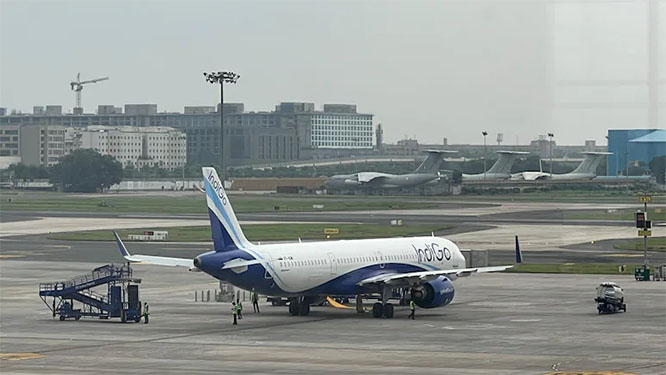
IndiGo, India’s largest airline, is battling one of its worst operational disruptions in recent years, with hundreds of delays and cancellations throwing domestic travel into chaos.

Government data on Tuesday showed its on-time performance plunging to 35%, an unusual dip for a carrier long associated with punctuality.

By Wednesday afternoon, airports in Delhi, Mumbai, Bengaluru and Hyderabad had collectively reported close to 200 cancellations, stranding travellers across the country.

Crew Shortage After New Duty Norms

A major trigger behind the meltdown is a severe crew shortage, especially among pilots, following the rollout of revised Flight Duty Time Limitation (FDTL) norms last month.

The rules mandate longer rest hours and more humane rosters — a shift IndiGo has struggled to incorporate across its vast network.

Sources said several flights were grounded due to lack of cabin crew, while some delays stretched upwards of eight hours.

With IndiGo controlling over 60% of India’s domestic aviation market, the ripple effect has impacted airports nationwide.

IndiGo Issues Apology, Lists “Compounding Factors”

In a statement, IndiGo acknowledged the large-scale disruption:

“We sincerely apologise to customers. A series of unforeseen operational challenges — technology glitches, winter schedule changes, adverse weather, system congestion and updated FDTL norms — created a compounding impact that could not have been anticipated.”

To stabilise operations, the airline has begun calibrated schedule adjustments for the next 48 hours, aiming to restore punctuality. Affected passengers are being offered refunds or alternate travel arrangements, IndiGo said.

What the FDTL Rules Require

The FDTL norms, designed to reduce pilot fatigue, cap duty and flying hours as follows:
•    Maximum 8 hours of flying per day
•    35 hours per week
•    125 hours per month
•    1,000 hours per year

Crew must also receive rest equalling twice the flight duration, with a minimum 10-hour rest period in any 24-hour window.

The DGCA introduced these limits to enhance flight safety.

Hyderabad: 33 Flights Cancelled, Long Queues Reported

Hyderabad’s Rajiv Gandhi International Airport saw heavy early-morning crowds as 33 IndiGo flights (arrivals and departures) were cancelled.

The airport clarified on X that operations were normal, advising passengers to contact IndiGo directly for latest flight status.

Cancellations included flights to and from Visakhapatnam, Goa, Ahmedabad, Delhi, Bengaluru, Chennai, Madurai, Hubli, Bhopal and Bhubaneswar.

Bengaluru: 42 Flights Disrupted

Bengaluru’s Kempegowda International Airport recorded 42 cancellations — 22 arrivals and 20 departures — affecting routes to Delhi, Mumbai, Chennai, Hyderabad, Goa, Kolkata and Lucknow.

Passengers Vent on Social Media

Irate travellers took to X to share their experiences. One passenger stranded in Hyderabad wrote: “I have been here since 3 a.m. and missed an important meeting.”

Another said: “My flight was pushed from 1:55 PM to 2:55 PM and now 4:35 PM. I was informed only three minutes before entering the airport.”

Delhi Airport Hit by Tech Glitch

At Delhi Airport, the disruption deepened due to a slowdown in the Amadeus system — used for reservations, check-ins and departure control.

The technical issue led to longer queues and sluggish processing, adding to delays already worsened by staff shortages.

Comments

Add new comment

  • Coastaldigest.com reserves the right to delete or block any comments.
  • Coastaldigset.com is not responsible for its readers’ comments.
  • Comments that are abusive, incendiary or irrelevant are strictly prohibited.
  • Please use a genuine email ID and provide your name to avoid reject.
News Network
November 26,2025

Mangaluru, Nov 26: Assembly Speaker and local MLA U.T. Khader has initiated a high-level push to resolve one of Mangaluru’s longest-standing traffic headaches: the narrow, high-density stretch of National Highway-66 between Nanthoor and Talapady.

He announced on Tuesday that a formal proposal has been submitted to the Union Ministry of Road Transport and Highways (MoRTH) seeking approval to prepare a Detailed Project Report (DPR) for the widening of this crucial corridor.

The plan specifically aims to expand the existing 45-meter road width to a full 60 meters, coupled with the construction of dedicated service roads. Khader highlighted that land for a 60-meter highway was originally acquired during the initial four-laning project, but only 45 meters were developed, leading to a perpetual bottleneck.

"With vehicle density rising sharply, the expansion has become unavoidable," Khader stated, stressing that the upgrade is essential for ensuring smoother traffic flow and improving safety at the city's main entry and exit points.

The stretch between Nanthoor and Talapady is a vital link on the busy Kochi-Panvel coastal highway and connects to major city junctions. The move to utilize the previously acquired land for the full 60-meter width is seen as a necessary measure to catch up with the region's rapid vehicular growth and prevent further traffic gridlocks.

Comments

Add new comment

  • Coastaldigest.com reserves the right to delete or block any comments.
  • Coastaldigset.com is not responsible for its readers’ comments.
  • Comments that are abusive, incendiary or irrelevant are strictly prohibited.
  • Please use a genuine email ID and provide your name to avoid reject.