No written exams till class 2, assessment should not cause burden for children: Draft NCF

News Network
April 7, 2023

students.jpg

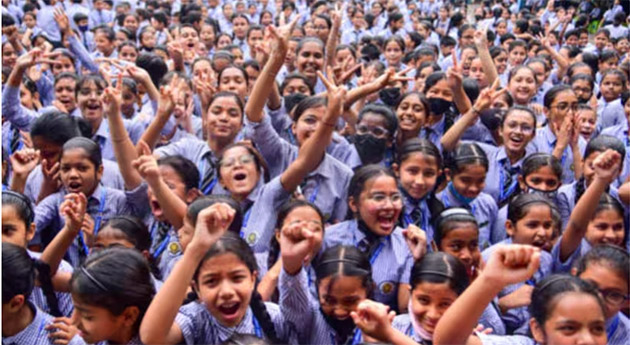
New Delhi, Apr 7: Explicit tests and exams are completely inappropriate assessment tools for children up to class 2 and written tests should be introduced from class 3 onwards, the draft National Curriculum Framework (NCF) has recommended stressing that assessment methods should be such that they do not contribute to any additional burden for the child.

The framework which is being developed along the lines of the new National Education Policy (NEP) suggests that two important methods of assessment that are appropriate for the foundational stage are observations of the child and analysing of artefacts that the child has produced as part of their learning experience.

The draft notes that explicit tests and examinations are completely inappropriate assessment tools for the Foundational stage (preschool to class 2).

"Assessment should allow for diversity among children and in their learning. Children learn differently and express their learning differently too. There might be many ways to assess the achievement of a learning outcome or competency. The teacher should have the ability to design different kinds of assessments for the same learning outcome and use each assessment appropriately.

"Assessment should enable recording and documentation. Children's progress should be described and analysed through the systematic collection of evidence. Assessment should not contribute to any additional burden for the child. Assessment tools and processes should be designed such that they are a natural extension of the learning experience for the child," it adds.

Describing the assessment for the preparatory stage (class 3 to 5), the draft recommends that "written tests should be introduced at this stage".

"A variety of assessment methods should be used to promote learning. Portfolios can be used to capture student progress holistically through their work. This could also provide a reliable picture of their learning to parents. Peer and self-assessments could also be introduced to help students monitor the trajectory of their own learning.

"At the end of the preparatory stage, there should be a comprehensive summative assessment of the student's readiness to enter the middle stage where several new curricular areas are introduced," it adds.

The education ministry released a "pre-draft" of the NCF for school education on Thursday and invited suggestions from stakeholders such as students, parents, teachers and scholars.

The draft prepared by a panel headed by K Kasturirangan, former ISRO chief, suggests that at the middle stage (class 6 to 8), the focus of the curriculum should move to conceptual understanding and higher-order capacities.

"Therefore, classroom assessment techniques such as projects, debates, presentations, experiments, investigations, role plays, journals and portfolios should be used to assess learning. Regular summative assessments at this stage will help students synthesize their learning at logical intervals such as year-end, term-end, unit-end. Summative assessments comprising multiple-choice questions and constructed responses like short and long answers may be used periodically," it says.

In the secondary stage (class 9 to 12), the panel has asserted that comprehensive classroom assessments should be effectively practised for facilitating meaningful learning and constructive feedback. Regular summative assessments should be conducted for recording students learning against competencies.

"Self-assessment will play a key role in student learning at this stage. Students should be facilitated to monitor what they are learning and use the feedback from this monitoring to adjust, adapt, and decide their own strategies for learning.

"Summative assessments can be designed using case-based questions, simulations, and essay-type questions to enable assessment of competencies. At this stage, students should also be prepared to undertake the board examinations and other selection tests to gain access to higher education and livelihood opportunities," the draft adds.

According to ministry officials, the textbooks as per the new NCF will be introduced from next year.

The Education Ministry has designed four NCFs based on the 5+3+3+4 ‘curricular and pedagogical’ structure that NEP 2020 has recommended for school education.

The ministry launched the NCF for the foundational stage (NCF-FS) for children between ages 3-8 years in October 2022. In continuation of that policy, the next NCF for school education is being prepared.

Revamping class 10 and 12 board exams, aligning the shift from 10+2 structure to 5+3+3+4 structure and emphasis on developmental perspectives suggesting curricular and pedagogical shifts at different stages - foundational, preparatory, middle and secondary - are among the recommendations made in the pre-draft.

The NCF has been revised four times - in 1975, 1988, 2000 and 2005. The new proposed revision will be the fifth of the framework.

 

Comments

Add new comment

  • Coastaldigest.com reserves the right to delete or block any comments.
  • Coastaldigset.com is not responsible for its readers’ comments.
  • Comments that are abusive, incendiary or irrelevant are strictly prohibited.
  • Please use a genuine email ID and provide your name to avoid reject.
News Network
November 21,2025

Bantwal: A domestic dispute appears to have led to a violent confrontation in BC Road area, where the owner of a textile shop was allegedly attacked with a knife by his wife on Wednesday evening.

Krishna Kumar Somayaji, the owner of Somayaji Textiles, sustained serious injuries in the incident and was immediately taken to a hospital for treatment. He is currently receiving care in the intensive care unit and is reported to have survived the assault, according to police.

The Bantwal Town police have registered a case against Somayaji's wife, Jyothi KT, who has since been taken into custody.

Police stated that the complainant, Namita, an employee at the shop, reported the sequence of events. She stated that around 7 p.m. on Wednesday, the suspect entered the shop, wearing a burqa and disguised as a customer, before attacking Somayaji with a knife. The employee then transported the injured owner to a local hospital via an autorickshaw.

Superintendent of Police Arun K confirmed that an ongoing domestic dispute between Somayaji and his wife reportedly preceded the attack. Police noted that Jyothi KT had previously visited the shop and issued threats.

Based on the complaint, Bantwal Town police have registered a case under relevant sections of the Bharatiya Nyaya Sanhita (BNS) and the Indian Arms Act-1959. An investigation into the incident is currently underway.

Comments

Add new comment

  • Coastaldigest.com reserves the right to delete or block any comments.
  • Coastaldigset.com is not responsible for its readers’ comments.
  • Comments that are abusive, incendiary or irrelevant are strictly prohibited.
  • Please use a genuine email ID and provide your name to avoid reject.
News Network
November 29,2025

DKSsiddu.jpg

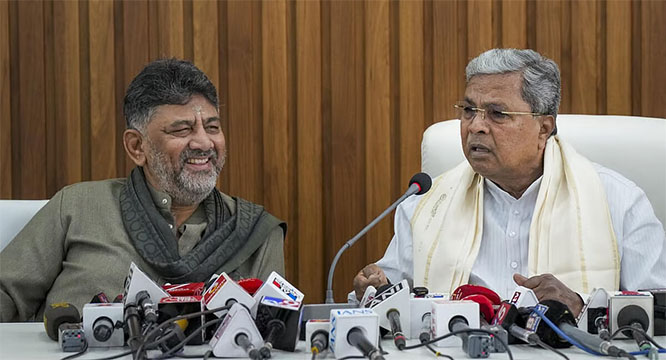
New Delhi: Karnataka chief minister Siddaramaiah and deputy CM DK Shivakumar on Saturday put up a dramatic display of unity at a closely watched joint press briefing, firmly dismissing weeks of speculation about a power-sharing tussle within the Congress. With the high command nudging both leaders to sit together and settle the dust, the meeting became a political spectacle, ending with the duo declaring that there was “no confusion, no differences.”

Calling the reports of a rift “manufactured confusion,” Siddaramaiah said the talks had gone smoothly, even joking about their breakfast. “Breakfast was very good. All three of us enjoyed it,” he said. “We want to end this confusion once and for all. For local elections and for 2028, our mission is clear — Congress must return to power. There is no difference between me and DKS, not now, not before.”

He blamed the media for fuelling rumours and reiterated absolute adherence to the party leadership. “From tomorrow, let there be no confusion. What the high command says, we will follow.”

Siddaramaiah also assured that the Assembly session starting December 8 would run smoothly and vowed that Congress would take on the BJP and JD(S) “together.”

Shivakumar echoed the chief minister word for word, stressing loyalty and discipline. “People have given us a massive mandate. It is our duty to deliver,” he said. “This government was formed under Siddaramaiah’s leadership. We both have complete trust in the high command. If they tell me to wait, I will wait.”

He added that the two leaders had discussed strategy for the 2028 Assembly elections. “Whatever the CM says, I agree. We are loyal soldiers of the party. The party may be facing challenges nationally, but we will keep it strong in Karnataka.”

Shivakumar also said Siddaramaiah would soon visit his home for lunch or dinner — another symbolic gesture meant to underline their unity.

Both leaders later posted on social media describing the breakfast meeting as “productive” and focused on “Karnataka’s priorities.”

The BJP, however, rejected the show of camaraderie as “pure bunkum,” accusing Congress of trying to paper over an internal power struggle. But Siddaramaiah and Shivakumar insisted their united front would continue — and that there was “no confusion” within the state leadership.

Comments

Add new comment

  • Coastaldigest.com reserves the right to delete or block any comments.
  • Coastaldigset.com is not responsible for its readers’ comments.
  • Comments that are abusive, incendiary or irrelevant are strictly prohibited.
  • Please use a genuine email ID and provide your name to avoid reject.
News Network
December 3,2025

indigo.jpg

IndiGo, India’s largest airline, is battling one of its worst operational disruptions in recent years, with hundreds of delays and cancellations throwing domestic travel into chaos.

Government data on Tuesday showed its on-time performance plunging to 35%, an unusual dip for a carrier long associated with punctuality.

By Wednesday afternoon, airports in Delhi, Mumbai, Bengaluru and Hyderabad had collectively reported close to 200 cancellations, stranding travellers across the country.

Crew Shortage After New Duty Norms

A major trigger behind the meltdown is a severe crew shortage, especially among pilots, following the rollout of revised Flight Duty Time Limitation (FDTL) norms last month.

The rules mandate longer rest hours and more humane rosters — a shift IndiGo has struggled to incorporate across its vast network.

Sources said several flights were grounded due to lack of cabin crew, while some delays stretched upwards of eight hours.

With IndiGo controlling over 60% of India’s domestic aviation market, the ripple effect has impacted airports nationwide.

IndiGo Issues Apology, Lists “Compounding Factors”

In a statement, IndiGo acknowledged the large-scale disruption:

“We sincerely apologise to customers. A series of unforeseen operational challenges — technology glitches, winter schedule changes, adverse weather, system congestion and updated FDTL norms — created a compounding impact that could not have been anticipated.”

To stabilise operations, the airline has begun calibrated schedule adjustments for the next 48 hours, aiming to restore punctuality. Affected passengers are being offered refunds or alternate travel arrangements, IndiGo said.

What the FDTL Rules Require

The FDTL norms, designed to reduce pilot fatigue, cap duty and flying hours as follows:
•    Maximum 8 hours of flying per day
•    35 hours per week
•    125 hours per month
•    1,000 hours per year

Crew must also receive rest equalling twice the flight duration, with a minimum 10-hour rest period in any 24-hour window.

The DGCA introduced these limits to enhance flight safety.

Hyderabad: 33 Flights Cancelled, Long Queues Reported

Hyderabad’s Rajiv Gandhi International Airport saw heavy early-morning crowds as 33 IndiGo flights (arrivals and departures) were cancelled.

The airport clarified on X that operations were normal, advising passengers to contact IndiGo directly for latest flight status.

Cancellations included flights to and from Visakhapatnam, Goa, Ahmedabad, Delhi, Bengaluru, Chennai, Madurai, Hubli, Bhopal and Bhubaneswar.

Bengaluru: 42 Flights Disrupted

Bengaluru’s Kempegowda International Airport recorded 42 cancellations — 22 arrivals and 20 departures — affecting routes to Delhi, Mumbai, Chennai, Hyderabad, Goa, Kolkata and Lucknow.

Passengers Vent on Social Media

Irate travellers took to X to share their experiences. One passenger stranded in Hyderabad wrote: “I have been here since 3 a.m. and missed an important meeting.”

Another said: “My flight was pushed from 1:55 PM to 2:55 PM and now 4:35 PM. I was informed only three minutes before entering the airport.”

Delhi Airport Hit by Tech Glitch

At Delhi Airport, the disruption deepened due to a slowdown in the Amadeus system — used for reservations, check-ins and departure control.

The technical issue led to longer queues and sluggish processing, adding to delays already worsened by staff shortages.

Comments

Add new comment

  • Coastaldigest.com reserves the right to delete or block any comments.
  • Coastaldigset.com is not responsible for its readers’ comments.
  • Comments that are abusive, incendiary or irrelevant are strictly prohibited.
  • Please use a genuine email ID and provide your name to avoid reject.