Over 27% students have no access to gadgets for online classes: NCERT

Agencies
August 20, 2020

online-classes.jpg

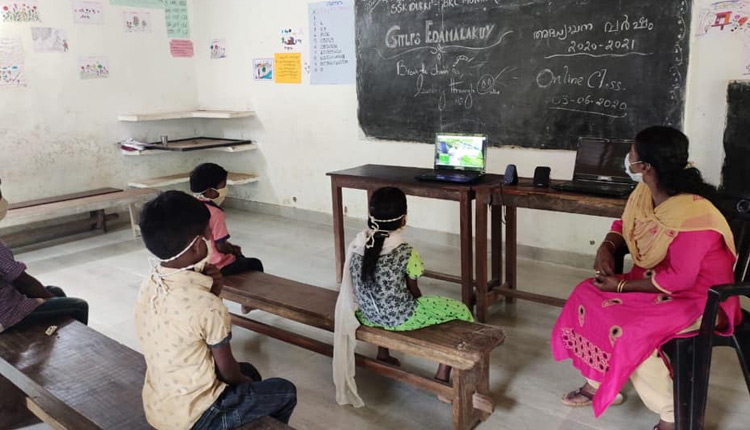
New Delhi, Aug 20: At least 27 per cent students do not have access to smartphones or laptops to attend online classes, while 28 per cent students and parents believe intermittent or lack of electricity is one of the major concerns hindering teaching-learning, according to a survey by the NCERT.

The survey with over 34,000 participants, including students, parents, teachers and school principals from Kendriya Vidyalayas, Navodyaya Vidyalas and CBSE affiliated schools, has pointed out that lack of knowledge of using devices for effective educational purposes and teachers not being well-versed with online teaching methodologies, caused hindrance in the learning process.

"Approximately 27 per cent of the students mentioned the non-availability of smartphones and laptops. The maximum number of stakeholders have opted for mobile phones as a medium for teaching-learning during the Covid-19 period," the survey by the National Council of Educational Research and Training (NCERT) said.

"About 36 per cent of the students used the textbooks and other books available with them. Laptops were the second most favoured option amongst teachers and principals. Television and radio were the least utilized devices for the teaching-learning in the pandemic situation. The absence of enriched interaction between the teacher and the students was one of the reasons as identified by the stakeholders," it added.

The survey noted that almost all of the responsive states use physical (non-digital) mechanisms to track the progress of learners with the majority of them either practising home visit by teachers or systematic parental guidance via phone calls.

"About half of the students stated that they did not have the school textbooks. Although the e-textbooks are available on NCERT website and DIKSHA, the probable reasons behind this feedback are that students are used to studying from the hardcopy of the textbooks, there is lack of awareness regarding the availability of the e-textbook and paucity of devices with students and teachers," it said.

The majority of the stakeholders pointed out that mathematics as a subject was difficult to learn via online medium.

"Since, mathematics contains a number of concepts which require interaction, continuous support, monitoring from the teacher and these aspects were lacking in the online mode of teaching.

"Next to Mathematics, Science was identified as the subject of concern since it contains several concepts and practical experiments which could only be done in the laboratory under the supervision of the teacher. A few stakeholders also found Social Science as a difficult subject to grasp through online classes," the survey said.

It said that around 17 pc of students identified languages as being a difficult subject to learn through online medium.

"Many students and parents felt the need for Physical Education classes through online mode, as physical fitness is the need of the hour to combat this pandemic. Arts education can help to reduce stress and boredom. Around 10 per cent of the stakeholders mentioned art education as a subject of concern," the survey said.

Universities and schools across the country have been closed since March 16, when the Centre announced a countrywide classroom shut down as part of measures to contain the Covid-19 pandemic.

A nationwide lockdown was imposed on March 25. While several restrictions have been eased, schools and colleges continue to be closed.

The prolonged closure of educational institutions has mandated a shift from classroom teaching to online learning.

Based on the NCERT survey findings, the Ministry of Education has formulated Students' Learning Enhancement Guidelines.

"The guidelines will help children, who do not have digital resources to get learning opportunities at their homes, with their teachers or volunteers. Apart from this, it will also help in our efforts to overcome the learning deficiencies of all those students who are learning at home through various alternative ways using radio, television or smartphone," Union Minister of Education, Ramesh Pokhriyal 'Nishank' said.

The minister informed that the guidelines and models are suggested for three types of situations.

"Firstly, in which students do not have any digital resources. Secondly, in which students have limited digital resources available. Lastly, in which students have digital resources available for online education," he said. 

Comments

Add new comment

  • Coastaldigest.com reserves the right to delete or block any comments.
  • Coastaldigset.com is not responsible for its readers’ comments.
  • Comments that are abusive, incendiary or irrelevant are strictly prohibited.
  • Please use a genuine email ID and provide your name to avoid reject.
News Network
December 4,2025

Udupi: A 40-year-old NRI from Udupi has reportedly lost more than Rs 12.25 lakh in an online investment scam operated through Telegram.

According to a complaint filed at the CEN police station, Leo Jerome Mendonsa, who has been working in Dubai for the past 15 years in computer accessories sales, maintains NRI accounts in Karkala and Nitte.

On November 12, 2025, Mendonsa was added to a Telegram group called Instaflow Earnings by unknown individuals. Users identified as Priya and Dipannita persuaded him to invest in “Revenue Tasks.” Initially, Mendonsa transferred Rs 1,100 multiple times and received the promised returns, encouraging him to continue.

On November 14, another user, Nishmitha Shetty, directed him to register on a website, digitvisionuoce.cc, and invest Rs 4 lakh in various shares. Over the next few days, he made multiple transfers totaling Rs 12,25,000, including Rs 50,000 via Google Pay, believing the scheme was legitimate.

After receiving the money, the alleged handlers stopped responding, and neither the invested amount nor the promised profits were returned.

The CEN police have registered a case under Sections 66(C) and 66(D) of the IT Act and Section 318(4) of the Bharatiya Nyaya Sanhita (BNS), and investigations are ongoing.

Comments

Add new comment

  • Coastaldigest.com reserves the right to delete or block any comments.
  • Coastaldigset.com is not responsible for its readers’ comments.
  • Comments that are abusive, incendiary or irrelevant are strictly prohibited.
  • Please use a genuine email ID and provide your name to avoid reject.
News Network
November 28,2025

ministerPM.jpg

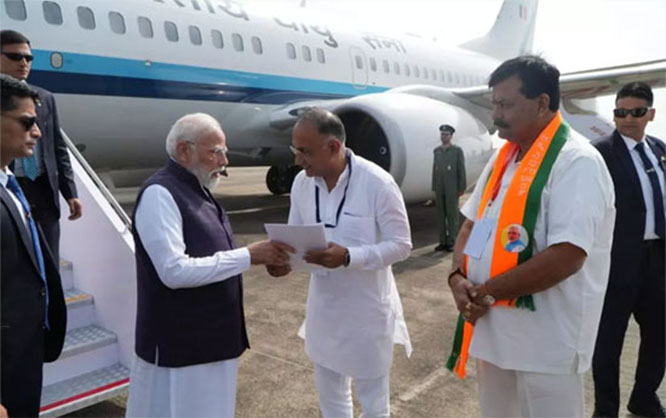
Mangaluru, Nov 28: Karnataka Health Minister and Dakshina Kannada district in-charge minister Dinesh Gundu Rao on Friday handed over Chief Minister Siddaramaiah’s letter to Prime Minister Narendra Modi, highlighting the severe distress faced by farmers due to crashing crop prices.

PM Modi arrived at the Mangaluru International Airport en route to Udupi, where Gundu Rao welcomed him and submitted the letter. The chief minister’s message stressed that farmers are suffering heavy losses because maize and green gram are being bought far below the Minimum Support Price (MSP). The state urged the Centre to immediately begin procurement at MSP.

According to the letter, Karnataka has a bumper harvest this year—over 54.74 lakh metric tons of maize and 1.98 lakh metric tons of green gram—yet farmers are unable to secure fair prices. Against the MSP of ₹2,400/MT for maize and ₹8,768/MT for green gram, market rates have plunged to ₹1,600–₹1,800 and ₹5,400 respectively.

The chief minister has requested the Centre to:

• Direct NAFED, FCI and NCCF to start MSP procurement immediately.
• Ensure ethanol units purchase maize directly from farmers or FPOs.
• Increase Karnataka’s ethanol allocation, citing high production capacity.
• Stop maize imports, which have depressed domestic prices.
• Relax quality norms for green gram, allowing up to 10% discoloration due to rains.

The letter stresses that MSP is crucial for farmer dignity and income stability and calls for swift central intervention to prevent a deepening crisis.

Comments

Add new comment

  • Coastaldigest.com reserves the right to delete or block any comments.
  • Coastaldigset.com is not responsible for its readers’ comments.
  • Comments that are abusive, incendiary or irrelevant are strictly prohibited.
  • Please use a genuine email ID and provide your name to avoid reject.
News Network
November 26,2025

students.jpg

Bengaluru, Nov 26: Karnataka is taking its first concrete steps towards lifting a three-decade-old ban on student elections in colleges and universities. Deputy Chief Minister D.K. Shivakumar announced Wednesday that the state government will form a small committee to study the reintroduction of campus polls, a practice halted in 1989 following incidents of violence.

Speaking at a 'Constitution Day' event organised by the Karnataka Congress, Mr. Shivakumar underscored the move's aim: nurturing new political leadership from the grassroots.

"Recently, (Leader of the Opposition in Lok Sabha) Rahul Gandhi wrote a letter to me and Chief Minister (Siddaramaiah) asking us to think about restarting student elections," Shivakumar stated. "I'm announcing today that we'll form a small committee and seek a report on this."

Student elections were banned in Karnataka in 1989, largely due to concerns over violence and the infiltration of political party affiliates into campus life. The ban effectively extinguished vibrant student bodies and the pipeline of young leaders they often produced.

Mr. Shivakumar, who also serves as the Karnataka Congress president, said that former student leaders will be consulted to "study the pros and cons" of the re-introduction.

Acknowledging the history of the ban, he added, "There were many criminal activities taking place back then. We’ll see how we can conduct (student) elections by regulating such criminal activities."

The Deputy CM reminisced about his own journey, which began on campus. He recalled his political activism at Sri Jagadguru Renukacharya College leading to his first Assembly ticket in 1985 at the age of 23. "That's how student leadership was at the time. Such leadership has gone today. College elections have stopped," he lamented, adding that for many, college elections were "like a big movement" where leaders were forged.

The move, driven by the Congress high command's push to cultivate young talent, will face scrutiny from academics and university authorities who have, in the past, expressed concern that the return of polls could disrupt the peaceful academic environment and turn campuses into political battlegrounds.

Comments

Add new comment

  • Coastaldigest.com reserves the right to delete or block any comments.
  • Coastaldigset.com is not responsible for its readers’ comments.
  • Comments that are abusive, incendiary or irrelevant are strictly prohibited.
  • Please use a genuine email ID and provide your name to avoid reject.