



Pahalgam Terror: Modi govt’s security narrative collapses as local accounts tell different story

News Network
April 26, 2025

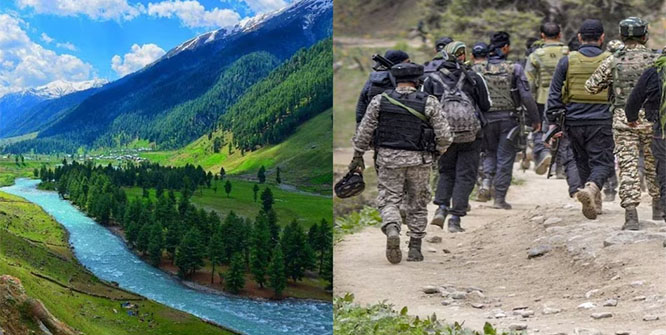
terrorkashmir.jpg

Srinagar: The Prime Minister Narendra Modi-led union government’s explanation for the lack of security at the site of Tuesday’s deadly terrorist attack in Pahalgam has triggered widespread skepticism, with local officials and tourism stakeholders offering accounts that sharply contradict the government’s claims.

At an all-party meeting in New Delhi on Thursday, the Central government reportedly informed lawmakers that Baisaran meadow — where 26 civilians were killed — was not officially open to tourists until June. The absence of police and paramilitary presence, they argued, was due to this status.

However, investigations on the ground reveal a very different reality.

Baisaran meadow — popularly known as "Mini Switzerland" — remains accessible to tourists for most of the year. According to local tour operators, pony ride associations, and tourism officials, the area typically stays open except during peak winter months when snowfall blocks access.

"Tourists have been visiting Baisaran daily this season. No police clearance or special permission has ever been required," said Sheikh Mohammad Sultan, senior tour operator and President of the Indian Association of Travel & Tourism Experts (Kashmir chapter). "Nearly 70 percent of visitors to Pahalgam make it a point to visit Baisaran."

Further evidence lies in the operational signboard installed by the Pahalgam Development Authority at the meadow's entrance, listing an entry fee of ₹35 per person. Officials confirmed that this fee collection is outsourced annually through auction — a clear indication that the site was officially functioning and welcoming tourists at the time of the attack.

"Infrastructure projects have been developed for Baisaran tourism, and more are in the pipeline. Visiting Baisaran has never required security clearance or police authorization," a tourism official said on condition of anonymity.

The lack of security now stands under intense scrutiny.

The dirt track connecting Pahalgam town to Baisaran was reportedly unguarded, with only four unarmed personnel from an auxiliary wing of the Jammu and Kashmir Police stationed there. The nearest Central Reserve Police Force (CRPF) camp was nearly five kilometers away — a critical gap that likely delayed the emergency response.

According to official sources, the first CRPF responder reached the attack site almost an hour later, with reinforcements arriving more than ninety minutes after the assault had ended.

Locals like Waheed Ahmad, president of the Pony Operators’ Association in Pahalgam, expressed concern over the lack of vigilance despite Baisaran’s heavy tourist footfall.

"We have been taking tourists to Baisaran for decades without ever needing police permission. But given today’s environment, one would expect much better security," Ahmad said.

Eyewitness videos and photographs from just days before the attack show tourists visiting Baisaran in significant numbers, enjoying pony rides and the vibrant spring bloom — further undermining the Centre’s assertion that the area was "closed" to visitors.

The glaring contradictions have fuelled growing suspicions that authorities failed to adequately assess the threat level, despite intelligence warnings about potential attacks targeting Kashmir’s fragile tourist season.

Comments

Add new comment

  • Coastaldigest.com reserves the right to delete or block any comments.
  • Coastaldigset.com is not responsible for its readers’ comments.
  • Comments that are abusive, incendiary or irrelevant are strictly prohibited.
  • Please use a genuine email ID and provide your name to avoid reject.
News Network
January 20,2026

Mangaluru: In a major step towards strengthening rural innovation, the Office of the Principal Scientific Adviser (PSA) to the Government of India is supporting the establishment of RuTAGe Smart Village Centres (RSVCs) across the country through collaborations with academic institutions, civil society organisations and philanthropic partners.

As part of this national initiative, Nitte (Deemed to be University) will set up the first RSVCs in the region at Nitte GP in Udupi district and at the Nitte Health Centre, Sevanjali Trust, Farangipete, in Dakshina Kannada district. The centres will be inaugurated on January 21. In South India, the programme is being implemented by the Section Infin-8 Foundation (SI-8).

Speaking to reporters on Monday, SI-8 founder-director Vishwas US said experts from Nitte University and SI-8 would work closely with farmers, students, youth and local entrepreneurs to adapt and deploy technologies tailored to local needs.

Project head Prof Iddya Karunasagar, representing Nitte DU, said the RSVCs at Nitte and Farangipete would serve as demonstration hubs for a wide range of agriculture, energy, skill-development and assistive technologies. These include solar dryers for fruits, vegetables and crops; soil-testing solutions; power weeders and women-friendly farm tools; wind-powered devices for rural artisans; grain storage systems; grass-cutting and tree-climbing equipment; and liquid fertiliser production using cowshed waste.

SI-8 CEO Aravind C Kumar said the centres would also provide access to digital and knowledge-based platforms such as ISRO applications, government scheme portals, market linkage tools and gamified learning resources, along with assistive technologies for persons with visual impairments.

Highlighting the broader impact of the initiative, Principal Scientific Adviser Prof Ajay Kumar Sood said it demonstrated how applied research could bridge the rural–urban divide and help create self-reliant, technology-enabled villages.

The initiative has been made possible through philanthropic support from Dr NC Murthy of ACM Business Solutions, LLC, USA. Dr Sapna Poti, Director (Strategic Alliances) at the Office of the Principal Scientific Adviser, said the long-term objective is to build self-sufficient, technology-driven communities capable of generating sustainable livelihoods on their own.

Comments

Add new comment

  • Coastaldigest.com reserves the right to delete or block any comments.
  • Coastaldigset.com is not responsible for its readers’ comments.
  • Comments that are abusive, incendiary or irrelevant are strictly prohibited.
  • Please use a genuine email ID and provide your name to avoid reject.
News Network
January 23,2026

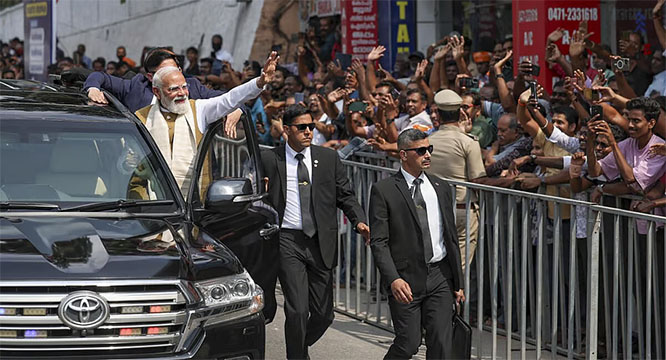
modIKERALA.jpg

Prime Minister Narendra Modi, during his visit to Thiruvananthapuram on Friday, January 23, indicated that the Bharatiya Janata Party (BJP) is aiming to expand its political footprint in Kerala ahead of the Assembly elections scheduled in the coming months.

Speaking at a BJP-organised public meeting, Modi drew parallels between the party’s early electoral gains in Gujarat and its recent victory in the Thiruvananthapuram Municipal Corporation. The civic body win, which ended decades of Left control, was cited by the Prime Minister as a possible starting point for the party’s broader ambitions in the state.

Recalling BJP’s political trajectory in Gujarat, Modi said the party was largely insignificant before 1987 and received little media attention. He pointed out that the BJP’s first major breakthrough came with its victory in the Ahmedabad Municipal Corporation that year.

“Just as our journey in Gujarat began with one city, Kerala’s journey has also started with a single city,” Modi said, suggesting that the party’s municipal-level success could translate into wider electoral acceptance.

The Prime Minister alleged that successive governments led by the Left Democratic Front (LDF) and the United Democratic Front (UDF) had failed to adequately develop Thiruvananthapuram. He accused both fronts of corruption and neglect, claiming that basic infrastructure and facilities were denied to the capital city for decades.

According to Modi, the BJP’s control of the civic body represents a shift driven by public dissatisfaction with the existing political alternatives. He asserted that the BJP administration in Thiruvananthapuram had begun working towards development, though no specific details or timelines were outlined.

Addressing the gathering at Putharikandam Maidan, Modi said the BJP intended to project Thiruvananthapuram as a “model city,” reiterating his party’s commitment to governance-led change.

The Prime Minister’s visit to Kerala also included the inauguration of several development projects and the flagging off of new train services, as the BJP intensifies its political outreach in the poll-bound state.

Comments

Add new comment

  • Coastaldigest.com reserves the right to delete or block any comments.
  • Coastaldigset.com is not responsible for its readers’ comments.
  • Comments that are abusive, incendiary or irrelevant are strictly prohibited.
  • Please use a genuine email ID and provide your name to avoid reject.
News Network
January 19,2026

New Delhi: Setting speculation to the rest, the CPI(M) has made it clear that it is open to have an electoral understanding with the Congress “to defeat” the Trinamool Congress and the BJP in West Bengal Assembly election even as it is all set to take on the grand old party in Kerala accusing it of “found wanting” in fighting the Hindutva forces.

The CPI(M) also said that it will contest the Tamil Nadu election “with DMK and its allies to defeat the BJP and its allies”, amid a section in the Congress triggering confusion about its participation in the M K Stalin-led coalition over demand over power-sharing and more seats. It is also willing to join hands with Congress and others in Assam and Puducherry to defeat the BJP.

The decisions came at a three-day meeting of the CPI(M) Central Committee in Thiruvananthapuram, which ended on Sunday after reviewing the poll preparations in the poll-bound states.

The CPI(M)'s decision came even as a section led by West Bengal Congress president Subhankar Sarkar is averse to tying up with the Left Front, claiming that their party is not benefitted by the electoral understanding. Both Congress and CPI(M)-led Left Front had electoral understanding in 2016 and 2021 Assembly elections and 2024 Lok Sabha polls.

Congress and the Left Front fought together for the first time in 2016 when Congress won 44 seats and the CPI(M) got 26. In 2021, the Left Front and the Congress drew a blank. In the 2024 Lok Sabha polls, Congress managed to win one seat while the Left did not win any. In the 2019 Lok Sabha polls, both fought against each other with Congress winning two and the Left none.

“In Bengal, the party will work for the defeat of both the TMC and the BJP, which are trying to polarise the society. We will try to rally all the forces that are ready to work against them,” the CPI(M) said in a statement without naming Congress by name. Senior leaders said there is no change in its strategy of pooling all non-BJP, non-TMC votes.

However, the party was critical of the Congress in Kerala where both will fight against each other.

The CPI(M) said it would "expose the BJP-led Union government’s denial of rightful dues to Kerala, the fiscal constraints imposed and the overall attack on federalism" as also "expose the failure of the Congress to effectively counter this attack on federalism, as the largest opposition party in the Parliament".

"The Congress, especially in Kerala, was found wanting in the fight against communal RSS-BJP, ideologically and this will also be exposed before the people," it added.

In Assam, it said, the CPI(M) will work for the mobilisation of all the anti-BJP parties and forces and defeat the rabidly communal and divisive BJP government. The Left parties are cooperating with Congress in the north-eastern state. In Puducherry, it said it will work for the defeat of the BJP alliance government.

Comments

Add new comment

  • Coastaldigest.com reserves the right to delete or block any comments.
  • Coastaldigset.com is not responsible for its readers’ comments.
  • Comments that are abusive, incendiary or irrelevant are strictly prohibited.
  • Please use a genuine email ID and provide your name to avoid reject.