



Pahalgam Terror: Modi govt’s security narrative collapses as local accounts tell different story

News Network
April 26, 2025

terrorkashmir.jpg

Srinagar: The Prime Minister Narendra Modi-led union government’s explanation for the lack of security at the site of Tuesday’s deadly terrorist attack in Pahalgam has triggered widespread skepticism, with local officials and tourism stakeholders offering accounts that sharply contradict the government’s claims.

At an all-party meeting in New Delhi on Thursday, the Central government reportedly informed lawmakers that Baisaran meadow — where 26 civilians were killed — was not officially open to tourists until June. The absence of police and paramilitary presence, they argued, was due to this status.

However, investigations on the ground reveal a very different reality.

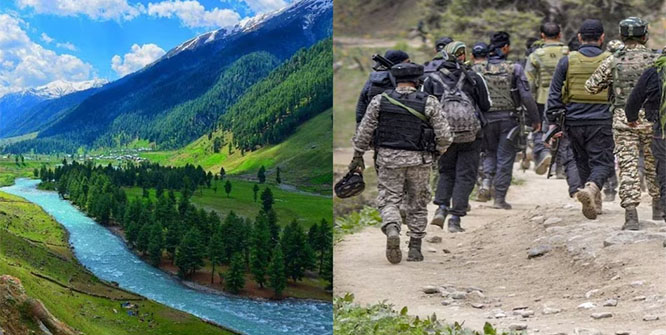
Baisaran meadow — popularly known as "Mini Switzerland" — remains accessible to tourists for most of the year. According to local tour operators, pony ride associations, and tourism officials, the area typically stays open except during peak winter months when snowfall blocks access.

"Tourists have been visiting Baisaran daily this season. No police clearance or special permission has ever been required," said Sheikh Mohammad Sultan, senior tour operator and President of the Indian Association of Travel & Tourism Experts (Kashmir chapter). "Nearly 70 percent of visitors to Pahalgam make it a point to visit Baisaran."

Further evidence lies in the operational signboard installed by the Pahalgam Development Authority at the meadow's entrance, listing an entry fee of ₹35 per person. Officials confirmed that this fee collection is outsourced annually through auction — a clear indication that the site was officially functioning and welcoming tourists at the time of the attack.

"Infrastructure projects have been developed for Baisaran tourism, and more are in the pipeline. Visiting Baisaran has never required security clearance or police authorization," a tourism official said on condition of anonymity.

The lack of security now stands under intense scrutiny.

The dirt track connecting Pahalgam town to Baisaran was reportedly unguarded, with only four unarmed personnel from an auxiliary wing of the Jammu and Kashmir Police stationed there. The nearest Central Reserve Police Force (CRPF) camp was nearly five kilometers away — a critical gap that likely delayed the emergency response.

According to official sources, the first CRPF responder reached the attack site almost an hour later, with reinforcements arriving more than ninety minutes after the assault had ended.

Locals like Waheed Ahmad, president of the Pony Operators’ Association in Pahalgam, expressed concern over the lack of vigilance despite Baisaran’s heavy tourist footfall.

"We have been taking tourists to Baisaran for decades without ever needing police permission. But given today’s environment, one would expect much better security," Ahmad said.

Eyewitness videos and photographs from just days before the attack show tourists visiting Baisaran in significant numbers, enjoying pony rides and the vibrant spring bloom — further undermining the Centre’s assertion that the area was "closed" to visitors.

The glaring contradictions have fuelled growing suspicions that authorities failed to adequately assess the threat level, despite intelligence warnings about potential attacks targeting Kashmir’s fragile tourist season.

Comments

Add new comment

  • Coastaldigest.com reserves the right to delete or block any comments.
  • Coastaldigset.com is not responsible for its readers’ comments.
  • Comments that are abusive, incendiary or irrelevant are strictly prohibited.
  • Please use a genuine email ID and provide your name to avoid reject.
News Network
February 1,2026

Bengaluru, Feb 1: For travelers landing at Kempegowda International Airport (KIA), the sleek, wood-paneled curves of Terminal 2 promise a world-class welcome. But the famed “Garden City” charm quickly withers at the curb. As India’s aviation sector swells to record numbers—handling over 43 million passengers in Bengaluru alone this past year—the “last mile” has turned into a marathon of frustration.

The Bengaluru Logjam: Rules vs Reality

While the city awaits the 2027 completion of the Namma Metro Blue Line, the interim has been chaotic. Recent “decongestion” rules at Terminal 1 have pushed app-based cab pickups to distant parking zones, forcing weary passengers into a 20-minute walk with luggage.

“I landed after ten months away and felt like a stranger in my own city,” says Ruchitha Jain, a Koramangala resident. “My driver couldn’t find me, staff couldn’t guide me, and the so-called ‘Premium’ lane is just a fancy tax on convenience.”

•    The Cost of Distance: A 40-km cab ride can now easily cross ₹1,500, driven by demand pricing and airport surcharges.

•    The Bus Gap: While Vayu Vajra remains a lifeline, its ₹300–₹400 fare is often cited as the most expensive airport bus service in the country.

A National Pattern of Disconnect

The struggle is not unique to Karnataka. From Chennai’s coast to Hyderabad’s plateau, India’s airports tell a familiar story: brilliant runways, broken exits.

City:    Primary Issue   |    Recent Development

Bengaluru:    Cab pickup restrictions & distance  |    App-based taxis shifted to far parking zones; long walks and fare spikes reported

Chennai:    Multi-Level Parking (MLCP) hike  |    Passengers report 40-minute walks to reach cab pickup points

Hyderabad:    “Taxi mafia” & touting  |    Over 440 touting cases reported; security presence intensified

Mumbai:    Fare scams  |     Tourists charged ₹18,000 for just 400 metres, triggering police action

In Hyderabad, travelers continue to battle entrenched local groups that intimidate Uber and Ola drivers, pushing passengers toward overpriced private taxis. Chennai flyers, meanwhile, complain that reaching the designated pickup zones now takes longer than short-haul flights from cities like Coimbatore.

The ‘Budget Day’ Hope

As Finance Minister Nirmala Sitharaman presents the Union Budget 2026 today, the aviation sector is watching closely. With the government’s renewed emphasis on multimodal integration, there is cautious hope for funding toward seamless airport-metro-bus hubs.

The vision is clear: a future where planes, trains, and metros speak the same language. Until then, passengers at KIA—and airports across India—will continue to discover that the hardest part of flying isn’t the thousands of kilometres in the air, but the last few on the ground.

Comments

Add new comment

  • Coastaldigest.com reserves the right to delete or block any comments.
  • Coastaldigset.com is not responsible for its readers’ comments.
  • Comments that are abusive, incendiary or irrelevant are strictly prohibited.
  • Please use a genuine email ID and provide your name to avoid reject.