Petrol, diesel at all-time high after prices hiked for the 4th straight day

News Network
October 3, 2021

New Delhi, Oct 3: Petrol and diesel prices were hiked again on Sunday to send rates soaring to new record highs across the country but top government officials insisted oil companies haven't passed on the entire increase warranted from international oil and gas rising to three-year highs and have ensured a UK-like situation of pumps going dry isn't seen anywhere in India.

Petrol price for the fourth straight day hiked by 25 paise a litre and diesel by 30 paise, according to a price notification of state-owned fuel retailers.

This sent the petrol price in Delhi to its highest ever level of Rs 102.39 a litre and to Rs 108.43 in Mumbai. Diesel rates too touched a record high of Rs 90.77 in Delhi and Rs 98.48 in Mumbai.

Prices differ from state to state depending on the incidence of local taxes.

Petroleum Secretary Tarun Kapoor said that oil companies are taking their own decision on aligning retail rates with the cost but they are ensuring extreme volatility is avoided.

"We are watching the situation and trying to ensure the impact of global volatility is moderated to a large extent," he said.

The basket of crude oil India buys has jumped to a near three-year high of $76.71 per barrel. International prices of petrol, against which local rates are benchmarked, have risen from $85.10 per barrel to $87.11 in just one day while diesel has gone up from $85.95 a barrel to $87.27.

This sudden spike in international oil prices follows global output disruptions but the entire increase in retail rates necessitated by such an increase is not being affected, another official with direct knowledge of the matter said.

"Just look at LPG rates. They have gone up from $665 to $797 in one month but oil companies haven't passed on the increase warranted from that," he said adding state-owned companies were absorbing a lot of volatility.

The increases, he said, have been "mild to moderate".

"Some people are making a big deal out of the 62 per cent hike in natural gas prices. But if you look at the rates previously at $1.79 per million British thermal units were abnormally low and way below cost. They have now gone up to $2.9. They still are less than the cost of production of $3.5 per mmBtu and are certainly lower than the $4.2 price that was prevalent in India a decade back," the official said.

Naturally, the hike in natural gas price will warrant an increase in CNG price but the increase is again being moderated there too, he said adding internationally the price of LNG in the spot market last week soared to an unprecedented $35.

"Compare to what is happening worldwide, we have managed the situation well," the official said. "Some of the developed nations such as the UK have seen petrol pumps go dry but you won't have heard of such a situation anywhere in India. Our oil companies are not just moderating retail prices but also ensuring uninterrupted supplies."

Officials said India believes the situation internationally is temporary and abnormal and things should stabilise over the next few days and weeks.

The fifth increase in its rates in less than a week's time has sent petrol prices above Rs 100 in most major cities of the country.

Similarly, the eighth increase in prices in 10 days has shot up diesel rates above Rs 100 mark in several cities in Madhya Pradesh, Rajasthan, Odisha, Andhra Pradesh and Telangana.

State-owned Indian Oil Corp (IOC), Bharat Petroleum Corp Ltd (BPCL) and Hindustan Petroleum Corp Ltd (HPCL) resumed daily price revisions on September 24 after international oil prices neared a three-year high. Global benchmark Brent crude is trading above $78 per barrel.

In eight price increases since September 24, diesel rates have gone up by 2.15 paise per litre. Petrol price has increased by Rs 1.25 per litre in five instalments this week.

When international oil rates fell in July and August, retail prices of petrol and diesel in the Delhi market were reduced by Rs 0.65 and Rs 1.25 per litre.

Prior to that, the petrol price was increased by Rs 11.44 a litre between May 4 and July 17. Diesel rate had gone up by Rs 9.14 during this period.

India is dependent on imports to meet nearly 85 per cent of its oil needs and so benchmarks local fuel rates to international oil prices. 

Comments

Add new comment

  • Coastaldigest.com reserves the right to delete or block any comments.
  • Coastaldigset.com is not responsible for its readers’ comments.
  • Comments that are abusive, incendiary or irrelevant are strictly prohibited.
  • Please use a genuine email ID and provide your name to avoid reject.
News Network
December 6,2025

pilot.jpg

New Delhi: IndiGo, India’s largest airline, faced major operational turbulence this week after failing to prepare for new pilot-fatigue regulations issued by the Directorate General of Civil Aviation (DGCA). The stricter rules—designed to improve flight safety—took effect in phases through 2024, with the latest implementation on November 1. IndiGo has acknowledged that inadequate roster planning led to widespread cancellations and delays.

Below are the key DGCA rules that affected IndiGo’s operations:

1. Longer Mandatory Weekly Rest

Weekly rest for pilots has been increased from 36 hours to 48 hours.

The government says the extended break is essential to curb cumulative fatigue. This rule remains in force despite the current crisis.

2. Cap on Night Landings

Pilots can now perform only two night landings per week—a steep reduction from the earlier limit of six.

Night hours, defined as midnight to early morning, are considered the least alert period for pilots.

Given the disruptions, this rule has been temporarily relaxed for IndiGo until February 10.

3. Reduced Maximum Night Flight Duty

Flight duty that stretches into the night is now capped at 10 hours.

This measure has also been kept on hold for IndiGo until February 10 to stabilize operations.

4. Weekly Rest Cannot Be Replaced With Personal Leave

Airlines can no longer count a pilot’s personal leave as part of the mandatory 48-hour rest.

Pilots say this closes a loophole that previously reduced actual rest time.

Currently, all airlines are exempt from this rule to normalise travel.

5. Mandatory Fatigue Monitoring

Airlines must submit quarterly fatigue reports along with corrective actions to DGCA.

This system aims to create a transparent fatigue-tracking framework across the industry.

The DGCA has stressed that these rules were crafted to strengthen flight safety and align India with global fatigue-management standards. The temporary relaxations are expected to remain until February 2025, giving IndiGo time to stabilise its schedules and restore normal air travel.

Comments

Add new comment

  • Coastaldigest.com reserves the right to delete or block any comments.
  • Coastaldigset.com is not responsible for its readers’ comments.
  • Comments that are abusive, incendiary or irrelevant are strictly prohibited.
  • Please use a genuine email ID and provide your name to avoid reject.
News Network
December 5,2025

indigoCEO.jpg

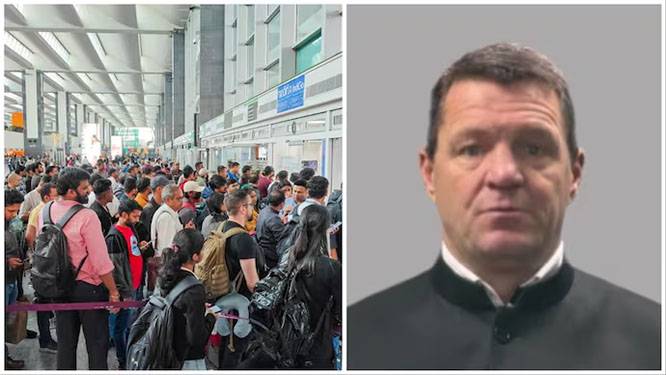
New Delhi, Dec 5: IndiGo CEO Pieter Elbers issued a public apology this evening after more than a thousand flights were cancelled today, making it the "most severely impacted day" in terms of cancellations. The biggest airline of the country cancelled "more than half" of its daily number of flights on Friday, said Elbers. He also said that even though the crisis will persist on Saturday, the airline anticipates fewer than 1,000 flight cancellations.

"Full normalisation is expected between December 10 and 15, though IndiGo cautions that recovery will take time due to the scale of operations," the IndiGo CEO said. 

IndiGo operates around 2,300 domestic and international flights daily.

Pieter Elbers, while apologising for the major inconvenience due to delays and cancellations, said the situation is a result of various causes.

The crisis at IndiGo stems from new regulations that boost pilots' weekly rest requirements by 12 hours to 48 and allow only two night-time landings per week, down from six. IndiGo has attributed the mass cancellations to "misjudgment and planning gaps".

Elbers also listed three lines of action that the airline will adopt to address the issue.

"Firstly, customer communication and addressing your needs, for this, messages have been sent on social media. And just now, a more detailed communication with information, refunds, cancellations and other customer support measures was sent," he said.

The airline has also stepped up its call centre capacity.

"Secondly, due to yesterday's situation, we had customers stranded mostly at the nation's largest airports. Our focus was for all of them to be able to travel today itself, which will be achieved. For this, we also ask customers whose flights are cancelled not to come to the airports as notifications are sent," the CEO said.

"Thirdly, cancellations were made for today to align our crew and planes to be where they need to start tomorrow morning afresh. Earlier measures of the last few days, regrettable, have proven not to be enough, but we have decided today to reboot all our systems and schedules, resulting in the highest numbers of cancellations so far, but imperative for progressive improvements starting from tomorrow," he added.

As airports witnessed chaotic scenes, the Directorate General of Civil Aviation (DGCA) stepped in to grant IndiGo a temporary exemption from stricter night duty rules for pilots. It also allowed substitution of leaves with a weekly rest period. 

Civil Aviation Minister Ram Mohan Naidu has said a high-level inquiry will be ordered and accountability will be fixed.

Comments

Add new comment

  • Coastaldigest.com reserves the right to delete or block any comments.
  • Coastaldigset.com is not responsible for its readers’ comments.
  • Comments that are abusive, incendiary or irrelevant are strictly prohibited.
  • Please use a genuine email ID and provide your name to avoid reject.
News Network
November 24,2025

Mangaluru, Nov 24: The original departure time of 11.10 pm was a distant memory for scores of Dammam-bound passengers at Mangaluru International Airport last Friday night, as their Air India Express flight was abruptly cancelled at the eleventh hour, sparking hours of frustration and chaos.

The flight, IX 885, initially scheduled to depart at 11.10 pm on November 22, was subject to two back-to-back reschedules—first pushed to 11.45 pm and then significantly postponed to 1.40 am—before the final, crushing announcement of cancellation was made. For the travellers, many of whom are likely expatriate workers with tight schedules, the last-minute change marked the beginning of a distressing ordeal.

"There was no drinking water, no food, and absolutely no proper guidance. We were left stranded like refugees," complained a stranded passenger.

According to multiple passenger accounts, the airline's ground staff failed to provide adequate support or essential amenities following the cancellation. Complaints poured in about the total absence of drinking water, food provisions, and any reliable guidance from the carrier's representatives. Travellers alleged they were left stranded for a considerable period, with no immediate arrangements or clear communication offered regarding accommodation or alternative travel to send them back home.

The incident has highlighted serious concerns over the carrier's contingency planning and customer service protocols during flight disruptions at one of India's key international gateways. The airline is yet to issue a comprehensive statement addressing the alleged lapse in passenger care.
 

Comments

Add new comment

  • Coastaldigest.com reserves the right to delete or block any comments.
  • Coastaldigset.com is not responsible for its readers’ comments.
  • Comments that are abusive, incendiary or irrelevant are strictly prohibited.
  • Please use a genuine email ID and provide your name to avoid reject.