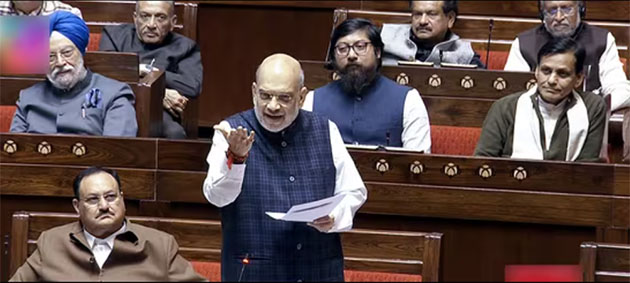
PoK belongs to India; 24 seats reserved in J-K assembly for representatives from that region: Amit Shah

News Network
December 12, 2023

amitshah.jpg

New Delhi: Union home minister Amit Shah has underscored India’s claim over Pakistan Occupied Kashmir (PoK) and said 24 seats were reserved in the Jammu and Kashmir assembly for representatives from the region as he blamed India’s first Prime Minister Jawaharlal Nehru for the delay in the integration of the erstwhile state with the rest of the country.

Shah’s comments came during his reply to the debate on two bills related to Jammu and Kashmir in the Rajya Sabha. The Jammu and Kashmir reservation (Amendment) Bill, 2023, and Jammu and Kashmir Reorganization (Amendment) Bill, 2023 were later passed by the Upper House with a voice vote.

 “PoK is ours and no one can snatch it from us...” he said, adding that full statehood will be given to J&K at an appropriate time.

The Opposition walked out of the proceedings before the amendments to the bills were put to vote.

The J&K reservation bill seeks to provide reservation in jobs and admission in professional institutions to scheduled castes, scheduled tribes, and other socially and educationally backward classes. The amendments seek to reword Section 2 of the Reservation Act to change the nomenclature of “weak and under privileged classes (social castes)” to “other backward classes” and make consequential amendments.

The J&K reorganisation bill provides for the reorganisation of the erstwhile state of J&K into the Union Territories of Jammu and Kashmir (with an elected legislature) and Ladakh (without an elected legislature). It seeks to increase the number of seats to 90 from 83 in J&K assembly — a number fixed by the delimitation commission earlier this year. It also reserves seven seats for scheduled castes, nine for scheduled tribes, two for Kashmiri migrants and one for displaced people from PoK. In addition, 24 seats are reserved for PoK.

Shah hailed the Supreme Court’s verdict upholding the abrogation of Article 370 that bestowed special status to J&K, and lashed out at the Congress for not supporting the 2019 move. “If you (Congress) still want to stick to this (stand), PM (Narendra Modi) will become the PM for the third time.”

“The Supreme Court verdict is a historic decision and I welcome it. Now there will be only one Constitution, one flag and one PM,” Shah said.

He also quoted Nehru’s own statements to buttress his claims that taking the Kashmir issue to the United Nations (UN) was an ill-conceived move. “Everyone knows that J&K’s accession to India was delayed as one person was given this task and that gave Pakistan an opportunity to attack Kashmir.” Had ceasefire not happened, there would have been no PoK,” he said.

Shah said Nehru admitted that more thought should have gone into the idea of a ceasefire. He also read out a quote from Sam Manekshaw, the then director of military operations, on the delay in sending out troops to stop the Kabali invaders who were on a rampage.

“I want to give a reference to Sam Manekshaw. He said at one place that when the Pakistanis were attacking Kashmir, then he was busy in discussions (don’t want to name the person). Sam Manekshaw was present at a meeting in which Sardar Patel told Nehru, “Do you want Kashmir or not?” Then the decision to send the army was taken,” Shah said.

While parties such as the Congress, the Trinamool Congress and the Dravida Munnetra Kazhagam (DMK) are opposed to repealing the special status, the Union government defends the move to read down Article 370 as constitutional, pointing out that the grant of special status was not a part of the standard Instrument of Accession Agreement signed in 1947 by the Maharaja of Jammu and Kashmir as well as by rulers of more than 500 other princely states and it was a temporary article in the Indian Constitution.

Reiterating the stand, Shah said, “I want to ask the followers of Nehru...Why did he prefix the word temporary....”

The minister also cited a quote where he said Nehru “accepted his mistake” of taking the Kashmir issue to the UN, and said, “After the experience of United Nations, I have come to the conclusions that no satisfactory results can be expected from there. I considered the ceasefire decision a good one, but we could not deal with this matter well. We should have had more thoughts on the ceasefire and taken it late. Though, these are the mistakes of the past.” This quote is of Jawaharlal Nehru. Unko toh manoge ya nahi manoge ki unhone galti ki. Accept this...(Nehru himself is accepting that he did a mistake)”.

The home minister, who had piloted the bill for the abrogation of Article 370 in 2019, blamed it for fostering separatism and terrorism. “States like Gujarat, Uttar Pradesh, and Bihar have larger Muslim populations than Kashmir. It wasn’t a border issue either… Gujarat shares a border with Pakistan. Why did separatism flourish in J&K? It was because Article 370 played a role in enabling and encouraging secession and that in turn promoted terrorism,” he said.

Underlining the changes that have been ushered in on the ground in the UT post 2019, Shah said the Union government has not only tackled terrorism, but has also dismantled the ecosystem that fostered it. “We have done the work of finishing the ecosystem of terrorism. 32 terrorism finance cases have been registered by SIT and 51 terrorism finance cases were registered by SIG. 229 arrests have been made in terror finance cases. Properties worth ₹150 crores have been seized and SIA has frozen 134 bank accounts with ₹100 crores in them,” he said.

Provisions such as not giving jobs to individuals whose family members are accused of stone pelting or other terror acts, he said, has helped bring down instances of stone pelting and the resultant casualties.

He said the Union government will not shy away from owning responsibility for the decision to abrogate Article 370. “If it’s a wrong decision...neither Modi, the cabinet or the party will run away from it. We take responsibility and own it, but also be ready to give an answer to the country because history spares none,” he said.

Speaking about the Opposition MPs‘ walkout, RJD MP Manoj Jha said, “I just said that there is no elected MP from Kashmir but he took it to somewhere else...The kind of speech the HM gave today lacked dignity... So our LoP Mallikarjun Kharge decided that we should walk out of the Parliament.”

Comments

Add new comment

  • Coastaldigest.com reserves the right to delete or block any comments.
  • Coastaldigset.com is not responsible for its readers’ comments.
  • Comments that are abusive, incendiary or irrelevant are strictly prohibited.
  • Please use a genuine email ID and provide your name to avoid reject.
P A Hameed Padubidri
November 26,2025

CD.jpg

Constitution Day, also known as Samvidhan Divas, is observed every year on November 26 to honor the adoption of the Constitution of India and to recognize the visionary effort that shaped the world’s largest democracy.

Historical Background

It’s on November 26, 1949, the Constituent Assembly of India formally adopted the Constitution.This date is commemorated to acknowledge the completion of nearly three years of drafting, debate, and refinement.

On January 26, 1950, the Constitution came into force, marking India’s transition from a dominion to a sovereign republic.

The date 26 January was chosen to honor the “Purna Swaraj” declaration made in 1930 that marked the relentless efforts & sacrifices of the many. 

Why Constitution Day is Celebrated

* To honor & remember the framers of the Constitution, especially Dr. B. R. Ambedkar, the Chairman of the Drafting Committee, & many others. 

* To remind the citizens of the values, responsibilities, and rights enshrined in the Constitution.

* To promote constitutional values & literacy among students, institutions, and the general public.

* To reaffirm the nation’s commitment to justice, equality, liberty, fraternity and secular values. 

Vision and Significance of the Constitution

It establishes the fundamental political and legal framework for the nation.

Defines the structure, powers and functions of:
    •    The Executive
    •    The Legislature
    •    The Judiciary
    •    Guarantees a comprehensive set of Fundamental Rights, including:

-Equality before law
-Freedom of speech & expression
-Protection of life and personal liberty
-Freedom of religion
-Embeds Directive Principles of State Policy, guiding governance toward social justice and welfare.
-Introduces Fundamental Duties to ensure civic responsibility among citizens.

Key Features Celebrated on Constitution Day

-The Indian constitution is considered one of the longest written constitutions of the world. It’s systematically drafted considering almost all aspects that properly fits to the country. 

-Blend of multiple global constitutional principles while staying rooted in Indian values and realities.

-Framework that balances Federalism, Secularism, Democracy and Rule of Law. This makes everyone-from President to common man-below the law & are equal in the sight of law. 

-Another feature is that it’s based on built-in mechanisms for amendments, ensuring the Constitution grows with changing needs.

Message of the Day

The core ethos of this  Constitution Day is not merely about looking back at history-it’s a reminder of the continuous duty to protect democratic values, respect diversity and uphold the principles that define India as a sovereign, socialist, secular and democratic republic.

Happy Constitution Day to all my compatriots

Comments

Add new comment

  • Coastaldigest.com reserves the right to delete or block any comments.
  • Coastaldigset.com is not responsible for its readers’ comments.
  • Comments that are abusive, incendiary or irrelevant are strictly prohibited.
  • Please use a genuine email ID and provide your name to avoid reject.
News Network
November 24,2025

Mangaluru, Nov 24: The original departure time of 11.10 pm was a distant memory for scores of Dammam-bound passengers at Mangaluru International Airport last Friday night, as their Air India Express flight was abruptly cancelled at the eleventh hour, sparking hours of frustration and chaos.

The flight, IX 885, initially scheduled to depart at 11.10 pm on November 22, was subject to two back-to-back reschedules—first pushed to 11.45 pm and then significantly postponed to 1.40 am—before the final, crushing announcement of cancellation was made. For the travellers, many of whom are likely expatriate workers with tight schedules, the last-minute change marked the beginning of a distressing ordeal.

"There was no drinking water, no food, and absolutely no proper guidance. We were left stranded like refugees," complained a stranded passenger.

According to multiple passenger accounts, the airline's ground staff failed to provide adequate support or essential amenities following the cancellation. Complaints poured in about the total absence of drinking water, food provisions, and any reliable guidance from the carrier's representatives. Travellers alleged they were left stranded for a considerable period, with no immediate arrangements or clear communication offered regarding accommodation or alternative travel to send them back home.

The incident has highlighted serious concerns over the carrier's contingency planning and customer service protocols during flight disruptions at one of India's key international gateways. The airline is yet to issue a comprehensive statement addressing the alleged lapse in passenger care.
 

Comments

Add new comment

  • Coastaldigest.com reserves the right to delete or block any comments.
  • Coastaldigset.com is not responsible for its readers’ comments.
  • Comments that are abusive, incendiary or irrelevant are strictly prohibited.
  • Please use a genuine email ID and provide your name to avoid reject.
News Network
December 4,2025

indigocrisis.jpg

Angry outbursts, long queues, and desperate appeals filled airports across India today as IndiGo grappled with a severe operational breakdown. Hundreds of flights have been cancelled or delayed, leaving thousands of passengers stranded through the night and forcing many to spend long hours at helpdesks.

Social media was flooded with videos of fliers pleading for assistance, accusing the airline of misleading updates, and demanding accommodation after being stuck for 10 to 12 hours at airports such as Hyderabad and Bengaluru.

What Triggered the Meltdown?

IndiGo has attributed the widespread disruption to “a multitude of unforeseen operational challenges.” These include:

•    Minor technology glitches
•    Winter-season schedule adjustments
•    Bad weather
•    Congestion in the aviation network
•    New crew rostering rules (Flight Duty Time Limitations or FDTL)

Among these, the most disruptive has been the implementation of the updated FDTL norms introduced by the Directorate General of Civil Aviation (DGCA) in January 2024.

These rules were designed to reduce pilot fatigue and improve passenger safety. Key changes include:

•    Longer weekly rest periods for flight crew
•    A revised definition of “night,” extending it by an extra hour
•    Tighter caps on flight duty timing and night landings
•    Cutting night shifts for pilots and crew from six per roster cycle to just two

Once these norms became fully enforceable, airlines were required to overhaul rosters well in advance. For IndiGo, this triggered a sudden shortage of crew available for duty, leading to cascading delays and cancellations.

Why IndiGo Was Hit the Hardest

IndiGo is India’s largest airline by a wide margin, operating over 2,200 flights daily. That’s roughly double the number operated by Air India.

When an airline of this size experiences even a 10–20% disruption, it translates to 200–400 flights being delayed or grounded — producing massive spillover effects across the country.

IndiGo also relies heavily on high-frequency overnight operations, a model typical of low-cost carriers that aim to maximise aircraft utilisation and reduce downtime. The stricter FDTL norms clash with these overnight-heavy schedules, forcing the airline to pull back services.

Aviation bodies have also criticised IndiGo’s preparedness. The Airline Pilots' Association of India (ALPA) said airlines were given a two-year window to plan for the new rules but “started preparing rather late.” IndiGo, it said, failed to rebuild crew rosters 15 days in advance as required.

The Federation of Indian Pilots (FIP) went further, calling the crisis the result of IndiGo’s “prolonged and unorthodox lean manpower strategy,” and alleging that the airline adopted a hiring freeze even as it knew the new rules would require more careful staffing.

How Many Flights Are Affected?

In the past 48 hours, over 300 flights have been cancelled. At least 100 more are expected to be cancelled today.

City-wise impact:

•    Hyderabad: 33 expected cancellations; several fliers stranded overnight
•    Bengaluru: over 70 expected cancellations
•    Delhi, Mumbai, Chennai, Kolkata: widespread delays and missed connections

Passengers shared distressing accounts online.

One customer at Hyderabad airport said they waited from 6 PM to 9 AM with “no action taken” regarding their delayed Pune flight. Another said IndiGo repeatedly told them the crew was “arriving soon,” only for the delay to stretch over 12 hours.

IndiGo has apologised for the disruption and promised that operations will stabilise within 48 hours, adding that “calibrated adjustments” are being made to contain the chaos.

What Should Passengers Do Now?

For those flying in the next few days, especially with IndiGo, here are key precautions:

1. Keep Checking Flight Status
Monitor your flight closely before leaving for the airport, as delays may be announced last-minute.

2. Arrive Early
Expect long queues at counters and security due to crowding and rescheduling.

3. Carry Essentials
Pack snacks, water, basic medicines, chargers, and items for children or senior citizens. Extended waiting times should be anticipated.

4. Use Flexible Booking Options
If you booked tickets with a free-date-change or cancellation option, consider using them.
If you haven’t booked yet, prefer refundable or flexible fares, or even consider alternate airlines.

5. Follow IndiGo’s Updates
Keep an eye on IndiGo’s official social media channels and contact customer support for rebooking and refund queries.

What Needs to Change?

Pilot groups have raised concerns not just about staffing but also the planning practices behind it.
The Federation of Indian Pilots accused IndiGo of:

•    Imposing an unexplained hiring freeze despite knowing the FDTL changes were coming
•    Entering non-poaching agreements that limited talent movement
•    Keeping pilot pay frozen
•    Underestimating the need to restructure operations in advance

They have urged DGCA to approve seasonal schedules only after airlines prove they have adequate pilot strength under the new norms.

ALPA also warned that some airlines might be using the delays as an “immature pressure tactic” to push DGCA for relaxations in the new rules — which, if granted, could compromise the very safety standards the norms were meant to protect.

Both pilot bodies stressed that no exemption should dilute safety, and any deviations should be based solely on scientific risk assessment.

Is a Solution in Sight?

While IndiGo says normalcy will return within two days, aviation experts believe that fully stabilising operations could take longer, depending on how quickly the airline can:
•    Re-align rosters
•    Mobilise rested crew
•    Boost staffing
•    Adjust its winter schedule to match regulatory requirements
Passengers are advised to remain prepared for continued delays over the next few days as the airline works through its backlog. 

Comments

Add new comment

  • Coastaldigest.com reserves the right to delete or block any comments.
  • Coastaldigset.com is not responsible for its readers’ comments.
  • Comments that are abusive, incendiary or irrelevant are strictly prohibited.
  • Please use a genuine email ID and provide your name to avoid reject.