



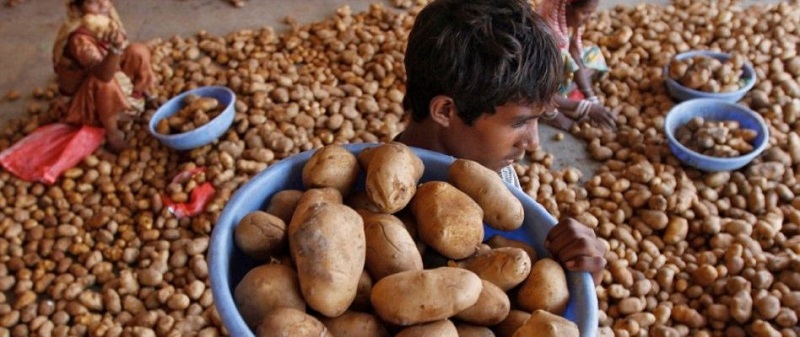
Potato, onion getting out of reach for poor, Rs 150 not enough to buy these veggies

Agencies
November 1, 2020

potato.jpg

New Delhi, Nov 1: Aloo and pyaz (potato and onion), considered as the poor's basic vegetables, are getting out of reach now as one needs to shell out at least Rs 150 to buy one kg each of these two commodities at a time when the common man is reeling under the COVID-19-induced hardships.

Farm experts are of the view that rising prices of essential commodities coupled with wage deflation and increasing joblessness are pushing poor households to the point of distress despite the government''s relief measures.

Not only daily wagers and the economically poor section, but middle class families also are finding it hard to manage their kitchen budget with skyrocketing prices of these two commodities since the last few weeks, they said.

Prices of potato and onion have shot up in both wholesale and retail markets of the national capital and other parts of the country because of tight supplies, the reason that the government attributes to damage to the crop due to heavy rains.

In Delhi, retail onion prices spiked to Rs 80 per kg on October 21 from Rs 20 per kg in June while that of potato to over Rs 70 per kg from Rs 30 in the said period, according to trade data.

In Mother Dairy''s Safal outlets, potato was being sold at Rs 58-62 per kg in the last week while onion was hardly available in some outlets.

"With my daily earning of Rs 150-200, I cannot think of buying aloo and pyaz. What will I feed my family of five members? Other vegetables are equally costlier. How do we survive?" Brij Mohan, a rickshaw-puller at Sadar Bazar, cried.

Mohan, who hails from Bihar, returned to the national capital to restart his life after the COVID-19 lockdown was lifted.

"But earnings are not that great as people are not very keen to take rickshaws these days due to the fear of infection. Somehow I am managing to meet the house expenses. The rise in prices of vegetables has added to my woes," he said.

Sharing a similar ordeal, carpenter Mustakeen who hails from Uttar Pradesh, stated, "Though life has limped back to normalcy in markets but my earnings are still low. On the top of it, potato-onion prices are touching sky-high. What will I feed my children? Cannot buy even aloo and pyaz."

Mustakeen, who works in Bhogal and Ashram areas of the city, said his hopes of earning extra during Diwali are all dashed to the ground as not many people are interested to get any big carpentry work in this pandemic.

Experts, who do not want to be identified, said as long as the price inflationary pressure persists along with wage deflation and increased joblessness, the measures like free distribution of grains to ration card holders will not fully solve the real problems of the common man.

To give relief to the poor, the government has taken several steps. It is distributing additional foodgrains of 5 kg per person for free via ration shops under the Pradhan Mantri Garib Kalyan Yojana till November.

The government has also launched new PM Street Vendors'' Aatmanirbhar Nidhi (SVANidhi) microcredit programme and other steps to help the poor to tide over the crisis.

However, Roma Devi, a housemaid working in Nizamuddin area, said: "No matter how much free grains I get from the ration shop, I have to buy at least potato and onion, else what sabzi my family of five will have with rice or roti?"

"My daily aloo consumption is 1 kg. How will I manage now?" she said as she purchased a half kg potatoes at Rs 70 per kg from a nearby market.

The irony is that India, which was exporting both potato and onion till a few months back, has started importing them now -- a situation which experts say the government could have easily avoided and not left the poor to bear the brunt of price rise at a time the pandemic hit them harder like never before.

According to the official data, the country exported 8,05,259 tonnes of onion till June this year while 1,26,728 tonnes of potato till May.

Last week, Food and Consumer Affairs Minister Piyush Goyal had said about 7,000 tonnes of onion have already been imported by private traders and 25,000 tonnes more are expected to arrive before Diwali. Also, 30,000 tonnes of potatoes are being imported from Bhutan to boost domestic supply.


Comments

Add new comment

  • Coastaldigest.com reserves the right to delete or block any comments.
  • Coastaldigset.com is not responsible for its readers’ comments.
  • Comments that are abusive, incendiary or irrelevant are strictly prohibited.
  • Please use a genuine email ID and provide your name to avoid reject.
News Network
December 7,2025

SHRIMP.jpg

Mangaluru, Dec 7: A rare bamboo shrimp has been rediscovered on mainland India more than 70 years after it was last reported, confirming for the first time the presence of Atyopsis spinipes in the country. The find was made by researchers from the Centre for Climate Change Studies at Sathyabama Institute of Science and Technology, Chennai, during surveys in Karnataka and Odisha.

The team — shrimp expert Dr S Prakash, PhD scholar K Kunjulakshmi, and Mangaluru-based researcher Maclean Antony Santos — combined field surveys, ecological assessments and DNA analysis to identify the elusive species. Their findings, published in Zootaxa, resolve decades of taxonomic confusion stemming from a 1951 report that misidentified the species as Atyopsis moluccensis without strong evidence.

The shrimp has now been confirmed at two locations: the Mulki–Pavanje estuary near Mangaluru and the Kuakhai River in Bhubaneswar. Historical specimens from the Andaman Islands, previously labelled as A. moluccensis, were also found to be misidentified and actually belong to A. spinipes.

The rediscovery began after an aquarium hobbyist in Odisha spotted a shrimp in 2022, prompting systematic surveys across Udupi, Karwar and Mangaluru. Four female specimens were collected in Mulki and one in Odisha, all genetically matching.

Researchers warn the species may exist in very small, vulnerable populations as freshwater habitats face increasing pressure from pollution, sand mining and infrastructure development. All verified specimens have been deposited with the Zoological Survey of India for future reference.

Comments

Add new comment

  • Coastaldigest.com reserves the right to delete or block any comments.
  • Coastaldigset.com is not responsible for its readers’ comments.
  • Comments that are abusive, incendiary or irrelevant are strictly prohibited.
  • Please use a genuine email ID and provide your name to avoid reject.
News Network
December 6,2025

pilot.jpg

New Delhi: IndiGo, India’s largest airline, faced major operational turbulence this week after failing to prepare for new pilot-fatigue regulations issued by the Directorate General of Civil Aviation (DGCA). The stricter rules—designed to improve flight safety—took effect in phases through 2024, with the latest implementation on November 1. IndiGo has acknowledged that inadequate roster planning led to widespread cancellations and delays.

Below are the key DGCA rules that affected IndiGo’s operations:

1. Longer Mandatory Weekly Rest

Weekly rest for pilots has been increased from 36 hours to 48 hours.

The government says the extended break is essential to curb cumulative fatigue. This rule remains in force despite the current crisis.

2. Cap on Night Landings

Pilots can now perform only two night landings per week—a steep reduction from the earlier limit of six.

Night hours, defined as midnight to early morning, are considered the least alert period for pilots.

Given the disruptions, this rule has been temporarily relaxed for IndiGo until February 10.

3. Reduced Maximum Night Flight Duty

Flight duty that stretches into the night is now capped at 10 hours.

This measure has also been kept on hold for IndiGo until February 10 to stabilize operations.

4. Weekly Rest Cannot Be Replaced With Personal Leave

Airlines can no longer count a pilot’s personal leave as part of the mandatory 48-hour rest.

Pilots say this closes a loophole that previously reduced actual rest time.

Currently, all airlines are exempt from this rule to normalise travel.

5. Mandatory Fatigue Monitoring

Airlines must submit quarterly fatigue reports along with corrective actions to DGCA.

This system aims to create a transparent fatigue-tracking framework across the industry.

The DGCA has stressed that these rules were crafted to strengthen flight safety and align India with global fatigue-management standards. The temporary relaxations are expected to remain until February 2025, giving IndiGo time to stabilise its schedules and restore normal air travel.

Comments

Add new comment

  • Coastaldigest.com reserves the right to delete or block any comments.
  • Coastaldigset.com is not responsible for its readers’ comments.
  • Comments that are abusive, incendiary or irrelevant are strictly prohibited.
  • Please use a genuine email ID and provide your name to avoid reject.
News Network
November 26,2025

Mangaluru, Nov 26: Mangaluru East police have registered a case following a sophisticated online fraud where a 57-year-old local resident was allegedly cheated out of ₹13.4 lakh after being targeted on Facebook.

The scam began in February when the complainant, while browsing Facebook reels, was contacted by a woman identifying herself as "Lillian Mary George" from London. After establishing a chat relationship, the woman claimed she would visit India in November and bring a significant sum of money.

The trap was sprung on November 15, when the victim received a call from a woman named "Sonali Gupta," who claimed Lillian had arrived at Mumbai International Airport but was detained by customs. The fraudsters convinced the man that Lillian was carrying £25,000 (about ₹26 lakh) in traveller’s cheques and 1 kg of gold (valued at around ₹30 lakh).

Under the pretense of clearing these items, the victim was asked to make numerous online transfers between November 15 and 18 for various bogus charges, including:

•    "Pounds exchange registration"
•    "Customs declaration issues"
•    "Discount charges"
•    "Money-laundering charges"

Believing the fictitious story, the complainant transferred the cumulative sum of ₹13.4 lakh to various bank accounts provided by the fraudsters. He realised he was cheated when the culprits later promised a refund within two days but stopped answering his calls. The Mangaluru East police are now investigating the case, which highlights the continuing threat of transnational cyber fraud using social engineering and promises of fictitious wealth.

Comments

Add new comment

  • Coastaldigest.com reserves the right to delete or block any comments.
  • Coastaldigset.com is not responsible for its readers’ comments.
  • Comments that are abusive, incendiary or irrelevant are strictly prohibited.
  • Please use a genuine email ID and provide your name to avoid reject.
