



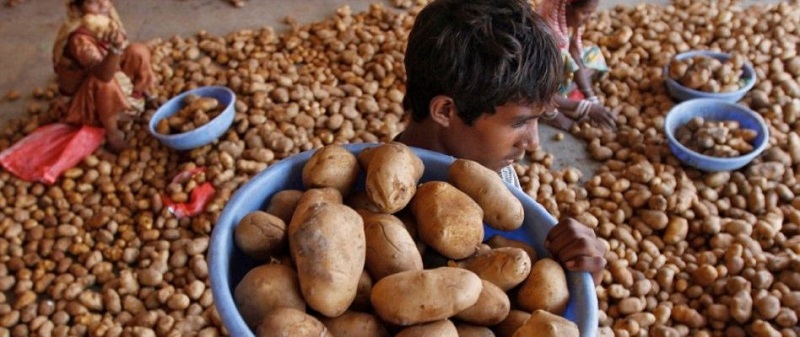
Potato, onion getting out of reach for poor, Rs 150 not enough to buy these veggies

Agencies
November 1, 2020

potato.jpg

New Delhi, Nov 1: Aloo and pyaz (potato and onion), considered as the poor's basic vegetables, are getting out of reach now as one needs to shell out at least Rs 150 to buy one kg each of these two commodities at a time when the common man is reeling under the COVID-19-induced hardships.

Farm experts are of the view that rising prices of essential commodities coupled with wage deflation and increasing joblessness are pushing poor households to the point of distress despite the government''s relief measures.

Not only daily wagers and the economically poor section, but middle class families also are finding it hard to manage their kitchen budget with skyrocketing prices of these two commodities since the last few weeks, they said.

Prices of potato and onion have shot up in both wholesale and retail markets of the national capital and other parts of the country because of tight supplies, the reason that the government attributes to damage to the crop due to heavy rains.

In Delhi, retail onion prices spiked to Rs 80 per kg on October 21 from Rs 20 per kg in June while that of potato to over Rs 70 per kg from Rs 30 in the said period, according to trade data.

In Mother Dairy''s Safal outlets, potato was being sold at Rs 58-62 per kg in the last week while onion was hardly available in some outlets.

"With my daily earning of Rs 150-200, I cannot think of buying aloo and pyaz. What will I feed my family of five members? Other vegetables are equally costlier. How do we survive?" Brij Mohan, a rickshaw-puller at Sadar Bazar, cried.

Mohan, who hails from Bihar, returned to the national capital to restart his life after the COVID-19 lockdown was lifted.

"But earnings are not that great as people are not very keen to take rickshaws these days due to the fear of infection. Somehow I am managing to meet the house expenses. The rise in prices of vegetables has added to my woes," he said.

Sharing a similar ordeal, carpenter Mustakeen who hails from Uttar Pradesh, stated, "Though life has limped back to normalcy in markets but my earnings are still low. On the top of it, potato-onion prices are touching sky-high. What will I feed my children? Cannot buy even aloo and pyaz."

Mustakeen, who works in Bhogal and Ashram areas of the city, said his hopes of earning extra during Diwali are all dashed to the ground as not many people are interested to get any big carpentry work in this pandemic.

Experts, who do not want to be identified, said as long as the price inflationary pressure persists along with wage deflation and increased joblessness, the measures like free distribution of grains to ration card holders will not fully solve the real problems of the common man.

To give relief to the poor, the government has taken several steps. It is distributing additional foodgrains of 5 kg per person for free via ration shops under the Pradhan Mantri Garib Kalyan Yojana till November.

The government has also launched new PM Street Vendors'' Aatmanirbhar Nidhi (SVANidhi) microcredit programme and other steps to help the poor to tide over the crisis.

However, Roma Devi, a housemaid working in Nizamuddin area, said: "No matter how much free grains I get from the ration shop, I have to buy at least potato and onion, else what sabzi my family of five will have with rice or roti?"

"My daily aloo consumption is 1 kg. How will I manage now?" she said as she purchased a half kg potatoes at Rs 70 per kg from a nearby market.

The irony is that India, which was exporting both potato and onion till a few months back, has started importing them now -- a situation which experts say the government could have easily avoided and not left the poor to bear the brunt of price rise at a time the pandemic hit them harder like never before.

According to the official data, the country exported 8,05,259 tonnes of onion till June this year while 1,26,728 tonnes of potato till May.

Last week, Food and Consumer Affairs Minister Piyush Goyal had said about 7,000 tonnes of onion have already been imported by private traders and 25,000 tonnes more are expected to arrive before Diwali. Also, 30,000 tonnes of potatoes are being imported from Bhutan to boost domestic supply.

Comments

Add new comment

  • Coastaldigest.com reserves the right to delete or block any comments.
  • Coastaldigset.com is not responsible for its readers’ comments.
  • Comments that are abusive, incendiary or irrelevant are strictly prohibited.
  • Please use a genuine email ID and provide your name to avoid reject.
News Network
November 27,2025

imrankhan.jpg

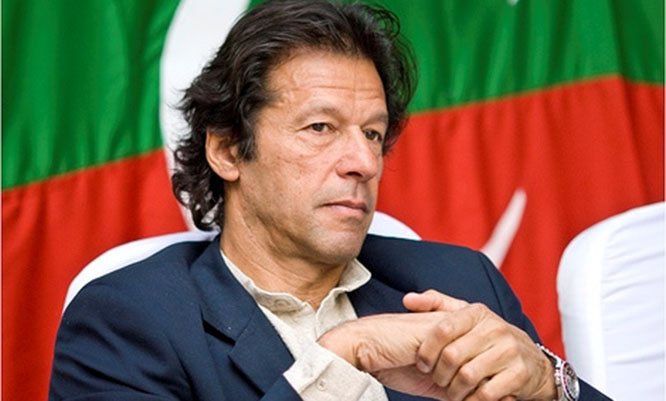
Authorities at Pakistan’s high-security Adiala Jail in Rawalpindi on Wednesday dismissed speculation about the condition of imprisoned former Pakistan Prime Minister Imran Khan, rejecting rumours that he had been moved out of the facility or was in danger. Officials said Khan was in “good health” and described the viral death claims as “baseless.”

“There is no truth to reports about his transfer from Adiala Jail,” the Rawalpindi prison administration said in a statement, according to Geo News. “He is fully healthy and receiving complete medical attention.”

Amid swirling rumours on social media, Imran Khan’s party, Pakistan Tehreek-e-Insaf (PTI), urged the federal government to issue an official clarification and demanded that authorities allow his family to meet him immediately, Dawn reported.

The frenzy began after Khan’s three sisters called for an impartial probe into what they described as a “brutal” police assault on them and other PTI supporters outside Adiala Jail last week. Soon after, several social media handles circulated unverified claims alleging that Khan had been “killed” inside the prison.

The rumours intensified when a handle named “Afghanistan Times” claimed that “credible sources” had confirmed Khan’s “murder” and that his body had been moved out of the jail — allegations that have not been verified by any credible agency.

Imran Khan, PTI’s patron-in-chief, has been lodged in the Rawalpindi prison since August 2023 in multiple cases. For over a month, an undeclared restriction has prevented family members and senior PTI leaders from meeting him. Khyber-Pakhtunkhwa Chief Minister Sohail Afridi has reportedly been denied access despite making seven attempts.

In a letter to Punjab Police Chief Usman Anwar, Khan’s sisters — Noreen Niazi, Aleema Khan, and Dr. Uzma Khan — said they were “peacefully protesting” outside the jail when police allegedly launched an unprovoked assault after streetlights were switched off.

“At 71, I was seized by my hair, thrown to the ground and dragged across the road,” Noreen Niazi said, alleging that other women present were also slapped and manhandled.

Adiala Jail officials reiterated that speculation over Imran Khan’s health was unfounded and insisted that his well-being was being ensured, Geo News reported.

Comments

Add new comment

  • Coastaldigest.com reserves the right to delete or block any comments.
  • Coastaldigset.com is not responsible for its readers’ comments.
  • Comments that are abusive, incendiary or irrelevant are strictly prohibited.
  • Please use a genuine email ID and provide your name to avoid reject.
News Network
November 30,2025

The United Nations Committee against Torture (CAT) has condemned the Israeli regime for enforcing a policy of “organized torture” against Palestinians.

In a report published on Friday, CAT stated that the occupying regime enforces a deliberate policy of “organized and widespread torture and ill-treatment” against Palestinian abductees, particularly since October 7, 2023, when Israel launched its genocidal war on Gaza.

The committee expressed “deep concern over repeated severe beatings, dog attacks, electrocution, water-boarding, use of prolonged stress positions [and] sexual violence” inflicted on Palestinians.

Palestinian prisoners were degraded by “being made to act like animals or being urinated on,” systematically denied medical care, and subjected to excessive restraints, “in some cases resulting in amputation,” the report added.

CAT also condemned the routine application of “unlawful combatants law” to justify the prolonged detention without trial of thousands of Palestinian men, women, and children.

More than 10,000 Palestinians, including women and children, are currently held in Israeli prisons, according to Palestinian and international human rights groups, with 3,474 Palestinians in “administrative detention,” meaning they are imprisoned without trial for indefinite periods.

The report highlighted the “high proportion of children who are currently detained without charge or on remand,” noting that while Israel sets the age of criminal responsibility at 12, even younger children have been abducted.

Children designated as security prisoners face severe restrictions on family contact, may be subjected to solitary confinement, and are denied access to education, in clear violation of international law.

The committee further suggested that Israel’s policies across the Occupied Territories constitute collective torture against the Palestinian population.

“A range of policies adopted by Israel in the course of its continued unlawful presence in the Occupied Palestinian Territory amounts to cruel, inhuman or degrading living conditions for the Palestinian population,” the report said.

On Thursday, the Palestinian resistance movement Hamas condemned the systematic killing and torture of Palestinian abductees in Israeli prisons, urging international action to halt these abuses.

Citing human rights data, Hamas stated that 94 Palestinians have been killed in Israeli prisons since the start of Tel Aviv’s genocidal war on Gaza.

“This reflects an organized criminal approach that has turned these prisons into direct killing grounds to eliminate our people,” the resistance movement said.

Hamas called on the international community, the UN, and human rights organizations to immediately pressure Israel to end crimes against prisoners and uphold their rights as guaranteed by all international conventions and norms.

Comments

Add new comment

  • Coastaldigest.com reserves the right to delete or block any comments.
  • Coastaldigset.com is not responsible for its readers’ comments.
  • Comments that are abusive, incendiary or irrelevant are strictly prohibited.
  • Please use a genuine email ID and provide your name to avoid reject.
News Network
November 26,2025

students.jpg

Bengaluru, Nov 26: Karnataka is taking its first concrete steps towards lifting a three-decade-old ban on student elections in colleges and universities. Deputy Chief Minister D.K. Shivakumar announced Wednesday that the state government will form a small committee to study the reintroduction of campus polls, a practice halted in 1989 following incidents of violence.

Speaking at a 'Constitution Day' event organised by the Karnataka Congress, Mr. Shivakumar underscored the move's aim: nurturing new political leadership from the grassroots.

"Recently, (Leader of the Opposition in Lok Sabha) Rahul Gandhi wrote a letter to me and Chief Minister (Siddaramaiah) asking us to think about restarting student elections," Shivakumar stated. "I'm announcing today that we'll form a small committee and seek a report on this."

Student elections were banned in Karnataka in 1989, largely due to concerns over violence and the infiltration of political party affiliates into campus life. The ban effectively extinguished vibrant student bodies and the pipeline of young leaders they often produced.

Mr. Shivakumar, who also serves as the Karnataka Congress president, said that former student leaders will be consulted to "study the pros and cons" of the re-introduction.

Acknowledging the history of the ban, he added, "There were many criminal activities taking place back then. We’ll see how we can conduct (student) elections by regulating such criminal activities."

The Deputy CM reminisced about his own journey, which began on campus. He recalled his political activism at Sri Jagadguru Renukacharya College leading to his first Assembly ticket in 1985 at the age of 23. "That's how student leadership was at the time. Such leadership has gone today. College elections have stopped," he lamented, adding that for many, college elections were "like a big movement" where leaders were forged.

The move, driven by the Congress high command's push to cultivate young talent, will face scrutiny from academics and university authorities who have, in the past, expressed concern that the return of polls could disrupt the peaceful academic environment and turn campuses into political battlegrounds.

Comments

Add new comment

  • Coastaldigest.com reserves the right to delete or block any comments.
  • Coastaldigset.com is not responsible for its readers’ comments.
  • Comments that are abusive, incendiary or irrelevant are strictly prohibited.
  • Please use a genuine email ID and provide your name to avoid reject.