Protect environment for future, says outgoing President in farewell address to India

News Network
July 24, 2022

ramnathkovind.jpg

New Delhi, July 24: Mother nature is in deep agony and the climate crisis can endanger the very future of this planet, outgoing President Ram Nath Kovind said in his farewell address to the nation on Sunday as he appealed to all to protect the environment for the coming generations.

Emphasising that the country is getting equipped to make the 21st century "the century of India," Kovind highlighted the importance of healthcare and education and said these, along with economic reforms, would enable citizens to pursue happiness by discovering their potential.

President-elect Droupadi Murmu will be sworn in as the country's 15th President on Monday.

In his last televised address to the nation, Kovind said, "The pandemic has underlined the need to further improve the public healthcare infrastructure. I am glad that the government has accorded top priority to this task.

"Once education and healthcare are in place, economic reforms will let citizens find the best course for their lives, he said, adding that "I firmly believe that our country is getting equipped to make the 21st century, the century of India".

He said the National Education Policy will go a long way in making it possible for young Indians to connect with their heritage and also find their feet in the twenty-first century.

The president made a special mention of the threat to the environment and asked all citizens to take care of it for future generations.

"Mother Nature is in deep agony and the climate crisis can endanger the very future of this planet. We must take care of our environment, our land, air and water for the sake of our children.

"In our daily lives and routine choices, we must be more careful to protect our trees, rivers, seas and mountains as well as all other living beings. As the first citizen, if I have to give one advice to my fellow citizens, it has to be this," he added.

President Kovind also hailed the trinity of ideals of liberty, equality and fraternity, saying they must not be mistaken as abstractions beacause they ''are lofty, noble and uplifting."

"Our history, not only of modern times but also from ancient times, reminds us that they are real; that they can be realised, and indeed have been realised in different eras.

"Our ancestors and founders of our modern nation exemplified the meaning of justice, liberty, equality and fraternity with hard work and an attitude of service. We only have to follow in their footsteps and keep walking," he said.

And what do such ideals mean for a common citizen today? Kovind asked.

"I believe the chief goal is to help them discover the joy of living. For that, first of all, their basic necessities must be taken care of," the president emphasised.

During his address, the president went down memory lane to highlight the inherent power of vibrant democratic institutions.

Kovind recalled his earlier days when the country had just achieved independence and said, "There was a fresh wave of energy to rebuild the country; there were new dreams. I too had a dream, that one day I would be able to participate in a meaningful way in this nation-building exercise."

"A young boy living in a mud house could not have any idea about the highest Constitutional office of the Republic. But it is a testament to the strength of India's democracy that it has created pathways to let each citizen take part in the shaping of our collective destiny.

"If that Ram Nath Kovind from village Paraunkh is addressing you today, it is solely thanks to the inherent power of our vibrant democratic institutions," he said.

In his farewell speech on the eve of his completing five-year tenure as the president, Kovind said the founders of our modern nation exemplified the meaning of justice, liberty, equality and fraternity with hard work and an attitude of service, and "we only have to follow in their footsteps and keep walking".

The president said the nation is working with the objective of providing better housing, and access to drinking water and electricity for every family.

"This change has been made possible by the momentum of development and good governance which knows no discrimination," he said.

Kovind said the formal map for the democratic path "we all have been navigating was drafted by the Constituent Assembly" and the Constitution they prepared, with invaluable contributions from each of them, has been our guiding beacon.

"Values enshrined in it have been part of the Indian ethos since time immemorial," the outgoing president said and quoted Dr Babasaheb Bhimrao Ambedkar's concluding remarks in the Constituent Assembly where he had pointed out the distinction between political and social democracy.

"What does social democracy mean? It means a way of life which recognises liberty, equality and fraternity as the principles of life.

"These principles of liberty, equality and fraternity are not to be treated as separate items in a trinity. They form a union of trinity in the sense that to divorce one from the other is to defeat the very purpose of democracy," Kovind quoted Ambedkar as having said.

President Kovind said in modern times, the glorious journey of the country commenced with the awakening of nationalist feelings during colonial rule and the launch of the freedom struggle.

"There were many uprisings across the country in the nineteenth century. The names of many of the heroes who brought hopes of new dawn have long been forgotten.

"Contributions of some of them have come to be appreciated only in recent times. Around the turn of the century, the various struggles were coming together, creating a new consciousness," he said.
When Gandhiji returned to the motherland in 1915, the nationalist fervour was gaining momentum, Kovind said, mentioning Gurudev Rabindranath Tagore, Babasaheb Bhimrao Ambedkar, Jawaharlal Nehru and Syama Prasad Mookerjee among others.

"From Tilak and Gokhale to Bhagat Singh and Netaji, from Jawaharlal Nehru, Sardar Patel and Shyama Prasad Mukherjee to Sarojini Naidu and Kamaladevi Chattopadhyay – nowhere in the history of humankind have so many great minds come together for a common cause," he said.

Expressing deep gratitude to all fellow citizens and elected representatives, Kovind said he has been inspired and energised by interactions with farmers and workers from small villages, teachers shaping young minds, artists enriching our legacy, scholars investigating various facets of our country and business people creating wealth for the nation.

He also mentioned doctors and nurses serving the people, scientists and engineers engaged in nation-building, judges and advocates contributing to the justice delivery system of the country and civil servants who run the administration smoothly.

"'Our social workers actively connecting every social segment with development, preachers and masters of all sects who maintain the flow of spirituality in Indian society – you all have continuously helped me discharge my duties," he said.

"In short, I received full cooperation, support and blessings from all sections of society. I will especially cherish the occasions when I had an opportunity to meet our brave jawans of the armed forces, para-military forces and the police. Their patriotic zeal is as amazing, as it is inspiring," the president said.

Referring to his interaction with the Indian diaspora during his visits abroad, Kovind said he found their love and concern for the homeland very touching.

"All these re-affirm the belief that the nation is after all composed of its citizens; and with each of you striving to make India better and better, the nation’s great future is secure," he said.

Kovind said that among the most memorable moments of his life has been visiting his home during his term and touching the feet of his teachers at Kanpur to seek their blessings.

"This year, the prime minister also honoured my village Paraunkh with his visit. This connection with our roots has been the essence of India. I would request the younger generation to continue this tradition of staying connected with their village or town, their schools and teachers," the president said.

Asserting that he has discharged his responsibilities to the best of his ability and has been conscious of being a successor to great icons like Dr Rajendra Prasad, Dr S Radhakrishnan and Dr APJ Abdul Kalam, Kovind said, "Still, whenever I was in doubt, I turned to Gandhiji and his famous talisman."

"His advice of recalling the face of the poorest man and asking myself if the step I am about to take will be of any use to him. At the risk of repeating myself, I will urge you to contemplate Gandhiji’s life and teachings at least for a few minutes every day," he said. 

Comments

Add new comment

  • Coastaldigest.com reserves the right to delete or block any comments.
  • Coastaldigset.com is not responsible for its readers’ comments.
  • Comments that are abusive, incendiary or irrelevant are strictly prohibited.
  • Please use a genuine email ID and provide your name to avoid reject.
News Network
November 26,2025

students.jpg

Bengaluru, Nov 26: Karnataka is taking its first concrete steps towards lifting a three-decade-old ban on student elections in colleges and universities. Deputy Chief Minister D.K. Shivakumar announced Wednesday that the state government will form a small committee to study the reintroduction of campus polls, a practice halted in 1989 following incidents of violence.

Speaking at a 'Constitution Day' event organised by the Karnataka Congress, Mr. Shivakumar underscored the move's aim: nurturing new political leadership from the grassroots.

"Recently, (Leader of the Opposition in Lok Sabha) Rahul Gandhi wrote a letter to me and Chief Minister (Siddaramaiah) asking us to think about restarting student elections," Shivakumar stated. "I'm announcing today that we'll form a small committee and seek a report on this."

Student elections were banned in Karnataka in 1989, largely due to concerns over violence and the infiltration of political party affiliates into campus life. The ban effectively extinguished vibrant student bodies and the pipeline of young leaders they often produced.

Mr. Shivakumar, who also serves as the Karnataka Congress president, said that former student leaders will be consulted to "study the pros and cons" of the re-introduction.

Acknowledging the history of the ban, he added, "There were many criminal activities taking place back then. We’ll see how we can conduct (student) elections by regulating such criminal activities."

The Deputy CM reminisced about his own journey, which began on campus. He recalled his political activism at Sri Jagadguru Renukacharya College leading to his first Assembly ticket in 1985 at the age of 23. "That's how student leadership was at the time. Such leadership has gone today. College elections have stopped," he lamented, adding that for many, college elections were "like a big movement" where leaders were forged.

The move, driven by the Congress high command's push to cultivate young talent, will face scrutiny from academics and university authorities who have, in the past, expressed concern that the return of polls could disrupt the peaceful academic environment and turn campuses into political battlegrounds.

Comments

Add new comment

  • Coastaldigest.com reserves the right to delete or block any comments.
  • Coastaldigset.com is not responsible for its readers’ comments.
  • Comments that are abusive, incendiary or irrelevant are strictly prohibited.
  • Please use a genuine email ID and provide your name to avoid reject.
News Network
November 30,2025

The United Nations Committee against Torture (CAT) has condemned the Israeli regime for enforcing a policy of “organized torture” against Palestinians.

In a report published on Friday, CAT stated that the occupying regime enforces a deliberate policy of “organized and widespread torture and ill-treatment” against Palestinian abductees, particularly since October 7, 2023, when Israel launched its genocidal war on Gaza.

The committee expressed “deep concern over repeated severe beatings, dog attacks, electrocution, water-boarding, use of prolonged stress positions [and] sexual violence” inflicted on Palestinians.

Palestinian prisoners were degraded by “being made to act like animals or being urinated on,” systematically denied medical care, and subjected to excessive restraints, “in some cases resulting in amputation,” the report added.

CAT also condemned the routine application of “unlawful combatants law” to justify the prolonged detention without trial of thousands of Palestinian men, women, and children.

More than 10,000 Palestinians, including women and children, are currently held in Israeli prisons, according to Palestinian and international human rights groups, with 3,474 Palestinians in “administrative detention,” meaning they are imprisoned without trial for indefinite periods.

The report highlighted the “high proportion of children who are currently detained without charge or on remand,” noting that while Israel sets the age of criminal responsibility at 12, even younger children have been abducted.

Children designated as security prisoners face severe restrictions on family contact, may be subjected to solitary confinement, and are denied access to education, in clear violation of international law.

The committee further suggested that Israel’s policies across the Occupied Territories constitute collective torture against the Palestinian population.

“A range of policies adopted by Israel in the course of its continued unlawful presence in the Occupied Palestinian Territory amounts to cruel, inhuman or degrading living conditions for the Palestinian population,” the report said.

On Thursday, the Palestinian resistance movement Hamas condemned the systematic killing and torture of Palestinian abductees in Israeli prisons, urging international action to halt these abuses.

Citing human rights data, Hamas stated that 94 Palestinians have been killed in Israeli prisons since the start of Tel Aviv’s genocidal war on Gaza.

“This reflects an organized criminal approach that has turned these prisons into direct killing grounds to eliminate our people,” the resistance movement said.

Hamas called on the international community, the UN, and human rights organizations to immediately pressure Israel to end crimes against prisoners and uphold their rights as guaranteed by all international conventions and norms.

Comments

Add new comment

  • Coastaldigest.com reserves the right to delete or block any comments.
  • Coastaldigset.com is not responsible for its readers’ comments.
  • Comments that are abusive, incendiary or irrelevant are strictly prohibited.
  • Please use a genuine email ID and provide your name to avoid reject.
News Network
December 5,2025

indigoCEO.jpg

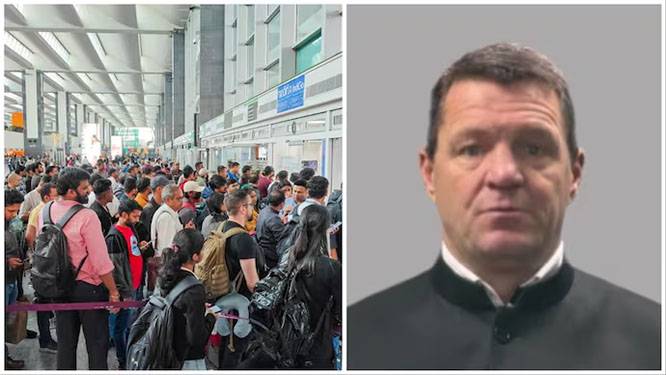
New Delhi, Dec 5: IndiGo CEO Pieter Elbers issued a public apology this evening after more than a thousand flights were cancelled today, making it the "most severely impacted day" in terms of cancellations. The biggest airline of the country cancelled "more than half" of its daily number of flights on Friday, said Elbers. He also said that even though the crisis will persist on Saturday, the airline anticipates fewer than 1,000 flight cancellations.

"Full normalisation is expected between December 10 and 15, though IndiGo cautions that recovery will take time due to the scale of operations," the IndiGo CEO said. 

IndiGo operates around 2,300 domestic and international flights daily.

Pieter Elbers, while apologising for the major inconvenience due to delays and cancellations, said the situation is a result of various causes.

The crisis at IndiGo stems from new regulations that boost pilots' weekly rest requirements by 12 hours to 48 and allow only two night-time landings per week, down from six. IndiGo has attributed the mass cancellations to "misjudgment and planning gaps".

Elbers also listed three lines of action that the airline will adopt to address the issue.

"Firstly, customer communication and addressing your needs, for this, messages have been sent on social media. And just now, a more detailed communication with information, refunds, cancellations and other customer support measures was sent," he said.

The airline has also stepped up its call centre capacity.

"Secondly, due to yesterday's situation, we had customers stranded mostly at the nation's largest airports. Our focus was for all of them to be able to travel today itself, which will be achieved. For this, we also ask customers whose flights are cancelled not to come to the airports as notifications are sent," the CEO said.

"Thirdly, cancellations were made for today to align our crew and planes to be where they need to start tomorrow morning afresh. Earlier measures of the last few days, regrettable, have proven not to be enough, but we have decided today to reboot all our systems and schedules, resulting in the highest numbers of cancellations so far, but imperative for progressive improvements starting from tomorrow," he added.

As airports witnessed chaotic scenes, the Directorate General of Civil Aviation (DGCA) stepped in to grant IndiGo a temporary exemption from stricter night duty rules for pilots. It also allowed substitution of leaves with a weekly rest period. 

Civil Aviation Minister Ram Mohan Naidu has said a high-level inquiry will be ordered and accountability will be fixed.

Comments

Add new comment

  • Coastaldigest.com reserves the right to delete or block any comments.
  • Coastaldigset.com is not responsible for its readers’ comments.
  • Comments that are abusive, incendiary or irrelevant are strictly prohibited.
  • Please use a genuine email ID and provide your name to avoid reject.