Research models predict India's covid death toll may double in the coming weeks

News Network
May 6, 2021

The coronavirus wave that plunged India into the world’s biggest health crisis has the potential to worsen in the coming weeks, with some research models projecting that the death toll could more than double from current levels.

A team at the Indian Institute of Science in Bangalore used a mathematical model to predict about 404,000 deaths will occur by June 11 if current trends continue. A model from the Institute for Health Metrics and Evaluation at the University of Washington forecast 1,018,879 deaths by the end of July.

While coronavirus cases can be hard to predict, particularly in a sprawling nation like India, the forecasts reflect the urgent need for India to step up public health measures like testing and social distancing. c The US currently has the largest number of fatalities at around 578,000. 

India reported a record 3,780 deaths on Wednesday for an overall toll of 226,188, along with 382,315 new cases, taking its outbreak past 20.6 million infections. In recent weeks, the scenes on the ground, with long lines outside crematoriums and hospitals turning away ambulances, have painted a picture of a nation overwhelmed by the crisis.

“The next four to six weeks are going to be very, very difficult for India,” said Ashish Jha, the dean of Brown University School of Public Health. “The challenge is going to be to do things now that will make sure it is four weeks, not six or eight, and that we minimize how bad things will get. But in no way is India anywhere near out of the woods.”

A spokesperson for the health ministry couldn’t immediately be reached. The ministry said on Monday that in about a dozen states, including Delhi, Chhattisgarh and Maharashtra, there are early signs that the number of daily new infections are starting to plateau.

The Indian rupee has declined about 1% this quarter in Asia’s worst performance as investors turned cautious ahead of an unscheduled speech by India’s central bank governor Wednesday. The benchmark S&P BSE Sensex Index is down about 2% as foreign funds sold about $1.7 billion of the nation’s stocks.

Economic Impact

A prolonged crisis has the potential to dent the popularity of Prime Minister Narendra Modi as well as slow or reverse India’s recovery from last year’s economic recession. Bloomberg Economics lowered its growth projection for the year ending March 2022 to 10.7% from 12.6%, and even these numbers are flattered by a low base as activity ground to a halt due to a strict lockdown last year.

India’s central bank, meanwhile, has announced new loan-relief measures for small businesses and promised to inject 500 billion rupees ($6.8 billion) of liquidity to support the economy.

For public health researchers, a key concern is the relative dearth of coronavirus testing, which many scientists believe is causing a sharp undercounting of cases.

“It could honestly get a lot worse, which is hard to imagine given how staggering the impacts have already been when you see 400,000 new cases each day and you know that that’s probably an underestimation,” said Jennifer Nuzzo, a senior scholar at the Johns Hopkins Center for Health Security in Baltimore, Maryland.

The main metric that officials are watching is the test positivity rate, which is the percentage of people with positive test results. The overall positivity rate is 20% in India now, and in some parts of the country, it tops 40%, a shockingly high number that indicates as many as three-fourths of infections are being missed, said Jha.

The World Health Organization considers anything above 5% too high, saying that governments should implement social distancing measures until positivity rates are below that level for at least two weeks.

“Despite scaling up testing considerably, it’s still not enough to capture all the infected people,” said Soumya Swaminathan, chief scientist at the World Health Organization, speaking on Bloomberg TV. “So the numbers, while very high, are likely an underestimate of the true numbers of infections,” she said. “It’s a grim situation.”

Social Distancing

The goal is to run enough tests that a large number of infected people aren’t going undiagnosed. If only the sickest patients are tested, many people with milder disease or no symptoms at all may continue to unwittingly spread the disease.

 “There are reports of tests being considerably delayed and of patients delaying having to go to hospital as much as they can, given the stresses on the health system,” said Gautam Menon, a professor of physics and biology at Ashoka University, who also works on modelling outbreaks. “We don’t know enough about Covid-19 spread away from the major cities, in the rural heartland of India, although reports from there suggest that the situation is dire.”

The U.S. government, as part of a package of supplies for India, pledged last week to send one million rapid tests to India. There are several other things that could be done quickly to try to help staunch the outbreak. High on the list is wearing masks, a crucial element for disease control, said Catherine Blish, an infectious disease specialist and global health expert at Stanford Medicine in California.

Major cities in India already require people to wear masks, but such rules can be harder to implement in crowded slums and rural areas. Several states have introduced lockdowns, although Modi has resisted a national effort after one imposed by him last year fueled a humanitarian crisis with migrant workers fleeing the cities on foot and in some cases bringing the virus with them.

Lockdowns

The Indian Institute of Science has estimated that with a 15-day lockdown deaths could be lower at 300,000, falling to 285,000 with a 30-day lockdown. IMHE estimates a lower death toll of around 940,000 by the end of July with universal mask-wearing.

Vaccines will be the big way to remove risks, although it will take time to get there, public health experts say.

It takes several weeks for immunity to build after someone has been vaccinated. The process is even longer with those that require two shots, stretching the process out from six weeks to two months.

“The vaccines are working,” said Kim Mulholland, an Australian paediatrician and leader of the infection and immunity group at the Murdoch Children’s Research Institute in Melbourne. “They just haven’t got the capacity.”

Ultimately, cases will come down, it’s just a matter of when, said Michael Osterholm, director of the Center for Infectious Disease Research and Policy at the University of Minnesota, and an adviser to US President Joe Biden. Scientists still don’t have a good understanding of why Covid-19 comes in sudden, roller-coaster-like changes, he said.

“It will eventually burn itself through the population,” Osterholm said. “Within several weeks to a month and a half, you will see this peak come back down, and it’s likely to come down quickly.” 

Comments

Add new comment

  • Coastaldigest.com reserves the right to delete or block any comments.
  • Coastaldigset.com is not responsible for its readers’ comments.
  • Comments that are abusive, incendiary or irrelevant are strictly prohibited.
  • Please use a genuine email ID and provide your name to avoid reject.
Agencies
November 22,2025

indiapak.jpg

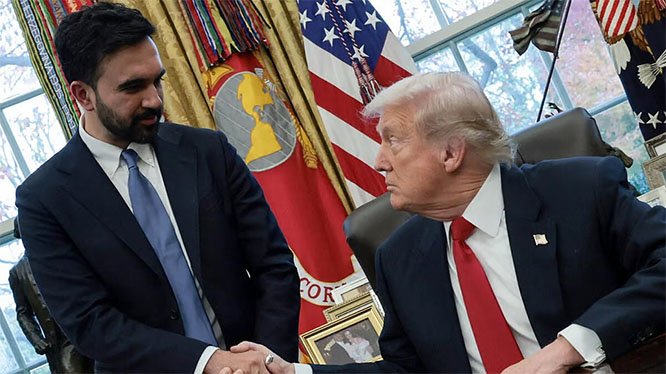
New York/Washington: US President Donald Trump has again claimed to have solved the conflict between India and Pakistan, repeating his assertion during a meeting with New York City Mayor-elect Zohran Mamdani in the Oval Office.

Mamdani flew to Washington DC for his first meeting with Trump in the White House on Friday. Trump said he “enjoyed” the meeting, which he described as “great.”

During remarks in the Oval Office, with Mamdani standing next to him, Trump repeated his claim that he solved the May conflict between India and Pakistan.

"I did eight peace deals of countries, including India and Pakistan,” he said.

On Wednesday, Trump had said he threatened to put 350 per cent tariffs on India and Pakistan if they did not end their conflict, repeating his claim that he solved the fighting between the nuclear-armed neighbours and that Prime Minister Narendra Modi had called him to say “we're not going to go to war.”

Since May 10, when Trump announced on social media that India and Pakistan had agreed to a “full and immediate” ceasefire after a “long night” of talks mediated by Washington, he has repeated his claim over 60 times that he “helped settle” the tensions between India and Pakistan.

India has consistently denied any third-party intervention. India launched Operation Sindoor on May 7, targeting terror infrastructure in Pakistan and Pakistan-occupied Kashmir in retaliation for the April 22 Pahalgam attack that killed 26 civilians. India and Pakistan reached an understanding on May 10 to end the conflict after four days of intense cross-border drone and missile strikes.

Mamdani emerged victorious in the closely-watched battle for New York City Mayor, becoming the first South Asian and Muslim to be elected to sit at the helm of the largest city in the US.

He had been the front-runner in the NYC Mayoral election for months and defeated Republican nominee Curtis Sliwa and political heavyweight former New York State Governor Andrew Cuomo, who ran as an independent candidate and was officially endorsed by Trump just hours before the elections.

Indian-descent Mamdani is the son of renowned filmmaker Mira Nair and Columbia University professor Mahmood Mamdani. He was born and raised in Kampala, Uganda and moved to New York City with his family when he was 7. Mamdani became a naturalised US citizen only recently, in 2018.

Comments

Add new comment

  • Coastaldigest.com reserves the right to delete or block any comments.
  • Coastaldigset.com is not responsible for its readers’ comments.
  • Comments that are abusive, incendiary or irrelevant are strictly prohibited.
  • Please use a genuine email ID and provide your name to avoid reject.
News Network
December 4,2025

Mangaluru: Chaos erupted at Mangaluru International Airport (MIA) after IndiGo flight 6E 5150, bound for Mumbai, was repeatedly delayed and ultimately cancelled, leaving around 100 passengers stranded overnight. The incident highlights the ongoing country-wide operational disruptions affecting the airline, largely due to the implementation of new Flight Duty Time Limitations (FDTL) norms for crew.

The flight was initially scheduled for 9:25 PM on Tuesday but was first postponed to 11:40 PM, then midnight, before being cancelled around 3:00 AM. Passengers expressed frustration over last-minute communication and the lack of clarity, with elderly and ailing travellers particularly affected. “Though the airline arranged food, there was no proper communication, leaving us confused,” said one family member.

An IndiGo executive at MIA cited the FDTL rules, designed to prevent pilot fatigue by limiting crew working hours, as the cause of the cancellation. While alternative arrangements, including hotel stays, were offered, about 100 passengers chose to remain at the airport, creating tension. A replacement flight was arranged but also faced delays due to the same constraints, finally departing for Mumbai around 1:45 PM on Wednesday. Passengers either flew, requested refunds, or postponed their travel.

The Mangaluru delay is part of a broader crisis for IndiGo. The airline has been forced to make “calibrated schedule adjustments”—a euphemism for widespread cancellations and delays—after stricter FDTL norms came into effect on November 1.

While an IndiGo spokesperson acknowledged unavoidable flight disruptions due to technology issues, operational requirements, and the updated crew rostering rules, the DGCA has intervened, summoning senior airline officials to explain the chaos and outline corrective measures.

The ripple effect has been felt across the country, with major hubs like Bengaluru and Mumbai reporting numerous cancellations. The Mangaluru incident underscores the systemic operational strain currently confronting India’s largest carrier, leaving passengers nationwide grappling with uncertainty and delays.

Comments

Add new comment

  • Coastaldigest.com reserves the right to delete or block any comments.
  • Coastaldigset.com is not responsible for its readers’ comments.
  • Comments that are abusive, incendiary or irrelevant are strictly prohibited.
  • Please use a genuine email ID and provide your name to avoid reject.
News Network
December 1,2025

hindutvaboy.jpg

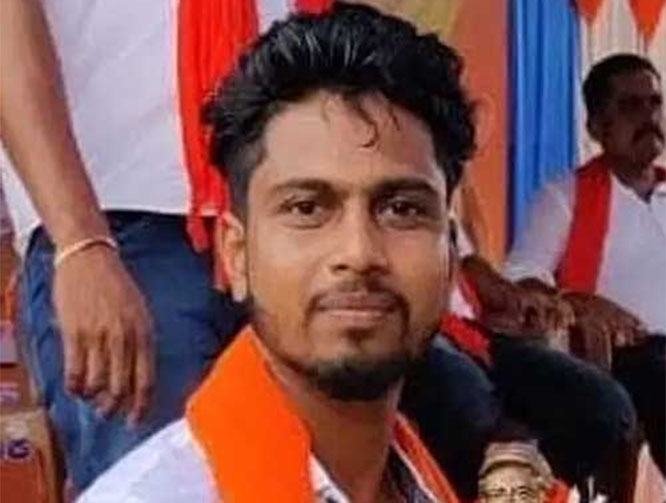
Udupi, Dec 1: A horrific case of alleged rape has unfolded in Udupi, where a worker from a Hindutva organisation, previously arrested and released on bail for harassing a young woman, is now accused of waylaying and sexually assaulting her.

The arrested individual has been identified as Pradeep Poojary (26), a member of the Hindu Jagarana Vedike's Nairkode unit in Perdur.

Poojary had allegedly been relentlessly harassing the young woman, pressuring her to marry him. When she bravely stood up to him and refused his demands, she filed a formal complaint at the Hiriyadka police station. He was subsequently arrested in that initial harassment case but was later granted bail.

According to police reports, driven by the same malicious grudge, Poojary allegedly intercepted the woman again on November 29. While she was walking through a deserted area, the accused is claimed to have threatened her by grabbing her neck. When she again refused to marry him, he allegedly proceeded to rape her.

The survivor immediately informed her family about the traumatic assault. Following this, her parents lodged a complaint at the Udupi women’s police station.

Police arrested Poojary again and produced him before the court. He has since been remanded to judicial custody.

Comments

Add new comment

  • Coastaldigest.com reserves the right to delete or block any comments.
  • Coastaldigset.com is not responsible for its readers’ comments.
  • Comments that are abusive, incendiary or irrelevant are strictly prohibited.
  • Please use a genuine email ID and provide your name to avoid reject.