Research models predict India's covid death toll may double in the coming weeks

News Network
May 6, 2021

The coronavirus wave that plunged India into the world’s biggest health crisis has the potential to worsen in the coming weeks, with some research models projecting that the death toll could more than double from current levels.

A team at the Indian Institute of Science in Bangalore used a mathematical model to predict about 404,000 deaths will occur by June 11 if current trends continue. A model from the Institute for Health Metrics and Evaluation at the University of Washington forecast 1,018,879 deaths by the end of July.

While coronavirus cases can be hard to predict, particularly in a sprawling nation like India, the forecasts reflect the urgent need for India to step up public health measures like testing and social distancing. c The US currently has the largest number of fatalities at around 578,000. 

India reported a record 3,780 deaths on Wednesday for an overall toll of 226,188, along with 382,315 new cases, taking its outbreak past 20.6 million infections. In recent weeks, the scenes on the ground, with long lines outside crematoriums and hospitals turning away ambulances, have painted a picture of a nation overwhelmed by the crisis.

“The next four to six weeks are going to be very, very difficult for India,” said Ashish Jha, the dean of Brown University School of Public Health. “The challenge is going to be to do things now that will make sure it is four weeks, not six or eight, and that we minimize how bad things will get. But in no way is India anywhere near out of the woods.”

A spokesperson for the health ministry couldn’t immediately be reached. The ministry said on Monday that in about a dozen states, including Delhi, Chhattisgarh and Maharashtra, there are early signs that the number of daily new infections are starting to plateau.

The Indian rupee has declined about 1% this quarter in Asia’s worst performance as investors turned cautious ahead of an unscheduled speech by India’s central bank governor Wednesday. The benchmark S&P BSE Sensex Index is down about 2% as foreign funds sold about $1.7 billion of the nation’s stocks.

Economic Impact

A prolonged crisis has the potential to dent the popularity of Prime Minister Narendra Modi as well as slow or reverse India’s recovery from last year’s economic recession. Bloomberg Economics lowered its growth projection for the year ending March 2022 to 10.7% from 12.6%, and even these numbers are flattered by a low base as activity ground to a halt due to a strict lockdown last year.

India’s central bank, meanwhile, has announced new loan-relief measures for small businesses and promised to inject 500 billion rupees ($6.8 billion) of liquidity to support the economy.

For public health researchers, a key concern is the relative dearth of coronavirus testing, which many scientists believe is causing a sharp undercounting of cases.

“It could honestly get a lot worse, which is hard to imagine given how staggering the impacts have already been when you see 400,000 new cases each day and you know that that’s probably an underestimation,” said Jennifer Nuzzo, a senior scholar at the Johns Hopkins Center for Health Security in Baltimore, Maryland.

The main metric that officials are watching is the test positivity rate, which is the percentage of people with positive test results. The overall positivity rate is 20% in India now, and in some parts of the country, it tops 40%, a shockingly high number that indicates as many as three-fourths of infections are being missed, said Jha.

The World Health Organization considers anything above 5% too high, saying that governments should implement social distancing measures until positivity rates are below that level for at least two weeks.

“Despite scaling up testing considerably, it’s still not enough to capture all the infected people,” said Soumya Swaminathan, chief scientist at the World Health Organization, speaking on Bloomberg TV. “So the numbers, while very high, are likely an underestimate of the true numbers of infections,” she said. “It’s a grim situation.”

Social Distancing

The goal is to run enough tests that a large number of infected people aren’t going undiagnosed. If only the sickest patients are tested, many people with milder disease or no symptoms at all may continue to unwittingly spread the disease.

 “There are reports of tests being considerably delayed and of patients delaying having to go to hospital as much as they can, given the stresses on the health system,” said Gautam Menon, a professor of physics and biology at Ashoka University, who also works on modelling outbreaks. “We don’t know enough about Covid-19 spread away from the major cities, in the rural heartland of India, although reports from there suggest that the situation is dire.”

The U.S. government, as part of a package of supplies for India, pledged last week to send one million rapid tests to India. There are several other things that could be done quickly to try to help staunch the outbreak. High on the list is wearing masks, a crucial element for disease control, said Catherine Blish, an infectious disease specialist and global health expert at Stanford Medicine in California.

Major cities in India already require people to wear masks, but such rules can be harder to implement in crowded slums and rural areas. Several states have introduced lockdowns, although Modi has resisted a national effort after one imposed by him last year fueled a humanitarian crisis with migrant workers fleeing the cities on foot and in some cases bringing the virus with them.

Lockdowns

The Indian Institute of Science has estimated that with a 15-day lockdown deaths could be lower at 300,000, falling to 285,000 with a 30-day lockdown. IMHE estimates a lower death toll of around 940,000 by the end of July with universal mask-wearing.

Vaccines will be the big way to remove risks, although it will take time to get there, public health experts say.

It takes several weeks for immunity to build after someone has been vaccinated. The process is even longer with those that require two shots, stretching the process out from six weeks to two months.

“The vaccines are working,” said Kim Mulholland, an Australian paediatrician and leader of the infection and immunity group at the Murdoch Children’s Research Institute in Melbourne. “They just haven’t got the capacity.”

Ultimately, cases will come down, it’s just a matter of when, said Michael Osterholm, director of the Center for Infectious Disease Research and Policy at the University of Minnesota, and an adviser to US President Joe Biden. Scientists still don’t have a good understanding of why Covid-19 comes in sudden, roller-coaster-like changes, he said.

“It will eventually burn itself through the population,” Osterholm said. “Within several weeks to a month and a half, you will see this peak come back down, and it’s likely to come down quickly.” 

Comments

Add new comment

  • Coastaldigest.com reserves the right to delete or block any comments.
  • Coastaldigset.com is not responsible for its readers’ comments.
  • Comments that are abusive, incendiary or irrelevant are strictly prohibited.
  • Please use a genuine email ID and provide your name to avoid reject.
News Network
December 6,2025

pilot.jpg

New Delhi: IndiGo, India’s largest airline, faced major operational turbulence this week after failing to prepare for new pilot-fatigue regulations issued by the Directorate General of Civil Aviation (DGCA). The stricter rules—designed to improve flight safety—took effect in phases through 2024, with the latest implementation on November 1. IndiGo has acknowledged that inadequate roster planning led to widespread cancellations and delays.

Below are the key DGCA rules that affected IndiGo’s operations:

1. Longer Mandatory Weekly Rest

Weekly rest for pilots has been increased from 36 hours to 48 hours.

The government says the extended break is essential to curb cumulative fatigue. This rule remains in force despite the current crisis.

2. Cap on Night Landings

Pilots can now perform only two night landings per week—a steep reduction from the earlier limit of six.

Night hours, defined as midnight to early morning, are considered the least alert period for pilots.

Given the disruptions, this rule has been temporarily relaxed for IndiGo until February 10.

3. Reduced Maximum Night Flight Duty

Flight duty that stretches into the night is now capped at 10 hours.

This measure has also been kept on hold for IndiGo until February 10 to stabilize operations.

4. Weekly Rest Cannot Be Replaced With Personal Leave

Airlines can no longer count a pilot’s personal leave as part of the mandatory 48-hour rest.

Pilots say this closes a loophole that previously reduced actual rest time.

Currently, all airlines are exempt from this rule to normalise travel.

5. Mandatory Fatigue Monitoring

Airlines must submit quarterly fatigue reports along with corrective actions to DGCA.

This system aims to create a transparent fatigue-tracking framework across the industry.

The DGCA has stressed that these rules were crafted to strengthen flight safety and align India with global fatigue-management standards. The temporary relaxations are expected to remain until February 2025, giving IndiGo time to stabilise its schedules and restore normal air travel.

Comments

Add new comment

  • Coastaldigest.com reserves the right to delete or block any comments.
  • Coastaldigset.com is not responsible for its readers’ comments.
  • Comments that are abusive, incendiary or irrelevant are strictly prohibited.
  • Please use a genuine email ID and provide your name to avoid reject.
coastaldigest.com news network
November 28,2025

roadshow.jpg

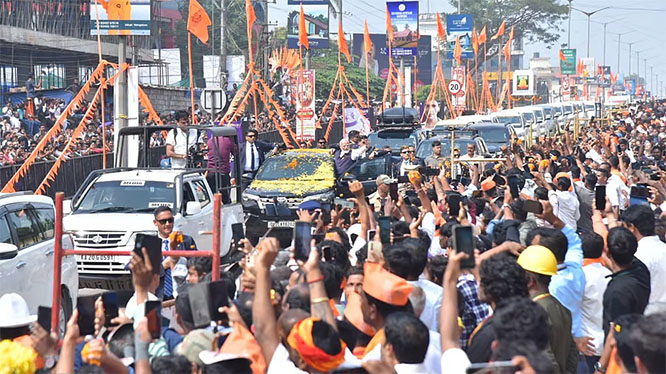
Udupi district transformed into a sea of saffron and celebration on Friday, November 28, as Prime Minister Narendra Modi’s roadshow swept through the coastal temple town. Thousands of residents lined the streets, turning the event into a vibrant public spectacle filled with cheers, flags, and festive energy.

The procession route—from the helipad to the historic Sri Krishna Math—was decked with buntings, saffron flags, and multilayered security barricades. One of the district’s largest-ever security deployments was put in place for the high-profile visit, with over 3,000 police personnel on duty. The arrangement included ten SPs, 27 DSPs, 49 inspectors, 127 sub-inspectors, 232 assistant sub-inspectors, 1,608 constables, and 39 women staff.

Six platoons of the Karnataka State Reserve Police, six Quick Response Teams, bomb detection units, and dog squads were stationed across Udupi. Enhanced surveillance covered Adi Udupi, Bannanje bus stand, and the Sri Krishna Math parking zone, with combing operations carried out along the roadshow corridor.

At the 800-year-old Sri Krishna Math, preparations reached a ceremonial peak. Paryaya Puttige Math seer Sugunendra Teertha Swamiji said the Prime Minister would take part in the Laksha Kantha Geetha Parayana, a mass chanting of the Bhagavad Gita by one lakh devotees, and inaugurate the new Suvarna Teertha Mantapa.

“He will first offer floral tributes to saint-poet Kanakadasa and then unveil the golden covering over the Kanakana Kindi,” the seer said.

The Prime Minister will also receive a Poorna Kumbha welcome and have darshan of Lord Sri Krishna, Mukhyaprana Devaru, and the Suvarna Paduke. Union Minister Pralhad Joshi, Karnataka Governor Thaawarchand Gehlot, Minister Bairathi Suresh, Dharmadhikari D. Veerendra Heggade, and seers from the Ashta Maths are expected to join the ceremony.

Ahead of his arrival, the Prime Minister posted on X that he felt “honoured” to attend the spiritually significant gathering. “This is a special occasion that brings together people from different sections of society for a recital of the Gita. This Matha has a very special significance in our cultural life,” he wrote, noting the institution’s long-standing legacy rooted in the teachings of Sri Madhvacharya.

roadshow2.jpg

Comments

Add new comment

  • Coastaldigest.com reserves the right to delete or block any comments.
  • Coastaldigset.com is not responsible for its readers’ comments.
  • Comments that are abusive, incendiary or irrelevant are strictly prohibited.
  • Please use a genuine email ID and provide your name to avoid reject.
News Network
December 5,2025

indigoCEO.jpg

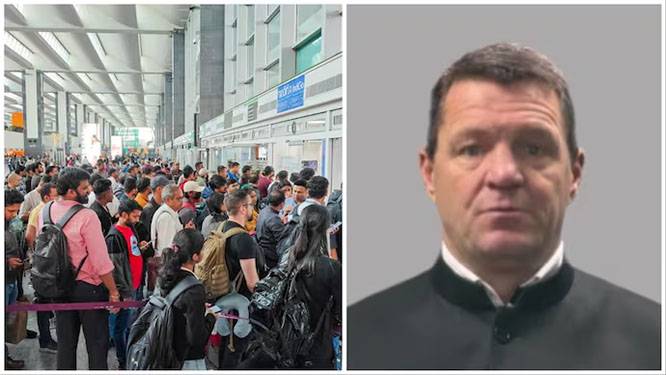
New Delhi, Dec 5: IndiGo CEO Pieter Elbers issued a public apology this evening after more than a thousand flights were cancelled today, making it the "most severely impacted day" in terms of cancellations. The biggest airline of the country cancelled "more than half" of its daily number of flights on Friday, said Elbers. He also said that even though the crisis will persist on Saturday, the airline anticipates fewer than 1,000 flight cancellations.

"Full normalisation is expected between December 10 and 15, though IndiGo cautions that recovery will take time due to the scale of operations," the IndiGo CEO said. 

IndiGo operates around 2,300 domestic and international flights daily.

Pieter Elbers, while apologising for the major inconvenience due to delays and cancellations, said the situation is a result of various causes.

The crisis at IndiGo stems from new regulations that boost pilots' weekly rest requirements by 12 hours to 48 and allow only two night-time landings per week, down from six. IndiGo has attributed the mass cancellations to "misjudgment and planning gaps".

Elbers also listed three lines of action that the airline will adopt to address the issue.

"Firstly, customer communication and addressing your needs, for this, messages have been sent on social media. And just now, a more detailed communication with information, refunds, cancellations and other customer support measures was sent," he said.

The airline has also stepped up its call centre capacity.

"Secondly, due to yesterday's situation, we had customers stranded mostly at the nation's largest airports. Our focus was for all of them to be able to travel today itself, which will be achieved. For this, we also ask customers whose flights are cancelled not to come to the airports as notifications are sent," the CEO said.

"Thirdly, cancellations were made for today to align our crew and planes to be where they need to start tomorrow morning afresh. Earlier measures of the last few days, regrettable, have proven not to be enough, but we have decided today to reboot all our systems and schedules, resulting in the highest numbers of cancellations so far, but imperative for progressive improvements starting from tomorrow," he added.

As airports witnessed chaotic scenes, the Directorate General of Civil Aviation (DGCA) stepped in to grant IndiGo a temporary exemption from stricter night duty rules for pilots. It also allowed substitution of leaves with a weekly rest period. 

Civil Aviation Minister Ram Mohan Naidu has said a high-level inquiry will be ordered and accountability will be fixed.

Comments

Add new comment

  • Coastaldigest.com reserves the right to delete or block any comments.
  • Coastaldigset.com is not responsible for its readers’ comments.
  • Comments that are abusive, incendiary or irrelevant are strictly prohibited.
  • Please use a genuine email ID and provide your name to avoid reject.