‘Sab Changa Si’: India's richest 1 per cent own more than 40 per cent of country’s total wealth!

News Network
January 16, 2023

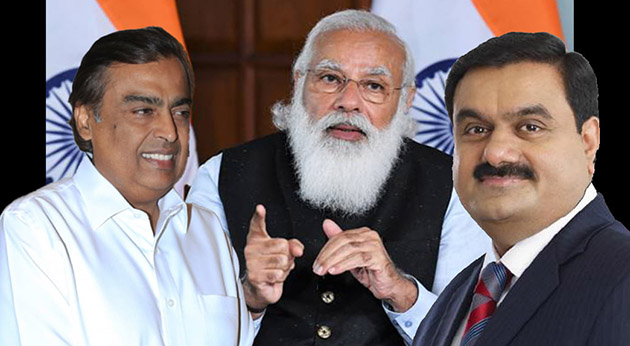
adaniambani.jpg

The richest one per cent in India now own more than 40 per cent of the country's total wealth, while the bottom half of the population together share just 3 per cent of wealth, a new study showed on Monday.

Releasing the India supplement of its annual inequality report on the first day of the World Economic Forum Annual Meeting here, rights group Oxfam International said that taxing India's ten-richest at 5 per cent can fetch entire money to bring children back to school.

"A one-off tax on unrealized gains from 2017–2021 on just one billionaire, Gautam Adani, could have raised Rs 1.79 lakh crore, enough to employ more than five million Indian primary school teachers for a year," it added.

The report titled 'Survival of the Richest' further said that if India's billionaires are taxed once at 2 per cent on their entire wealth, it would support the requirement of Rs 40,423 crore for the nutrition of malnourished in the country for the next three years.

"A one-time tax of 5 per cent on the 10 richest billionaires in the country (Rs 1.37 lakh crore) is more than 1.5 times the funds estimated by the Health and Family Welfare Ministry (Rs 86,200 crore) and the Ministry of Ayush (Rs 3,050 crore) for the year 2022-23," it added.

On gender inequality, the report said that female workers earned only 63 paise for every 1 rupee a male worker earned.

For Scheduled Castes and rural workers, the difference is even starker -- the former earned 55 per cent of what the advantaged social groups earned, and the latter earned only half of the urban earnings between 2018 and 2019.

"Taxing the top 100 Indian billionaires at 2.5 per cent, or taxing the top 10 Indian billionaires at 5 per cent would nearly cover the entire amount required to bring the children back into school," it added.

Oxfam said the report is a mix of qualitative and quantitative information to explore the impact of inequality in India.

Secondary sources like Forbes and Credit Suisse have been used to look at the wealth inequality and billionaire wealth in the country, while government sources like NSS, Union budget documents, parliamentary questions, etc have been used to corroborate arguments made through out the report.

Since the pandemic begun to Nov 2022, billionaires in India have seen their wealth surge by 121 per cent or Rs 3,608 crore per day in real terms, Oxfam said.

On the other hand, approximately 64 per cent of the total Rs 14.83 lakh crore in Goods and Services Tax (GST) came from bottom 50 per cent of the population in 2021-22, with only 3 per cent of GST coming from the top 10 per cent.

Oxfam said the total number of billionaires in India increased from 102 in 2020 to 166 in 2022.

The combined wealth of India's 100 richest has touched USD 660 billion (Rs 54.12 lakh crore) -– an amount that could fund the entire Union Budget for more than 18 months, it added.

Oxfam India CEO Amitabh Behar said, "The country's marginalised – Dalits, Adivasis, Muslims, Women and informal sector workers are continuing to suffer in a system which ensures the survival of the richest.

"The poor are paying disproportionately higher taxes, spending more on essentials items and services when compared to the rich. The time has come to tax the rich and ensure they pay their fair share."

Behar urged the Union finance minister to implement progressive tax measures such as wealth tax and inheritance tax, which he said have been historically proven to be effective in tackling inequality.

Citing a nationwide survey by Fight Inequality Alliance India (FIA India) in 2021, Oxfam said it found that more than 80 per cent of people in India support tax on the rich and corporations who earned record profits during the Covid-19 pandemic.

"More than 90 per cent participants demanded budget measures to combat inequality such as universal social security, right to health and expansion of budget to prevent gender-based violence," it added.

"It's time we demolish the convenient myth that tax cuts for the richest result in their wealth somehow 'trickling down' to everyone else. Taxing the super-rich is the strategic precondition to reducing inequality and resuscitating democracy.

"We need to do this for innovation. For stronger public services and for happier and healthier societies," said Gabriela Bucher, Executive Director of Oxfam International.

Oxfam India urged the Union finance minister to introduce one-off solidarity wealth taxes and windfall taxes to end crisis profiteering. It also demanded a permanent increase in taxes on the richest 1 per cent and especially raise taxes on capital gains, which are subject to lower tax rates than other forms of income.

Oxfam also called for inheritance, property, and land taxes, as well as net wealth taxes, while enhancing the budgetary allocation of the health sector to 2.5 per cent of GDP by 2025, as envisaged in the National Health Policy. Oxfam said it also wants public health systems to be strengthened and budgetary allocation for education to be enhanced to the global benchmark of 6 per cent of GDP.

"Ensure workers in formal and informal sector are paid basic minimum wages. The minimum wages should be at par with living wages which is essential for living a life with dignity," it added. 

Comments

Add new comment

  • Coastaldigest.com reserves the right to delete or block any comments.
  • Coastaldigset.com is not responsible for its readers’ comments.
  • Comments that are abusive, incendiary or irrelevant are strictly prohibited.
  • Please use a genuine email ID and provide your name to avoid reject.
News Network
November 26,2025

students.jpg

Bengaluru, Nov 26: Karnataka is taking its first concrete steps towards lifting a three-decade-old ban on student elections in colleges and universities. Deputy Chief Minister D.K. Shivakumar announced Wednesday that the state government will form a small committee to study the reintroduction of campus polls, a practice halted in 1989 following incidents of violence.

Speaking at a 'Constitution Day' event organised by the Karnataka Congress, Mr. Shivakumar underscored the move's aim: nurturing new political leadership from the grassroots.

"Recently, (Leader of the Opposition in Lok Sabha) Rahul Gandhi wrote a letter to me and Chief Minister (Siddaramaiah) asking us to think about restarting student elections," Shivakumar stated. "I'm announcing today that we'll form a small committee and seek a report on this."

Student elections were banned in Karnataka in 1989, largely due to concerns over violence and the infiltration of political party affiliates into campus life. The ban effectively extinguished vibrant student bodies and the pipeline of young leaders they often produced.

Mr. Shivakumar, who also serves as the Karnataka Congress president, said that former student leaders will be consulted to "study the pros and cons" of the re-introduction.

Acknowledging the history of the ban, he added, "There were many criminal activities taking place back then. We’ll see how we can conduct (student) elections by regulating such criminal activities."

The Deputy CM reminisced about his own journey, which began on campus. He recalled his political activism at Sri Jagadguru Renukacharya College leading to his first Assembly ticket in 1985 at the age of 23. "That's how student leadership was at the time. Such leadership has gone today. College elections have stopped," he lamented, adding that for many, college elections were "like a big movement" where leaders were forged.

The move, driven by the Congress high command's push to cultivate young talent, will face scrutiny from academics and university authorities who have, in the past, expressed concern that the return of polls could disrupt the peaceful academic environment and turn campuses into political battlegrounds.

Comments

Add new comment

  • Coastaldigest.com reserves the right to delete or block any comments.
  • Coastaldigset.com is not responsible for its readers’ comments.
  • Comments that are abusive, incendiary or irrelevant are strictly prohibited.
  • Please use a genuine email ID and provide your name to avoid reject.
News Network
November 27,2025

imrankhan.jpg

Authorities at Pakistan’s high-security Adiala Jail in Rawalpindi on Wednesday dismissed speculation about the condition of imprisoned former Pakistan Prime Minister Imran Khan, rejecting rumours that he had been moved out of the facility or was in danger. Officials said Khan was in “good health” and described the viral death claims as “baseless.”

“There is no truth to reports about his transfer from Adiala Jail,” the Rawalpindi prison administration said in a statement, according to Geo News. “He is fully healthy and receiving complete medical attention.”

Amid swirling rumours on social media, Imran Khan’s party, Pakistan Tehreek-e-Insaf (PTI), urged the federal government to issue an official clarification and demanded that authorities allow his family to meet him immediately, Dawn reported.

The frenzy began after Khan’s three sisters called for an impartial probe into what they described as a “brutal” police assault on them and other PTI supporters outside Adiala Jail last week. Soon after, several social media handles circulated unverified claims alleging that Khan had been “killed” inside the prison.

The rumours intensified when a handle named “Afghanistan Times” claimed that “credible sources” had confirmed Khan’s “murder” and that his body had been moved out of the jail — allegations that have not been verified by any credible agency.

Imran Khan, PTI’s patron-in-chief, has been lodged in the Rawalpindi prison since August 2023 in multiple cases. For over a month, an undeclared restriction has prevented family members and senior PTI leaders from meeting him. Khyber-Pakhtunkhwa Chief Minister Sohail Afridi has reportedly been denied access despite making seven attempts.

In a letter to Punjab Police Chief Usman Anwar, Khan’s sisters — Noreen Niazi, Aleema Khan, and Dr. Uzma Khan — said they were “peacefully protesting” outside the jail when police allegedly launched an unprovoked assault after streetlights were switched off.

“At 71, I was seized by my hair, thrown to the ground and dragged across the road,” Noreen Niazi said, alleging that other women present were also slapped and manhandled.

Adiala Jail officials reiterated that speculation over Imran Khan’s health was unfounded and insisted that his well-being was being ensured, Geo News reported.

Comments

Add new comment

  • Coastaldigest.com reserves the right to delete or block any comments.
  • Coastaldigset.com is not responsible for its readers’ comments.
  • Comments that are abusive, incendiary or irrelevant are strictly prohibited.
  • Please use a genuine email ID and provide your name to avoid reject.
News Network
November 26,2025

Mangaluru, Nov 26: Assembly Speaker and local MLA U.T. Khader has initiated a high-level push to resolve one of Mangaluru’s longest-standing traffic headaches: the narrow, high-density stretch of National Highway-66 between Nanthoor and Talapady.

He announced on Tuesday that a formal proposal has been submitted to the Union Ministry of Road Transport and Highways (MoRTH) seeking approval to prepare a Detailed Project Report (DPR) for the widening of this crucial corridor.

The plan specifically aims to expand the existing 45-meter road width to a full 60 meters, coupled with the construction of dedicated service roads. Khader highlighted that land for a 60-meter highway was originally acquired during the initial four-laning project, but only 45 meters were developed, leading to a perpetual bottleneck.

"With vehicle density rising sharply, the expansion has become unavoidable," Khader stated, stressing that the upgrade is essential for ensuring smoother traffic flow and improving safety at the city's main entry and exit points.

The stretch between Nanthoor and Talapady is a vital link on the busy Kochi-Panvel coastal highway and connects to major city junctions. The move to utilize the previously acquired land for the full 60-meter width is seen as a necessary measure to catch up with the region's rapid vehicular growth and prevent further traffic gridlocks.

Comments

Add new comment

  • Coastaldigest.com reserves the right to delete or block any comments.
  • Coastaldigset.com is not responsible for its readers’ comments.
  • Comments that are abusive, incendiary or irrelevant are strictly prohibited.
  • Please use a genuine email ID and provide your name to avoid reject.