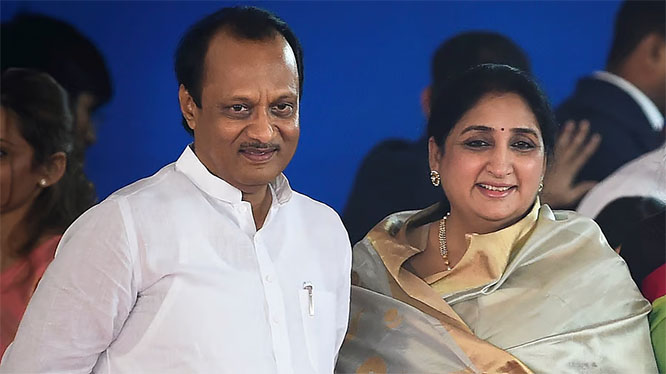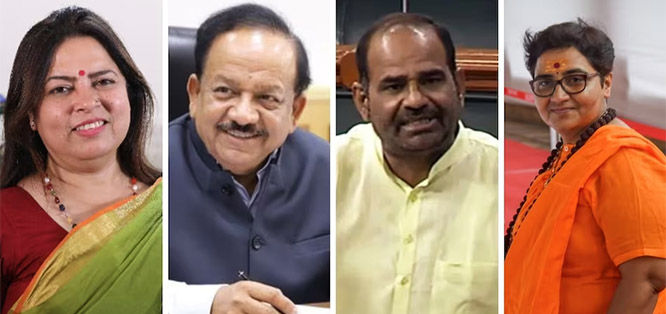
Sadhvi Pragya, Ramesh Bidhuri, Parvesh Sahib, Meenakshi Lekhi among 33 candidates dropped by BJP in first list

News Network
March 3, 2024

BJPhatespeech.jpg

The Bharatiya Janata Party (BJP) has announced the replacement of 33 incumbent MPs with fresh candidates in its first list of 195 nominees for the forthcoming Lok Sabha elections. 

As per this candidate list, five candidates for Delhi include Praveen Khandelwal from Chandani Chowk, dropping two-term MP and former Union Minister Harsh Vardhan. Late BJP leader Sushma Swaraj’s daughter Bansuri Swaraj has been named as the saffron party’s candidate from the New Delhi Lok Sabha constituency, replacing Union Minister Meenakshi Lekhi. 

Some of these leaders have made headlines for their controversial, provocative and anti-Islamic remarks inside and outside Parliament, and the BJP's move to drop them sends a message that the party is taking no chances ahead of an election in which it faces a joint Opposition.

The BJP named Ramvir Singh Bidhuri from South Delhi, dropping Ramesh Bidhuri. From the West Delhi seat, the BJP replaced two-term MP Parvesh Sahib Singh Verma with Kamaljeet Sehrawat. 

In Madhya Pradesh, seven sitting MPs have been replaced. The saffron party named Bharat Singh Kushwaha from Gwalior, replacing MP Vivek Narayan Shejwalker. 

Union Minister Jyotiraditya Scindia has been named from Guna, dropping Krishnapal Singh Yadav. Former Chief Minister Shivraj Singh Chouhan from Vidisha, currently held by MP Ramakant Bhargava. In Bhopal, Alok Sharma will be the candidate instead of Sadhvi Pragya Singh. 

BJP nominee Lata Wankhede has been named from the Sagar Lok Sabha seat, replacing Rajbahadur Singh. Virendra Singh Khatik will contest from Tikamgarh seat. Party nominee Anita Nagar Singh will contest from Ratlam seat, currently held by BJP MP Guman Singh Damor. 

Besides this, the list also includes 11 seats from Assam, with five new faces and six current MPs. Parimal Suklabaidhya will contest from Silchar, previously held by Rajdeep Roy. Amar Singh Tisso, Bijuli Kalita Medhi, and Ranjit Dutta are contesting from Autonomous District (ST), Gauhati, and Tezpur respectively. 

Union Minister Sarbanand Sonowal is the candidate from Dibrugarh, dropping sitting MP Rameswar Teli.  Four new candidates are named for 11 seats in Chhattisgarh. Senior leader Brijmohan Agrawal from Raipur and Roop Kumari Choudhary from Mahasamund are among them. 

In Gujarat, five incumbents have been replaced for 15 seats. Union Minister Mansukh Mandaviya will contest from Porbandar, currently held by party MP Rameshbhai Lavjibhai Dhaduk.  In Rajkot, the BJP named Union Minister Parshottam Rupala as the candidate, dropping sitting MP Mohanbhai Kalyanji Kundariya.

Party nominee Rekhaben Hiteshbhai Choudhary will contest from the Banaskantha Lok Sabha seat, currently held by Prabhatbhai Savabhai Patel. Dineshbhai Kidarbhai Makwana replaced three-term MP Kirit Solanki on Ahmedabad West seat. BJP nominee Rajpalsinh Mahendrasinh Jadhav will contest from the Panchmahal seat, dropping sitting MP Ratansinh Magansinh Rathod. 

Moreover, Manish Jaiswal and Samir Oraon are the new faces in Jharkhand. While Jaiswal replaced former Union Minister Jayant Sinha in Hazaribagh, Oraon replaced three-time MP Sudarshan Bhagat in Lohardaga seat. 

Comments

Add new comment

  • Coastaldigest.com reserves the right to delete or block any comments.
  • Coastaldigset.com is not responsible for its readers’ comments.
  • Comments that are abusive, incendiary or irrelevant are strictly prohibited.
  • Please use a genuine email ID and provide your name to avoid reject.
News Network
December 16,2025

bengal.jpg

The deletion of over 58 lakh names from West Bengal’s draft electoral rolls following a Special Intensive Revision (SIR) has sparked widespread concern and is likely to deepen political tensions in the poll-bound state.

According to the Election Commission, the revision exercise has identified 24 lakh voters as deceased, 19 lakh as relocated, 12 lakh as missing, and 1.3 lakh as duplicate entries. The draft list, published after the completion of the first phase of SIR, aims to remove errors and duplication from the electoral rolls.

However, the scale of deletions has raised fears that a large number of eligible voters may have been wrongly excluded. The Election Commission has said that individuals whose names are missing can file objections and seek corrections. The final voter list is scheduled to be published in February next year, after which the Assembly election announcement is expected. Notably, the last Special Intensive Revision in Bengal was conducted in 2002.

The development has intensified the political row over the SIR process. Chief Minister Mamata Banerjee and her Trinamool Congress have strongly opposed the exercise, accusing the Centre and the Election Commission of attempting to disenfranchise lakhs of voters ahead of the elections.

Addressing a rally in Krishnanagar earlier this month, Banerjee urged people to protest if their names were removed from the voter list, alleging intimidation during elections and warning of serious consequences if voting rights were taken away.

The BJP, meanwhile, has defended the revision and accused the Trinamool Congress of politicising the issue to protect what it claims is an illegal voter base. Leader of the Opposition Suvendu Adhikari alleged that the ruling party fears losing power due to the removal of deceased, fake, and illegal voters.

The controversy comes amid earlier allegations by the Trinamool Congress that excessive work pressure during the SIR led to the deaths by suicide of some Booth Level Officers (BLOs), for which the party blamed the Election Commission. With the draft list now out, another round of political confrontation appears imminent.

As objections begin to be filed, the focus will be on whether the correction mechanism is accessible, transparent, and timely—critical factors in ensuring that no eligible voter is denied their democratic right ahead of a crucial election.

Comments

Add new comment

  • Coastaldigest.com reserves the right to delete or block any comments.
  • Coastaldigset.com is not responsible for its readers’ comments.
  • Comments that are abusive, incendiary or irrelevant are strictly prohibited.
  • Please use a genuine email ID and provide your name to avoid reject.
News Network
December 17,2025

melkar1.jpg

Melkar, Dec 17: The 17th Annual Day and Graduation Ceremony of Melkar Women’s PU and Degree College, themed “Fusion-2K25,” was celebrated with dignity and enthusiasm, marking a significant milestone in the institution’s academic journey. The programme reflected the college’s steadfast commitment to academic excellence, character building, and the holistic development of students.

The event was inaugurated by Mr. Asif Mohammed, whose presence greatly enriched the occasion. The celebration was further graced by the chief guests Mr. P. B. Ahmed Mudassir and Mr. Nissar Fakeer Mohammed, along with the distinguished guests of honour Mr. B. A. Nazeer and Mr. Ibrahim Gadiyar. In their inspiring addresses, the guests encouraged the graduating students and appreciated the dedicated efforts of the management, faculty, and students.

The annual report was presented by the Principal, Mr. Abdul Majeed S, highlighting the institution’s academic progress, notable achievements, and extracurricular accomplishments during the academic year.

The presidential address was delivered by the esteemed Chairman of Melkar Women’s PU and Degree College, Dr. Haji S. M. Rasheed, who emphasized the vital role of education in empowering women and shaping responsible citizens. He also stressed the importance of discipline, dedication, and perseverance in achieving success.

Cultural programmes and academic recognitions formed an integral part of the celebration, showcasing the talents and achievements of the students. The graduation ceremony was a proud moment for the outgoing students as they were formally conferred degrees and wished success in their future endeavours.

Ms. Mashmooma Fathima served as the Master of Ceremonies. The welcome address was delivered by Ms. Fathima Nida, and the programme concluded with a vote of thanks proposed by Ms. Ayisha Suhana.

The event successfully achieved its objectives and was highly appreciated by the guests and attendees.

melkar3.jpg

melkar2.jpg

Comments

Add new comment

  • Coastaldigest.com reserves the right to delete or block any comments.
  • Coastaldigset.com is not responsible for its readers’ comments.
  • Comments that are abusive, incendiary or irrelevant are strictly prohibited.
  • Please use a genuine email ID and provide your name to avoid reject.
News Network
December 13,2025

New Delhi: School-going children are picking up drug and smoking habits and engaging in consumption of alcohol, with the average age of introduction to such harmful substances found to be around 13 years, suggesting a need for earlier interventions as early as primary school, a multi-city survey by AIIMS-Delhi said.

The findings also showed substance use increased in higher grades, with grade XI/XII students two times more likely to report use of substances when compared with grade VIII students. This emphasised the importance of continued prevention and intervention through middle and high school.

The study led by Dr Anju Dhawan of AIIMS's National Drug Dependence Treatment Centre, published in the National Medical Journal of India this month, looks at adolescent substance use across diverse regions.

The survey included 5,920 students from classes 8, 9, 11 and 12 in urban government, private and rural schools across 10 cities -- Bengaluru, Chandigarh, Delhi, Dibrugarh, Hyderabad, Imphal, Jammu, Lucknow, Mumbai, and Ranchi. The data were collected between May 2018 and June 2019.

The average age of initiation for any substance was 12.9 (2.8) years. It was lowest for inhalants (11.3 years) followed by heroin (12.3 years) and opioid pharmaceuticals (without prescription; 12.5 years).

Overall, 15.1 per cent of participants reported lifetime use, 10.3 per cent reported past year use, and 7.2 per cent reported use in the past month of any substance, the study found.

The most common substances used in the past year, after tobacco (4 per cent) and alcohol (3.8 per cent), were opioids (2.8 per cent), followed by cannabis (2 per cent) and inhalants (1.9 per cent). Use of non-prescribed pharmaceutical opioids was most common among opioid users (90.2 per cent).

On being asked, 'Do you think this substance is easily available for a person of your age' separately for each substance category, nearly half the students (46.3 per cent) endorsed that tobacco products and more than one-third of the students (36.5 per cent) agreed that a person of their age can easily procure alcohol products.

Similarly, for Bhang (21.9 per cent), ganja/charas (16.1 per cent), inhalants (15.2 per cent), sedatives (13.7 per cent), opium and heroin (10 per cent each), the students endorsed that these can be easily procured.

About 95 per cent of the children, irrespective of their grade, agreed with the statement that 'drug use is harmful'.

The rates of substance use (any) among boys were significantly higher than those of girls for substance use (ever), use in the past year and use in the past 30 days. Compared to grade VIII students, grade IX students were more likely, and grade XI/XII students were twice as likely to have used any substance (ever).

The likelihood of past-year use of any substance was also higher for grade IX students and for grade XI/XII students as compared to grade VIII students.

About 40 per cent of students mentioned that they had a family member who used tobacco or alcohol each. The use of cannabis (any product) and opioid (any product) by a family member was reported by 8.2 per cent and 3.9 per cent of students, respectively, while the use of other substances, such as inhalants/sedatives by family was 2-3 per cent, the study found.

A relatively smaller percentage of students reported use of tobacco or alcohol among peers as compared to among family members, while a higher percentage reported inhalants, sedatives, cannabis or opioid use among peers.

Children using substances (past year) compared to non-users reported significantly higher any substance use by their family members and peers.

There were 25.7 per cent students who replied 'yes' to the question 'conflicts/fights often occur in your family'. Most students also replied affirmatively to 'family members are aware of how their time is being spent' and 'damily members are aware of with whom they spend their time'.

Comments

Add new comment

  • Coastaldigest.com reserves the right to delete or block any comments.
  • Coastaldigset.com is not responsible for its readers’ comments.
  • Comments that are abusive, incendiary or irrelevant are strictly prohibited.
  • Please use a genuine email ID and provide your name to avoid reject.