SC directs Centre to install CCTV cameras in offices of CBI, ED, NIA, other probe agencies

Agencies
December 3, 2020

New Delhi, Dec 3: The Supreme Court directed the Centre on Wednesday to install CCTV cameras and recording equipment at the offices of investigating agencies, including the CBI, the ED and National Investigation Agency (NIA), which conduct interrogations and have the power of arrest.

A bench headed by Justice R F Nariman said that states and Union Territories (UTs) should ensure that CCTV cameras are installed at each and every police station, at all entry and exit points, main gate, lock-ups, corridors, lobby and reception as also areas outside the lock-up rooms so that no part is left uncovered.

The apex court had in 2018 ordered installation of CCTV cameras in police stations to check human rights abuses.

It said further that the CCTV systems must be equipped with night vision and have audio as well as video footage and it shall be mandatory for the Centre, states and UTs to purchase such systems which allow storage of data for maximum period possible, at least one year.

In addition, the Union of India is also directed to install CCTV cameras and recording equipment in the offices of: Central Bureau of Investigation, National Investigation Agency, Enforcement Directorate, Narcotics Control Bureau, Department of Revenue Intelligence, Serious Fraud Investigation Office (SFIO), any other agency which carries out interrogations and has the power of arrest, said the bench, also comprising Justices K M Joseph and Aniruddha Bose.

As most of these agencies carry out interrogation in their office(s), CCTVs shall be compulsorily installed in all offices where such interrogation and holding of accused takes place in the same manner as it would in a police station, the bench said in its order.

The top court said that in September this year, it had impleaded all the states and UTs in the matter to find out the exact position of CCTV cameras in each police station as well as constitution of Oversight Committees in accordance with the April 3, 2018 order.

The apex court, while dealing with a matter related to custodial torture, had in July this year taken note of a 2017 case in which it had ordered installation of CCTV cameras in all the police stations to check human rights abuses, videography of crime scene and setting up of a Central Oversight Committee and such a panel in every states and Union Territory.

In its 12-page order, the bench noted that till November 24, compliance affidavits and action taken reports were filed by 14 states and majority of them have failed to disclose the exact position of CCTV cameras in each police station and other details.

It said that state level oversight committee (SLOC) must consist of secretary or additional secretary of home department, secretary or additional secretary of finance department; director general or inspector general of police and chairperson or member of the state women's commission.

It said district level oversight committee (DLOC) should comprise of -- divisional commissioner or regional commissioner or revenue commissioner division of district, district magistrate and superintendent of police and mayor of a municipality within the district or head of zilla panchayat' in rural areas.

It also specified the duties of SLOC which included purchase, distribution and installation of CCTVs and equipment, obtain budgetary allocation for the same.

It said DLOC shall have the obligations including interact with station house officer (SHO) about its functioning and to review footage stored from CCTVs in various police stations to check for any human rights violation that may have occurred but are not reported .

It said adequate funds be allocated for this by the states and UTs at the earliest.

It said duty and responsibility for working, maintenance and recording of CCTVs shall be of the SHO of police station concerned.

It said in areas where there is either no electricity or internet, it shall be the duty of states and UTs to provide the same expeditiously using any mode of providing power, including solar or wind.

Whenever there is information of force being used at police stations resulting in serious injury and/or custodial deaths, it is necessary that persons be free to complain for a redressal of the same, it said.

It said SLOC and central oversight body shall give directions to all police stations and agencies to prominently display at the entrance and inside police stations, offices of investigative agencies about the coverage of concerned premises by CCTV and this shall be done by large posters in English, Hindi and vernacular language.

It shall further mention that CCTV footage is preserved for a certain minimum time period, which shall not be less than six months, and the victim has a right to have the same secured in the event of violation of his human rights, it said.

It said authorities would implement its order both in letter and in spirit as soon as possible.

The bench, which posted the matter for hearing on January 27, said that affidavits be filed within six weeks by principal secretary or cabinet secretary or home secretary of each states and UTs giving a firm action plan with exact timeline for compliance with the order.

Comments

Add new comment

  • Coastaldigest.com reserves the right to delete or block any comments.
  • Coastaldigset.com is not responsible for its readers’ comments.
  • Comments that are abusive, incendiary or irrelevant are strictly prohibited.
  • Please use a genuine email ID and provide your name to avoid reject.
News Network
November 21,2025

Bengaluru, Nov 21: The Karnataka government is facing pressure to overhaul its employment system after a high-level Cabinet sub-committee recommended the complete phase-out of job outsourcing in government offices, boards, and corporations by March 2028. The move is aimed at tackling a systemic issue that has led to the potential violation of constitutional reservation policies and the exploitation of workers.

The Call for Systemic Change

With over three lakh vacant posts currently being filled through private agencies on an outsource, insource, or daily wage basis, the sub-committee highlighted a significant lapse. "As a result, reservations are not being followed as per the Constitution and state laws. It’s an urgent need to take serious steps to change the system. It has been recommended to completely stop the system of outsourcing by March 2028," the panel stated in a document.

The practice of outsourcing involves private companies hiring workers to perform duties for a government agency. Critics argue this model results in lesser salaries, a lack of social security benefits (otherwise available to permanent government employees), and a failure to adhere to the provisions of Articles 14 and 15 of the Constitution, which guarantee equality before the law and prohibit discrimination.

The 'Bidar Model' as a Stop-Gap Solution

To regulate the current mode of employment and reduce worker exploitation until the 2028 deadline, the government plans to establish workers’ services multi-purpose cooperative societies across all districts, following the successful "Bidar Model."

The Bidar District Services of Labour Multi-purpose Cooperative Society Ltd., which operates under the District Commissioner, is cited as a successful example of providing a measure of social security to outsourced staff. Labour Department officials argue this society ensures workers receive their due wages and statutory facilities like ESI (Employees' State Insurance) and PF (Provident Fund), in exchange for a 1% service fee collected from the employees.

legislative push and Priority Insourcing

The recommendations, led by the sub-committee headed by Law and Parliamentary Affairs Minister H K Patil, are set to be discussed at the next Cabinet meeting. The committee has proposed the introduction of the Karnataka Outsourced Employees (Regulation, Placement and Welfare) Bill 2025.

In a move addressing immediate concerns, Labour Minister Santosh Lad, a member of the sub-committee, has reportedly assured that steps will be taken over the next 2-3 years to insource workers in "life-threatening services" on a priority basis. This includes essential personnel like pourakarmikas (sanitation workers), drivers, electrical staff in the Energy Department, and Health Department staff handling contagious diseases. The transition aims to grant these workers the long-term security and benefits they currently lack under the outsourcing system. 

Comments

Add new comment

  • Coastaldigest.com reserves the right to delete or block any comments.
  • Coastaldigset.com is not responsible for its readers’ comments.
  • Comments that are abusive, incendiary or irrelevant are strictly prohibited.
  • Please use a genuine email ID and provide your name to avoid reject.
News Network
December 2,2025

DKSsiddu.jpg

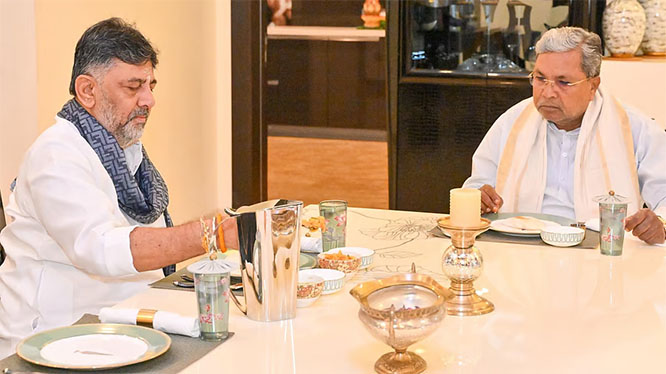
Bengaluru: 'Nati koli saaru' (country chicken curry) considered one of Chief Minister Siddaramaiah’s favourites along with steaming hot idlis was on the breakfast menu at Deputy CM D K Shivakumar’s residence on Tuesday, according to official sources.

The spread also included 'nati koli' fry, vada and pongal, among other items, they said.

In an apparent show of unity, Siddaramaiah visited Shivakumar’s residence for breakfast, just days after the two leaders shared a meal amid a simmering power tussle in the state Congress.

Siddaramaiah drove to the Deputy CM’s residence in Sadashivanagar, where he was received by Shivakumar and his brother D K Suresh, who is a former Congress MP.

Suresh and Kunigal MLA H D Ranganath, a relative of Shivakumar, joined them for breakfast, which featured a mix of vegetarian and non-vegetarian dishes.

Speaking to reporters later, Siddaramaiah said Shivakumar had invited him during his visit to the CM’s residence for breakfast on Saturday.

Asked about the difference between the two meals, the chief minister said, "At his (Shivakumar’s) house it was non-veg, while at my house it was veg. He is a vegetarian, I am a non-vegetarian. I had not prepared non-veg. I told DK to get chicken from the village as you won’t get the original in Bengaluru."

Shivakumar said he had initially invited Siddaramaiah to his residence, but the CM had suggested visiting his place first and reciprocating later. "It was a vegetarian breakfast at the CM’s house on Saturday," he noted.

"Today, I invited him (the CM) to my house. He enjoyed the breakfast, which had his Mysuru taste," Shivakumar added. At this point, Siddaramaiah remarked that Shivakumar’s wife is also from Mysuru.

Saturday’s breakfast at Siddaramaiah’s official residence, held as part of efforts by the Congress high command to ease tensions in the leadership dispute between the two, reportedly included idlis and sambar, according to official sources.

Comments

Add new comment

  • Coastaldigest.com reserves the right to delete or block any comments.
  • Coastaldigset.com is not responsible for its readers’ comments.
  • Comments that are abusive, incendiary or irrelevant are strictly prohibited.
  • Please use a genuine email ID and provide your name to avoid reject.
News Network
November 21,2025

malpe.jpg

Udupi: The Malpe Police have arrested two men from Uttar Pradesh for allegedly sharing classified information related to Indian Navy vessels with individuals in Pakistan, posing a serious threat to national security.

According to a complaint filed by the CEO of Udupi Cochin Shipyard, Malpe—an institution under the Union Ministry of Ports, Shipping and Waterways—the prime accused, Rohit (29), was working as an insulator through subcontractor M/S Shushma Marine Pvt Ltd. He had earlier served at Cochin Shipyard Limited in Kochi, Kerala, where naval ships are under construction.

Udupi SP Hariram Shankar said the accused had unlawfully shared, via WhatsApp, confidential identification numbers of Navy-related ships and other classified details while working in Kerala, allegedly for illegal gains.

After joining the Malpe shipyard unit, Rohit reportedly continued collecting sensitive information through a friend in Kochi and circulated it to unauthorised individuals, violating national security protocols and potentially endangering India’s sovereignty, unity, and integrity.

Based on the complaint, Malpe Police registered a case under Section 152 of the Bharatiya Nyaya Sanhita (BNS) and Sections 3 and 5 of the Official Secrets Act, 1923.

A police team led by Karkala Subdivision Assistant Superintendent of Police Harsha Priyamvada—along with PSI Anil Kumar D, ASI Harish, and PC Ravi Jadhav—conducted the investigation and arrested the two accused, identified as Rohit (29) and Santri (37), both residents of Sultanpur district, Uttar Pradesh.

The duo was produced before the court, which remanded them in judicial custody till December 3. Further investigation is in progress.

Comments

Add new comment

  • Coastaldigest.com reserves the right to delete or block any comments.
  • Coastaldigset.com is not responsible for its readers’ comments.
  • Comments that are abusive, incendiary or irrelevant are strictly prohibited.
  • Please use a genuine email ID and provide your name to avoid reject.