SC transfers Gyanvapi Masjid case from Varanasi civil court to ‘experienced’ district judge

News Network
May 20, 2022

The Supreme Court on Friday, 20 May directed that the Gyanvapi mosque case should be transferred from the civil judge in Varanasi, where it is currently being heard, to the court of the district judge Varanasi – who is "more senior and experienced" and will be better placed to address the complex issues in the matter.

The bench of the apex court headed by Justice DY Chandrachud also ordered that:

•    The application filed by the masjid committee under Order 7 Rule 11 of the Code of Civil Procedure – arguing the suit by "Hindu" devotees is barred by the Places of Worship Act – will be decided on priority by district judge

•    The Supreme Court's Interim order dated 17 May shall continue to remain in operation pending the disposal of the Order 7 Rule 11 application, and for a further period of 8 weeks, to allow any party to take necessary steps.

•    If adequate arrangements for wazu (ritual washing) have not been made, then district magistrate in consultation with masjid committee should make proper arrangements.

•    The order of civil judge dated 16 May (for sealing) stands subsumed by the Supreme Court's order of 17 May, which clarified that while the area where an alleged 'Shivling' was stated to be found

The bench of Justices DY Chandrachud, Surya Kant and PS Narasimha was hearing the pleas by the masjid committee against the orders of the Varanasi court, including the original order allowing a video survey of the Gyanvapi mosque as well as the order to seal part of the mosque where a 'Shivling' was allegedly found.

The masjid committee argues that the entire case is barred because of the Places of Worship Act 1991, which says that there can be no conversion of, or change to the character of, a place of worship which has been in existence since before 15 August 1947.

The masjid committee has challenged the maintainability of the case in the Varanasi court under Order 7 Rule 11 of the Code of Civil Procedure, which bars any suit where there is no cause of action. The Varanasi court instead of considering this issue at the outset, had allowed the video survey and passed several other orders.

The apex court on 19 May had directed the Varanasi civil court to "desist from taking any further action" till it completed its hearings.

Senior advocate Huzefa Ahmadi, representing the masjid committee, argued that things "need to be nipped in the bud." He argued that the orders of the Varanasi court has led to an alteration of a status quo at the Gyanvapi mosque which has been in place for the last 500 years.

Ahmadi pointed to the way in which the report of the survey commission was leaked by lawyers for the Hindu plaintiffs on Thursday evening to argue that there was "a design" to change the status quo which had been in place previously.

Ahmadi noted that Section 3 of the Places of Worship Act – which bars the conversion of "any place of worship of any religious denomination or any section thereof into a place of worship of a different section of the same religious denomination or of a different religious denomination or any section thereof" – has no exceptions provided to it.

Justice Chandrachud suggested that a survey to assess the religious character of a particular site would not contravene Sections 3 and 4 of the Places of Worship Act.

Ahmadi contended that if such surveys were allowed to be conducted, then this would defeat the very purpose of the 1991 Act.

The bench did not go further into this issue, saying it would need to be taken up by the district judge when considering the Order 7 Rule 11 issue, and could be revisited in the Supreme Court when it takes the matter up again after its vacations.

Ahmadi also asked the court to allow worshippers in the mosque access to the taps in the area sealed because a 'Shivling' was allegedly found there, so that they could perform wazu, ie ritual washing. Solicitor General Tushar Mehta, on behalf of the State of Uttar Pradesh, objected to this saying that it could lead to a law and order problem.

The judges sought to arrive at a solution for the problem by including the direction in their order that arrangements for wazu would have to be made by the district magistrate.

What is This Case About?

Five Hindu women have sought round-the-year access to pray at “a shrine behind the western wall of the mosque complex”. The site is currently made open for Hindu prayers once a year.

A Varanasi court had in April ordered a video inspection of the site, but the survey could not take place as the mosque committee opposed the videography inside the mosque, and accused Advocate Commissioner Ajay Kumar Mishra of bias and demanded his replacement.

The local court, however, on Thursday, 12 May, ordered that the survey work will continue, and instead of replacing Mishra, appointed two more lawyers — Vishal Kumar Singh and Ajay Singh — to accompany him.

The Allahabad High Court refused to stay this order despite it being argued by the masjid committee that the mosque was protected by the Places of Worship Act 1991, resulting in the pleas at the Supreme Court.

On Monday, 16 May, the Varanasi court ordered the sealing of part of the mosque on the basis that a 'Shivling' had been found on the premises. This order was also challenged by the masjid committee on Tuesday.

The Supreme Court on Tuesday, 17 May, issued notice on pleas challenging the orders of a district court regarding the Gyanvapi Mosque in Varanasi, and passed an interim order that while the area within the mosque where an alleged 'Shivling' was said to be found should be protected, Muslims must not be restricted from entering and praying in the mosque.

Following this interim order, the Hindu plaintiffs, through their advocate Vishnu Shankar Jain, filed an application in the Varanasi court have sought the razing of the wall and the removal of the resulting debris, in order for a further survey of the area where the alleged 'Shivling' was found.

The report submitted by the Varanasi court-appointed commissioners was released by the Hindu devotees' lawyers on 19 May.

The key findings from the survey – including the alleged discovery of Hindu symbols on the architecture as well as the structure in a pool in the mosque termed a Shivling by the plaintiffs and a fountain by the defendants – can be found here.

Hindu Sena president Vishnu Gupta has approached the Supreme Court as an intervenor in the masjid committee's case, saying that the Gyanvapi Mosque is not protected by the Places of Worship Act, under Section 4(3) of the Act.

Comments

Add new comment

  • Coastaldigest.com reserves the right to delete or block any comments.
  • Coastaldigset.com is not responsible for its readers’ comments.
  • Comments that are abusive, incendiary or irrelevant are strictly prohibited.
  • Please use a genuine email ID and provide your name to avoid reject.
News Network
November 30,2025

The United Nations Committee against Torture (CAT) has condemned the Israeli regime for enforcing a policy of “organized torture” against Palestinians.

In a report published on Friday, CAT stated that the occupying regime enforces a deliberate policy of “organized and widespread torture and ill-treatment” against Palestinian abductees, particularly since October 7, 2023, when Israel launched its genocidal war on Gaza.

The committee expressed “deep concern over repeated severe beatings, dog attacks, electrocution, water-boarding, use of prolonged stress positions [and] sexual violence” inflicted on Palestinians.

Palestinian prisoners were degraded by “being made to act like animals or being urinated on,” systematically denied medical care, and subjected to excessive restraints, “in some cases resulting in amputation,” the report added.

CAT also condemned the routine application of “unlawful combatants law” to justify the prolonged detention without trial of thousands of Palestinian men, women, and children.

More than 10,000 Palestinians, including women and children, are currently held in Israeli prisons, according to Palestinian and international human rights groups, with 3,474 Palestinians in “administrative detention,” meaning they are imprisoned without trial for indefinite periods.

The report highlighted the “high proportion of children who are currently detained without charge or on remand,” noting that while Israel sets the age of criminal responsibility at 12, even younger children have been abducted.

Children designated as security prisoners face severe restrictions on family contact, may be subjected to solitary confinement, and are denied access to education, in clear violation of international law.

The committee further suggested that Israel’s policies across the Occupied Territories constitute collective torture against the Palestinian population.

“A range of policies adopted by Israel in the course of its continued unlawful presence in the Occupied Palestinian Territory amounts to cruel, inhuman or degrading living conditions for the Palestinian population,” the report said.

On Thursday, the Palestinian resistance movement Hamas condemned the systematic killing and torture of Palestinian abductees in Israeli prisons, urging international action to halt these abuses.

Citing human rights data, Hamas stated that 94 Palestinians have been killed in Israeli prisons since the start of Tel Aviv’s genocidal war on Gaza.

“This reflects an organized criminal approach that has turned these prisons into direct killing grounds to eliminate our people,” the resistance movement said.

Hamas called on the international community, the UN, and human rights organizations to immediately pressure Israel to end crimes against prisoners and uphold their rights as guaranteed by all international conventions and norms.

Comments

Add new comment

  • Coastaldigest.com reserves the right to delete or block any comments.
  • Coastaldigset.com is not responsible for its readers’ comments.
  • Comments that are abusive, incendiary or irrelevant are strictly prohibited.
  • Please use a genuine email ID and provide your name to avoid reject.
News Network
November 26,2025

students.jpg

Bengaluru, Nov 26: Karnataka is taking its first concrete steps towards lifting a three-decade-old ban on student elections in colleges and universities. Deputy Chief Minister D.K. Shivakumar announced Wednesday that the state government will form a small committee to study the reintroduction of campus polls, a practice halted in 1989 following incidents of violence.

Speaking at a 'Constitution Day' event organised by the Karnataka Congress, Mr. Shivakumar underscored the move's aim: nurturing new political leadership from the grassroots.

"Recently, (Leader of the Opposition in Lok Sabha) Rahul Gandhi wrote a letter to me and Chief Minister (Siddaramaiah) asking us to think about restarting student elections," Shivakumar stated. "I'm announcing today that we'll form a small committee and seek a report on this."

Student elections were banned in Karnataka in 1989, largely due to concerns over violence and the infiltration of political party affiliates into campus life. The ban effectively extinguished vibrant student bodies and the pipeline of young leaders they often produced.

Mr. Shivakumar, who also serves as the Karnataka Congress president, said that former student leaders will be consulted to "study the pros and cons" of the re-introduction.

Acknowledging the history of the ban, he added, "There were many criminal activities taking place back then. We’ll see how we can conduct (student) elections by regulating such criminal activities."

The Deputy CM reminisced about his own journey, which began on campus. He recalled his political activism at Sri Jagadguru Renukacharya College leading to his first Assembly ticket in 1985 at the age of 23. "That's how student leadership was at the time. Such leadership has gone today. College elections have stopped," he lamented, adding that for many, college elections were "like a big movement" where leaders were forged.

The move, driven by the Congress high command's push to cultivate young talent, will face scrutiny from academics and university authorities who have, in the past, expressed concern that the return of polls could disrupt the peaceful academic environment and turn campuses into political battlegrounds.

Comments

Add new comment

  • Coastaldigest.com reserves the right to delete or block any comments.
  • Coastaldigset.com is not responsible for its readers’ comments.
  • Comments that are abusive, incendiary or irrelevant are strictly prohibited.
  • Please use a genuine email ID and provide your name to avoid reject.
News Network
November 29,2025

DKSsiddu.jpg

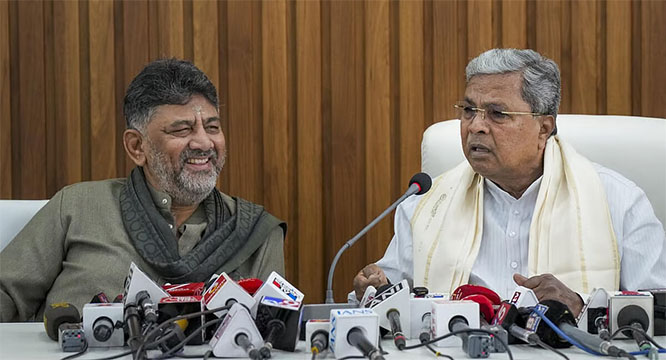
New Delhi: Karnataka chief minister Siddaramaiah and deputy CM DK Shivakumar on Saturday put up a dramatic display of unity at a closely watched joint press briefing, firmly dismissing weeks of speculation about a power-sharing tussle within the Congress. With the high command nudging both leaders to sit together and settle the dust, the meeting became a political spectacle, ending with the duo declaring that there was “no confusion, no differences.”

Calling the reports of a rift “manufactured confusion,” Siddaramaiah said the talks had gone smoothly, even joking about their breakfast. “Breakfast was very good. All three of us enjoyed it,” he said. “We want to end this confusion once and for all. For local elections and for 2028, our mission is clear — Congress must return to power. There is no difference between me and DKS, not now, not before.”

He blamed the media for fuelling rumours and reiterated absolute adherence to the party leadership. “From tomorrow, let there be no confusion. What the high command says, we will follow.”

Siddaramaiah also assured that the Assembly session starting December 8 would run smoothly and vowed that Congress would take on the BJP and JD(S) “together.”

Shivakumar echoed the chief minister word for word, stressing loyalty and discipline. “People have given us a massive mandate. It is our duty to deliver,” he said. “This government was formed under Siddaramaiah’s leadership. We both have complete trust in the high command. If they tell me to wait, I will wait.”

He added that the two leaders had discussed strategy for the 2028 Assembly elections. “Whatever the CM says, I agree. We are loyal soldiers of the party. The party may be facing challenges nationally, but we will keep it strong in Karnataka.”

Shivakumar also said Siddaramaiah would soon visit his home for lunch or dinner — another symbolic gesture meant to underline their unity.

Both leaders later posted on social media describing the breakfast meeting as “productive” and focused on “Karnataka’s priorities.”

The BJP, however, rejected the show of camaraderie as “pure bunkum,” accusing Congress of trying to paper over an internal power struggle. But Siddaramaiah and Shivakumar insisted their united front would continue — and that there was “no confusion” within the state leadership.

Comments

Add new comment

  • Coastaldigest.com reserves the right to delete or block any comments.
  • Coastaldigset.com is not responsible for its readers’ comments.
  • Comments that are abusive, incendiary or irrelevant are strictly prohibited.
  • Please use a genuine email ID and provide your name to avoid reject.